RED ALERT
SPACE APOCALYPSE IS IMMINENT ! |
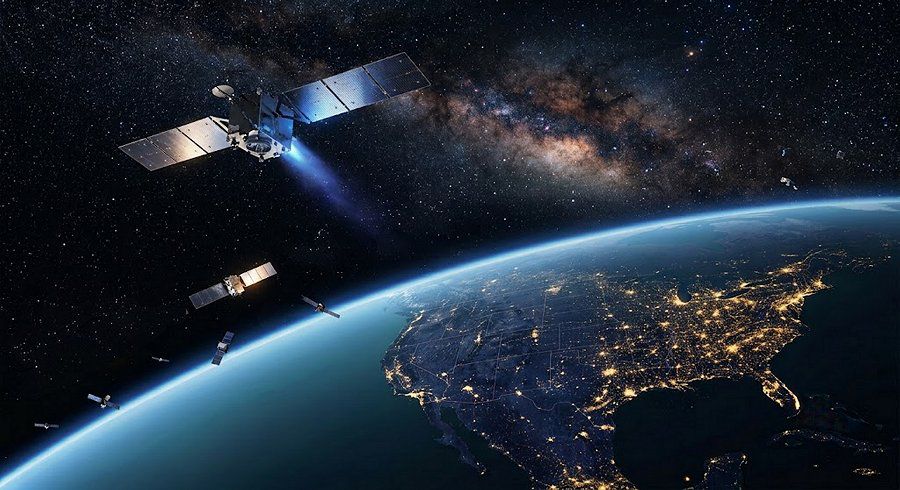
Outer space , particularly the critical zone between 400 and 550 kilometers altitude, is becoming an ultra-saturated orbital bottleneck where the risk of catastrophic collisions increases exponentially.
In this highly coveted terrestrial suburb, thousands of satellite constellations, foremost among them SpaceX's Starlink, cross paths at dizzying speeds.
Today, only an automated choreography of avoidance, repeated several times a day with micro-pushes, separates humanity from an irreversible technological disaster.
Here is an in-depth analysis of this invisible crisis that threatens our hyper-connected civilization.
1. The great 500-kilometer traffic jam
For decades, low Earth orbit (LEO) was a vast and relatively uncrowded space.
Those days are over. The advent of mega-constellations has transformed the area between 430 km and 500 km altitude into a veritable ring road during rush hour.
Why this precise altitude?
It offers the ideal compromise for low-bandwidth telecommunications and high-speed internet:
minimal latency and natural atmospheric reentry within a few years for the debris, thus avoiding perpetual pollution of space.
The result: everyone is rushing in. In addition to the thousands of Starlink satellites, there are the fleets of OneWeb, Amazon's projects (Project Kuiper) and a multitude of university or military cubesats.
2. The War of the Buttons: Thousands of Daily Avoiders
At altitudes where objects are traveling at nearly 28,000 km/h (approximately 7.8 km/s), a crossing at a distance of one kilometer is considered a hair's breadth.
At that speed, the slightest impact is not a simple shock: it is an explosion of pure kinetic energy.
To avoid the worst, operators must constantly adjust trajectories.
Autonomous algorithms:
SpaceX, for example, uses automated avoidance systems based on tracking data from the US Space Command.
Invisible impulses:
Thanks to Hall effect thrusters (ion engines), the satellites receive emergency commands, making small thrusts several times a day to modify their orbit by just a few meters.
The cost of survival:
Each maneuver consumes precious fuel, reducing the satellite's operational lifespan, and is akin to a game of orbital Russian roulette where the slightest computer bug would be equivalent to a head-on collision.
3. The Kessler Syndrome: The Apocalypse Scenario
If two medium-sized satellites were to collide head-on, the world would witness the onset of Kessler Syndrome .
Theorized in 1978 by NASA scientist Donald J. Kessler, this scenario describes a terrifying domino effect.
The mechanism of the chain reaction
The initial collision:
Two satellites pulverize, instantly generating a cloud of tens of thousands of debris the size of a marble or a brick.
The Shrapnel effect:
Each of these fragments retains its indomitable orbital velocity and in turn becomes a deadly projectile.
Saturation:
These debris will cross into neighboring orbits, colliding with other satellites, which will in turn break apart.
Within a few days, or even a few hours, an uncontrollable chain reaction could transform low Earth orbit into an unusable wasteland.
4. The "Night of the Satellites": the consequences of a global blackout
If this catastrophe were to occur, the consequences for humanity would not be merely a spectacle of lights in the night sky. It would be an immediate and brutal technological regression. A veritable "night of the satellites" would paralyze our daily lives.
Communications blackout: Instantaneous loss of global internet in isolated areas, disruption of maritime and air links.
Logistical and financial chaos: Geolocation systems (GPS, Galileo) interconnected with low Earth orbit would suffer major disruptions, freezing global banking transactions synchronized by space atomic clock and blocking transport.
Climate and weather blindness: No more real-time data to anticipate hurricanes, monitor fires or map agricultural resources.
Earth in quarantine: The curtain of debris surrounding the planet would make manned space missions, maintenance of the International Space Station, and deep-space exploration (to the Moon or Mars) simply impossible. Earth would be trapped under an armor of kinetic scrap metal.
5. The urgent need for a space highway code
Space today suffers from the "commons" syndrome:
Everyone benefits, no one regulates it in a binding way.
Current rules rely largely on the goodwill of private companies and national agencies.
If we want to prevent the 500-kilometer radius from becoming the graveyard of our modernity, the international community must urgently impose a universal space highway code :
financial penalties for abandoned debris, the obligation of immediate deorbiting in case of failure, and the industrial development of orbital cleaning technologies (space tugs, magnetic nets).
The orbital watch is working at full capacity, but the thread holding our space infrastructure together has never been thinner. The countdown to the final, fatal impact has already begun. |
|
|
|
| Paul Emison for DayNewsWorld |
 |
SUCCESSFUL LAUNCH FOR THE CREW-12 MISSION WITH FRENCH SPACEBOOK SOPHIE ADENOT
TO THE INTERNATIONAL SPACE STATION | 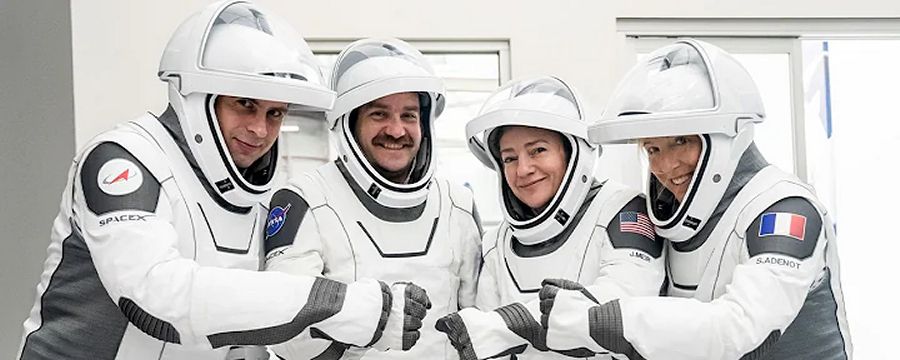
On February 13, 2026, the Falcon-9 rocket carrying the Crew-12 mission crew, including Frenchwoman Sophie Adenot, began its thirty-hour journey to the International Space Station (ISS).
The first French woman to go into space thirty years after Claudie Haigneré, and her three colleagues are currently travelling at more than 27,000 km/h towards the International Space Station.
Originally from Nièvre, she is accompanied by Americans Jessica Meir, Jack Hathaway and Russian Andrei Fedyaev. This former helicopter pilot in the army underwent an intense and accelerated training of only two years and ten months.
She will spend eight months aboard the ISS, a record for a European astronaut. She will participate in more than 200 scientific experiments.
The French astronaut's mission is primarily a scientific one focused on understanding the human body in weightlessness.
Understanding the effects of microgravity on the human body
After just a few days in weightlessness, the body begins to deadapt to gravity: this is the phenomenon of deconditioning. This manifests itself in particular through a decrease in physical capacity, a loss of muscle mass, weakened bones, metabolic disorders, and an increased risk of fainting upon returning to Earth.
This is why many experiments are carried out on board the ISS in order to better understand the impact of weightlessness on the major functions of the body.
The medical experiments entrusted to Sophie Adenot have the primary objective of observing and measuring these transformations in real time, in order to improve astronaut safety during long missions.
For example, some protocols use body sensors and physiological recording systems to continuously monitor the functioning of the heart, muscles, and metabolism. The data collected helps to understand how the body adapts to microgravity and to develop new medical countermeasures.
This research is also of major interest to terrestrial medicine: the results can improve the care of patients suffering from osteoporosis, cardiovascular disease, or neurological disorders.
Ultrasound and Autonomous Diagnostic Experiments:
A significant aspect of medical research relies on astronaut autonomy. On Earth, medical examinations are performed by specialists; in space, crews must be able to diagnose themselves.
With this in mind, Sophie Adenot is testing innovative ultrasound tools such as EchoFinder, which combines augmented reality and artificial intelligence to guide the user during a medical examination without direct assistance from a doctor.
The objective is to enable rapid and reliable diagnoses in isolated situations, an essential condition for future long-distance missions.
Another experiment, EchoBones, aims to analyze the evolution of bone density and structure during stays in microgravity using new imaging techniques. It allows for a better understanding of the bone fragility observed in astronauts and the development of preventative solutions.
In addition to research in physiology, Sophie Adenot will also participate in studies on the presence and spread of microorganisms (bacteria, fungi or viruses) in the space environment.
Although the equipment sent to the station is carefully disinfected, the human presence inevitably implies the introduction of microscopic life forms.
The human microbiota, made up of many species of microorganisms that live naturally in our bodies, can spread into the passenger compartment, particularly through droplets or contact, which requires rigorous scientific monitoring to guarantee the health safety of the crew.
By better understanding the mechanisms of human adaptation to space, these experiments help prepare future manned explorations to the Moon, Mars and beyond, while also providing concrete scientific benefits for health on Earth. |
|
|
|
| Paul Emison for DayNewsWorld |
|
NORTHERN LIGHTS IN EUROPE AND FRANCE
WHY THE SKY STILL LIGHT UP WITH COLOURS |
 On the night of November 12, 2025, many Europeans looked up at the sky to admire a phenomenon of exceptional beauty: the Northern Lights, visible at latitudes where they almost never appear. A rare spectacle that could be repeated in the nights to come. On the night of November 12, 2025, many Europeans looked up at the sky to admire a phenomenon of exceptional beauty: the Northern Lights, visible at latitudes where they almost never appear. A rare spectacle that could be repeated in the nights to come.
But to understand the origin of these luminous green, red or purple veils, we have to go back thousands of kilometers above our heads, where an invisible battle is taking place between the Sun and the Earth's magnetic field.
A solar spectacle above all
The polar auroras originate from solar activity.
Our star constantly expels a stream of charged particles called the solar wind. These particles, mainly electrons and protons, travel at several hundred kilometers per second.
During more violent events, such as solar flares or coronal mass ejections (CMEs), the Sun hurls billions of tons of plasma into space, accompanied by powerful magnetic fields.
It is precisely this type of particularly intense eruption that caused the auroras visible in Europe and France. When these clouds of particles reach Earth, their interaction with our space environment triggers phenomena that are sometimes spectacular.
The magnetosphere: a deforming shield
The primary terrestrial actor in this phenomenon is the planet's magnetic field.
Originating from the movements of the liquid core, it forms a vast protective shield, the magnetosphere, which deflects the majority of the solar wind.
This magnetic field extends up to 60,000 km on the day side and forms a huge tail of several million kilometers on the night side.
Normally, it prevents solar particles from easily penetrating.
But when the magnetic field carried by the solar wind is oriented towards the south, therefore opposite to that of the Earth, an essential process can occur: magnetic reconnection.
Magnetic reconnection occurs when two opposing magnetic fields break apart and then reform.
This complex phenomenon, still actively studied in plasma physics, temporarily opens "gates" in the magnetosphere.
At that moment:
- Solar particles massively penetrate the magnetosphere.
- A large amount of magnetic energy is released.
- The particles are accelerated along Earth's magnetic field lines.
Transported at high speed towards the poles, they form the famous auroral substorms, responsible for the most intense auroras.
When particles strike our atmosphere: the birth of light
Solar particles penetrate the upper atmosphere at altitudes between 100 and 300 km.
By colliding with oxygen and nitrogen molecules, they excite them.
When these molecules return to their normal state, they release energy… in the form of light.
Each gas produces a characteristic color:
- Green: oxygen at 557 nm, the most frequent color
- Red: oxygen at higher altitude
- Violet or blue: ionized nitrogen
- Pink: mixture of oxygen and nitrogen transitions.
The intensity and color of auroras depend on altitude, particle energy, and atmospheric density.
Why do the auroras extend as far south as France?
The auroras are normally visible in an auroral oval located around 65° latitude, near the Arctic.
But during strong geomagnetic storms measured by the Kp index, this oval widens.
- Kp 5: Scotland
- Kp 6: Germany
- Kp 7–8: France
- Kp 9: Mediterranean, possibly North Africa.
The November 2025 eruption reached a high level, shifting the auroral oval approximately 2,000 kilometers southward. As a result, auroras were visible as far south as Brittany, Normandy, the Île-de-France region, and the Southwest.
This phenomenon is all the more likely as the Sun approaches its peak activity, predicted for 2025–2026.
Experts point out that we are currently experiencing a period of high solar activity (five years around the maximum of the eleven-year cycle), which favors the occurrence of powerful eruptions.
According to some astrophysicists, this active phase could end towards the end of 2025 or the beginning of 2026, making these auroras particularly valuable to observe.
A universal phenomenon: auroras on other planets
Auroras are not an exclusively terrestrial phenomenon.
They exist wherever three ingredients are combined: a magnetic field, a flow of particles (like the solar wind), and a surrounding atmosphere or plasma.
Thus, Jupiter has the most powerful auroras in the solar system, fueled by the volcanic activity of Io. Saturn has auroras similar to those of Earth.
Uranus and Neptune, with their highly inclined magnetic fields, generate auroras that are still mysterious.
Mars, lacking a global field, shows local auroras above fossil magnetic zones.
Even some exoplanets appear to exhibit auroras detected by radio waves or ultraviolet light.
Auroras, far from being a mere spectacle, are therefore a natural laboratory of extreme physics throughout the cosmos.
Where beauty comes with risk.
These storms are not just visual: they also impact our technologies.
Among their possible effects: disrupting satellites (discharges, overheating, loss of orbit), disrupting GPS and radio communications, and creating risks for electrical networks (such as the Quebec blackout in 1989).
This is why organizations like NOAA, ESA, and CNES continuously monitor space weather.
The Northern Lights are much more than just colorful veils of light.
They bear witness to the complex and ongoing relationship between our star and our planet.
This celestial ballet, visible a few nights a century in France, reveals the immensity of the forces that surround us : solar plasma, the Earth's magnetosphere, the dynamics of magnetic fields and the fragility of our technological environment
A fascinating spectacle, and a reminder that even beauty can emerge from chaos. |
|
|
|
| Luc T. for DayNewsWorld |
|
JAMES-WEBB FIXES IT, OR HOW TWO PHD STUDENTS SAVED THE WORLD'S MOST POWERFULTELESCOPE WITH CODE
|
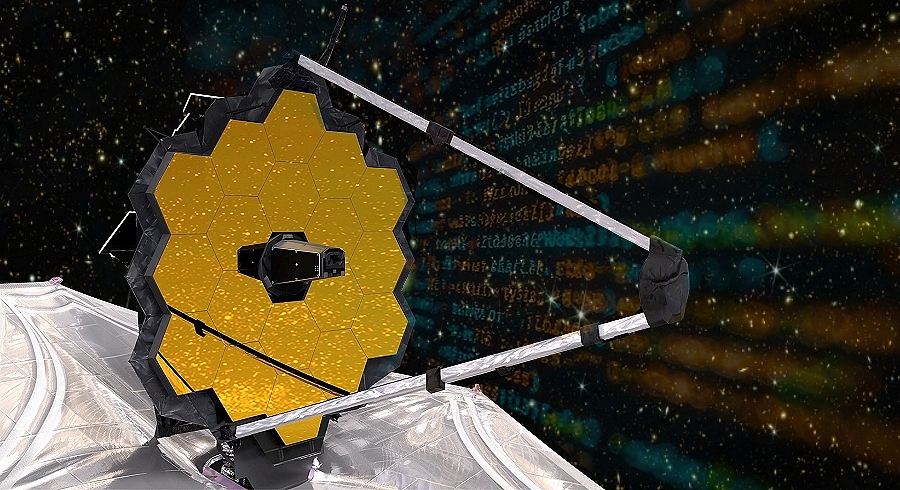
There are space stories that resemble science fiction, and then there are those that change science itself, in real time, without the lyrical tone of space conquest brochures.
This one is housed in a university laboratory in Sydney.
Not in a Californian control center saturated with 16K screens. Not in a vibration-controlled clean room with full-body suits.
In an office, probably with cans of coffee on the table, are two PhD students in their early twenties. And an anomaly that, until now, would have required a manned spacecraft.
Except that no shuttle today or in 20 years will be able to physically approach the place where James-Webb is located.
We're talking about 1.5 million kilometers.
A place further away than any safety cushion we've ever sent humans to.
And despite that, the problem was fixed.
Not with extravehicular gloves riveted to the orbit like for Hubble in 1993, but with code!
Louis Desdoigts and Max Charles, two young Australian researchers, corrected an optical defect in the most powerful space telescope ever built, without ever touching the hardware, without even lifting a screwdriver, and without any mechanical assistance from space.
In the history of space exploration, this marks a turning point.
This isn't just the trick of clever engineers.
This is a philosophical shift: repairing an inaccessible object that is absolutely inaccessible solely through modeling, algorithms, and software intelligence.
A failure reminiscent of Hubble's ghost
The scale of the comparison must be understood: when Hubble's mirror proved to be poorly polished, NASA had to charter astronauts, dock the shuttle, deploy the robotic arm, and install a complete optical corrector. This cost hundreds of millions of dollars and involved a major human risk.
Webb, however, is out of reach. He never will be .
The telescope is stationed at L2, accompanying the Earth in its dance around the Sun. A man in a spacesuit would not survive there. A spacecraft has never flown there before.
So when the first generation of images came back blurry, with an unacceptable optical haze , the anxiety was real: if it was a structural failure, we wouldn't be able to go and repair it.
The flaw came from a very particular instrument: the aperture masking interferometer, the only piece of Webb whose design originated in Australia, via Professor Peter Tuthill (University of Sydney).
A highly specialized instrument, designed to intelligently combine different areas of the main mirror in order to oversample the celestial scene and uncover exoplanets at the limit of detectability.
But a discreet, treacherous physical phenomenon was scrambling the signal: the so-called “brighter-fatter” effect.
The electrical charge spread slightly into the neighboring pixels of the infrared detectors, causing the light from bright sources to swell. A tiny propagation, certainly, but enough to ruin the precision of the combined optics.
There was no ON/OFF button to disable the effect.
No spare lens.
No logistics route. The invisible repair
So, what do we do when only the universe is reachable, but not the object that looks at it?
The object is simulated.
We simulate its physics.
His illness is being simulated.
And we calculate as if we were there.
The two doctoral students then developed AMIGO: a neural architecture designed to emulate the instrument as it actually is in space, with its flaws, and to digitally “re-linearize” the light flow.
AMIGO analyzes the diffusion patterns, recognizes the electrical fingerprint of the blur, then removes it, pixel by pixel.
And it returns to the point where Webb was able to capture, in direct imaging, that is to say, see an extremely faint exoplanet, and a red-brown dwarf orbiting around the star HD 206893, 133 light-years away.
It wasn't cosmetic.
That was crucial.
In another observation campaign, led by Max Charles, the instrument thus “re-spurred” was able to provide clear images of a black hole jet, the volcanic surface of Io, and the stellar winds of the variable star WR 137.
These are not laboratory demonstrations: these are deliverable scientific results.
Structural consequences
What we are observing here is not a local trick but the beginning of a new logic of spatial maintenance.
If we can repair an instrument 1.5 million kilometers away “remotely” — through modeling — then the scale of accessible space infrastructures changes.
We can imagine tomorrow more daring observatories, more isolated because we know that we can correct them without touching them.
This is not valid for all breakdowns obviously, but the conceptual shift is there: there is now a precedent.
What was once “irreparable” becomes “repairable by software”.
And this fact was raised by two doctoral students.
And besides, they engraved it on their skin: they got the aperture-masking interferometer tattooed on their arm.
This is not marketing: it is an act by researchers who are aware that they have inscribed something in the history of their discipline.
Louis Desdoigts then secured a postdoctoral position in Leiden. The team, for its part, now wants to distribute AMIGO to the entire JWST community so that others can also correct their data.
The studies were posted on arXiv in October 2025. Louis Desdoigts's will be published in Publications of the Astronomical Society of Australia .
This story comes at the exact moment when NASA is opening a new cycle of observations and going through a period of institutional turbulence.
A moment when Webb is already reshaping what we thought we knew about primordial galaxies, initial black holes, and the chemical composition of exoplanets.
And at the very moment when Webb's Australian instrument, long "the least visible", suddenly becomes one of the finest pieces in his arsenal.
In conclusion
We must face the facts: we are witnessing a profound shift.
The space mythology of the 20th century was a muscular mythology: gloved hands, titanium plates, steel structures, a robotic arm, men in the unknown, shuttles docking, rivets holding the destiny of a generation.
The mythology of the 21st century, however, will be a software mythology.
And the image can be summed up in a spectacular shortcut: the most remote repair in human history, the most inaccessible repair of all time, was not done with a screwdriver, but with a commit to a code repository.
This is a moment of rupture exactly like the appearance of radar, the transistor, the laser or GPS: an invisible functionality changes the nature of what is possible.
We don't feel it yet because the power of the act is… immaterial.
Because it makes no noise, no fire, no metal.
And yet: the civilizational shift is here.
What Louis Desdoigts and Max Charles have just proven in a university office in the south of the planet is that it is now realistic to augment, stabilize, repair machines located too far away for human hands to approach.
A new food chain in the cosmos has just been inaugurated.
This is not “just a study”.
It's not "just a gain in sharpness".
This is the launch of a new idea:
The future of exploration will not be mechanical. It will be mathematical.
And that statement is now a real fact. |
|
|
|
| Luc T. for DayNewsWorld |
|
WHEN THE ISS WAITS IN VAIN FOR FIVE TONS OF SUPPLIES LOST IN THE VOID OF SPACE | 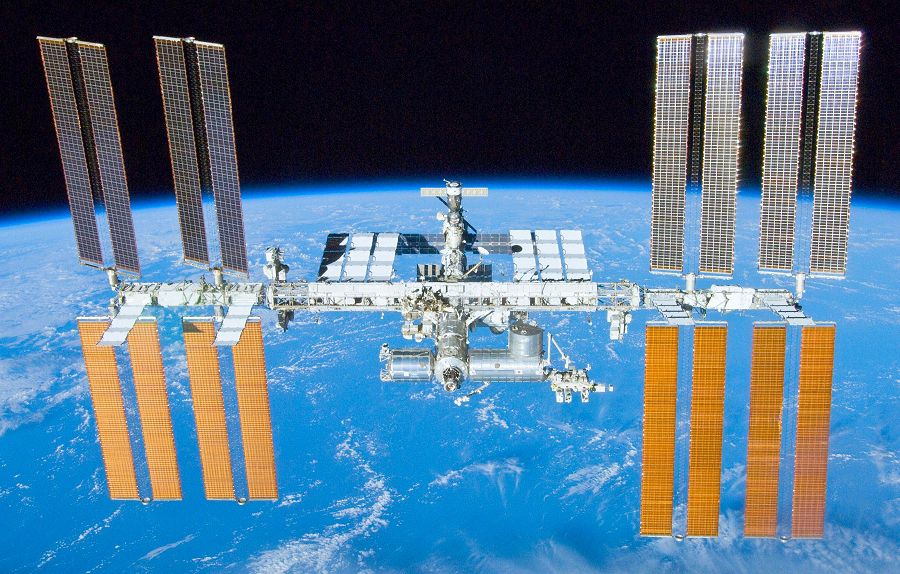
The International Space Station (ISS), a jewel of orbital engineering and a symbol of global scientific cooperation, rests on a fragile equation: without a constant flow of supplies, its astronauts, perched 400 kilometers above our heads, can neither eat, nor breathe, nor conduct the scientific experiments that justify their presence.
But on September 17, 2025, this equation cracked.
A Cygnus XL space cargo ship, launched by a Falcon 9 rocket, carrying five tons of food, equipment and crucial materials, missed its rendezvous with the station.
The event, discreet in NASA's official communication, nevertheless resonates like a brutal warning:
At 29,000 km/h, a margin of error of a few seconds can be enough to deprive an entire team of its means of survival.
Far from being a simple technical anecdote, this incident highlights the complexity of orbital supply chains, the geopolitical stakes of a continuous human presence in space, and the limits of a technology that we sometimes believe to be infallible.
This article proposes to return in detail to this spectacular failure, to analyze its immediate consequences and to place this setback in the broader context of the challenges of space exploration in the 21st century.
1. The ISS: an orbital citadel dependent on Earth
Inaugurated in 1998, the ISS is not a self-sufficient fortress. Far from being a space ark capable of producing everything it needs, it functions as an ultra-sophisticated scientific platform that consumes resources sent from Earth day after day.
The human connection : often overlooked, it's vital. Each shipment also carries letters and small personal items sent by families, helping to maintain the psychological health of the confined crews.
Food : each astronaut consumes approximately 0.8 to 1 kg of food per day. These rations are carefully balanced, calibrated to provide essential vitamins, proteins, and minerals in an environment where microgravity accelerates muscle and bone loss.
Oxygen and water : while some is recycled using onboard systems, the volumes required in the long term still require regular intake.
Clothing and living equipment : in the absence of space laundry, clothes must be replaced regularly.
Scientific instruments : the ISS is, above all, a laboratory. Experiments require consumables, replacement modules, sensors, and sometimes biological samples.
On average, six to eight resupply missions take place each year, carried out by an international consortium: SpaceX's Dragon cargo ships, Northrop Grumman's Cygnus, Russian Progress ships and, more recently, Japanese HTV-X cargo ships.
The station, despite its impressive size, is not designed to accumulate vast reserves. It lives in a permanent tension between consumption and delivery, between autonomy and dependence.
2. A millimeter-precise orbital ballet
Space logistics is anything but a routine supply chain. Sending cargo to the ISS is a meticulously choreographed process, where every parameter must be adjusted down to the second.
Launch : The cargo must be propelled into an orbit almost identical to that of the station.
Trajectory corrections : multiple engine firings gradually adjust speed and altitude to converge on the ISS.
The final approach is the most delicate phase. At less than 1,000 meters, every movement is controlled and monitored by the astronauts and the Houston center.
Capture : for Cygnus, unlike the autonomous Dragons, docking is done by manual capture using the Canadarm2 robotic arm, operated by an astronaut.
The slightest anomaly – a faulty sensor, a delay in the ignition of a thruster, a communication error – can lead to a postponement or even the failure of the mission.
3. The Cygnus XL Incident: The Ghost Freighter
During its September 2025 mission, the Cygnus XL took off safely from Cape Canaveral. Its payload represented a vital treasure: five tons of supplies, nearly a third of which was food and water, with the remainder consisting of scientific equipment, maintenance parts, and personal care packages.
As they approached the station, everything seemed normal. The astronauts, including American Jonny Kim (a physician, former Navy SEAL, and flight engineer on this rotation), were preparing to enter the spacecraft.
Then, an anomaly occurs: a delay in ignition of the approach engines causes a deviation from the trajectory. In a few seconds, the critical distance is exceeded. To avoid any risk of collision, the safety procedure is activated: the cargo ship moves away.
Result: the meeting is missed . At 29,000 km/h, there is no "immediate second chance."
4. Official reactions: caution and restraint
NASA communicates quickly but in a measured manner:
"A technical incident prevented the docking," a spokesperson said.
"Options are being explored for a further attempt."
"The safety of the crew was never compromised."
The astronauts, for their part, maintain a calm expression in front of the internal cameras. But behind the scenes, the tension is palpable. The missing five tons represent a logistical chasm.
5. Concrete consequences for the crew
The astronauts are not in immediate danger: the ISS has several weeks' worth of safety reserves. But every day without deliveries creates a delay in planning.
Psychology : Personal packages are among the most anticipated. Their absence reinforces the astronauts' isolation.
Food : Certain foods will have to be rationed. Planned menus, often varied to avoid dietary monotony, may be reduced.
Scientific experiments : Several expected modules—cell cultures, biological samples, sensors for physics experiments—are stuck on the cargo ship. Some experiments, scheduled for years, have to be postponed.
The situation is not dramatic, but it illustrates how each delivery is a fragile umbilical cord .
6. The solutions envisaged
NASA and Northrop Grumman immediately embarked on a race against time. Several scenarios were considered:
International coordination : accelerate an already planned Dragon or Progress mission to fill the gap.
Another docking attempt : If the cargo ship retains enough fuel, a second approach can be planned. But each maneuver consumes a portion of its precious reserve.
Partial load transfer : If this fails, consider repatriating the cargo or returning part of its load in a subsequent mission.
Each solution involves astronomical costs – literally.
7. Structural challenges of space refueling
This incident is not a first. Over the past twenty years, several cargo ships have run aground:
In 2021, a Japanese HTV cargo ship missed its capture slot.
In 2015, a Russian Progress exploded shortly after launch.
In 2019, a SpaceX Dragon experienced a docking anomaly.
These failures are a reminder that reliability, while very high, is never absolute. Every mission is a high-risk experiment .
8. A problem that goes beyond technology: political and economic issues
Behind the technical aspects lies a broader reality:
Commercial competition : SpaceX, Northrop Grumman, Roscosmos, JAXA – each is staking its credibility on these missions.
Economics : Each kilogram sent into orbit costs between $20,000 and $40,000. Five tons lost represents a colossal loss of revenue.
Politics : The station is a symbol of international cooperation. A failure undermines this image and fuels debates about the relevance of a permanent human presence.
The Cygnus incident thus becomes a reputational issue as much as a logistical one.
9. Lessons for the future
Every failure fuels learning. The incident underlines several points:
The growing role of advanced robotics and AI in critical operations.
The need for redundancy : multiplying supply vectors so as not to depend on a single mission.
The importance of autonomous technologies : Cargo ships capable of automatic docking (such as Dragon or Progress) reduce the margins of human error.
10. A mirror for the future of human exploration
This episode goes beyond the immediate scope of the ISS. It poses a broader question:
How to supply future lunar and Martian missions?
On Mars, delivery times can be months or even years. A delivery failure there could be potentially fatal.
On the Moon, the delays are a few days, but the environment is even more hostile.
The Cygnus incident is therefore an anticipated echo of tomorrow's challenges .
In conclusion: an assumed fragility
The International Space Station has never been a static achievement, but a living, fragile experiment, full of brilliant successes and instructive failures.
The Cygnus XL incident is a reminder that space exploration is not a series of spectacular triumphs, but a succession of precarious balances where every error has immediate repercussions.
By missing its rendezvous, this phantom cargo ship not only deprived the astronauts of five tons of resources.
He reminded all of humanity that our dream of space still rests, and will for a long time, on a thin thread stretched between Earth and the sky. |
|
|
|
| Luc T. for DayNewsWorld |
|
SPACEX ANNOUNCES RESUMPTION OF STARSHIP MEGAROCKET FLIGHTS | 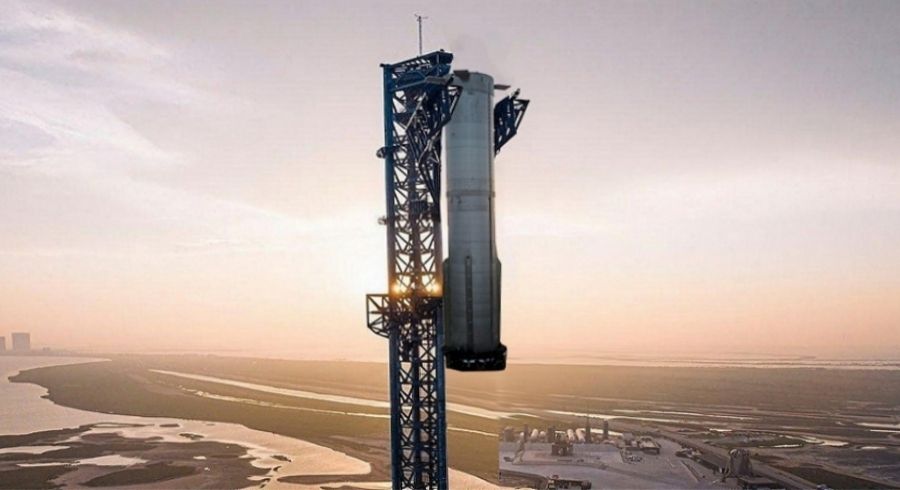
Elon Musk's company, SpaceX, is preparing to take a new step in the development of its Starship megarocket. After more than a month of shutdown forced by the explosion of the second stage during the previous test flight, the company aims to carry out an eighth test this Friday.
The launch is part of a series of tests aimed at perfecting the largest space launcher ever designed and demonstrating its reliability ahead of possible manned missions to the Moon and Mars.
A return after a thorough investigation
SpaceX announced Monday that it plans to resume test flights as early as Friday, subject to regulatory approval. The launch, scheduled to take place from its Boca Chica base in Texas, could take place as early as 23:30 GMT (12:30 a.m. French time on February 1). The resumption comes after a lengthy investigation by the Federal Aviation Administration (FAA), which ordered the flights suspended after the second stage disintegrated over the Caribbean in January.
The incident, spectacular in its scale, caused an incandescent rain of debris, observed as far as the Turks and Caicos Islands. While the material damage observed was minimal, the accident nevertheless raised questions about the robustness of the launcher's upper stage. In response to the conclusions of the investigation, SpaceX claims to have made "several modifications" aimed at improving the reliability of this critical stage.
Regulatory supervision under pressure
When asked by AFP, the FAA declined to comment on the investigation's findings or the adjustments made by SpaceX. This situation is reminiscent of the tensions that regularly pit Elon Musk against regulatory agencies. Under Joe Biden's administration, the SpaceX boss has consistently criticized the FAA, accusing it of stifling innovation through excessive oversight.
Musk’s close relationship with former President Donald Trump has also raised concerns about his potential influence on future regulatory decisions. As the billionaire and his companies continue to push technological boundaries, the balance between innovation and regulation remains at the heart of the debate.
An ambitious test flight
This eighth test flight is not just a simple launch attempt. SpaceX intends to test several new features and push the rocket to its limits in order to validate maneuvers essential to its future operation.
Among the main objectives is the recovery of the first stage of Starship, a spectacular operation already successfully carried out twice. This maneuver, which consists of returning the enormous booster to Earth for later reuse, is a central element of SpaceX's business model, based on reducing costs by reusing the components of its launchers.
In addition, the mission includes for the first time the deployment of simulated payloads: four replicas of next-generation Starlink satellites. These mock-ups, similar in size to the real craft, will be released into orbit before disintegrating in the Earth's atmosphere. This test aims to demonstrate Starship's ability to transport and deploy satellites, a key challenge for the company's commercial ambitions.
A second floor under surveillance
One of the major challenges of this test is the recovery of the Starship's second stage. During the previous flight, this stage could not be recovered due to its premature explosion. This time, SpaceX has integrated several atmospheric reentry experiments, aimed at testing the ability of this stage to return to Earth safely.
The company has notably added elements designed to simulate extreme re-entry conditions. These devices, present on the second-generation version of the Starship, aim to voluntarily apply constraints to the structures of the ship in order to evaluate their resistance to aerodynamic and thermal forces.
For safety reasons, SpaceX specifies that the return of the second stage to the launch base will only be attempted if strict criteria are met. In the absence of optimal conditions, the craft will be redirected to the Gulf of Mexico for a controlled splashdown, thus avoiding any risk to ground infrastructure.
A key step for the future of Starship
This eighth test is of crucial importance for the future of the Starship program. SpaceX hopes to increase the pace of its launches in 2024, with the ambition of reaching a regular cadence. The company is counting on this megarocket to realize its dream of sending humans to Mars, a flagship objective of Musk's space program.
NASA is also closely monitoring the tests, as Starship is expected to play a key role in its Artemis program. That effort, which aims to return astronauts to the Moon in the coming years, relies in part on a modified version of Starship to land lunar crews.
As the countdown begins for this new test flight, the success of this mission could mark a decisive step forward for SpaceX and confirm that Starship is well on its way to technical maturity. If the company succeeds in validating the objectives set, it could move a little closer to its ultimate dream: making humanity a multi-planetary species.
|
|
|
|
| Paul Emison for DayNewsWorld |
|
THE RETURN OF THE TWO ASTRONAUTS
STARLINER SHIP DELAYED AGAIN |
Astronauts stranded in space, but for how much longer ?
Butch Wilmore and Suni Williams, two Americans who left for an eight-day mission aboard the International Space Station (ISS), have been in weightlessness since last June.
On Tuesday, NASA announced that their return to Earth will not take place before "the end of March, at the earliest." That's still quite an extension for an impromptu vacation in space !
The cause ? The failures of Boeing's Starliner spacecraft. Instead of bringing back our two explorers, the Starliner preferred to turn back empty after long weeks of fruitless tests.
Fortunately, Elon Musk's company SpaceX sent a new ship to rescue our space Robinsons in September. The Crew-9 mission, with astronaut Nick Hague and Russian cosmonaut Alexander Gorbunov on board, reached the ISS.
But the shuttle will not be able to return until Crew-10 takes over. Surprise !
NASA has just pushed back this launch to "the end of March" to give SpaceX teams time to fine-tune their new ship. So, a few more months of patience for Butch and Suni.
The two astronauts were originally part of the first manned test flight of Boeing's Starliner. But propulsion problems stranded them in orbit, adding another chapter to Boeing's technical misadventures.
One begins to wonder whether they should not have been suspicious when seeing the performance of the airliners of the same company.
Despite everything, our two space heroes are taking the situation philosophically. During a press conference at the beginning of September, they assured that the extension of their mission was not so difficult to live with.
"The transition wasn't that hard," Williams said. "We both come from the Navy, so we're used to extended tours. It just gives us a little more time to enjoy the view."
So, next time you complain about your delayed flight, think of Butch and Suni, stuck in space ! |
|
|
|
| Andrew Preston for DayNewsWorld |
|
A FASCINATING DISCOVERY
ON BLACK HOLES | 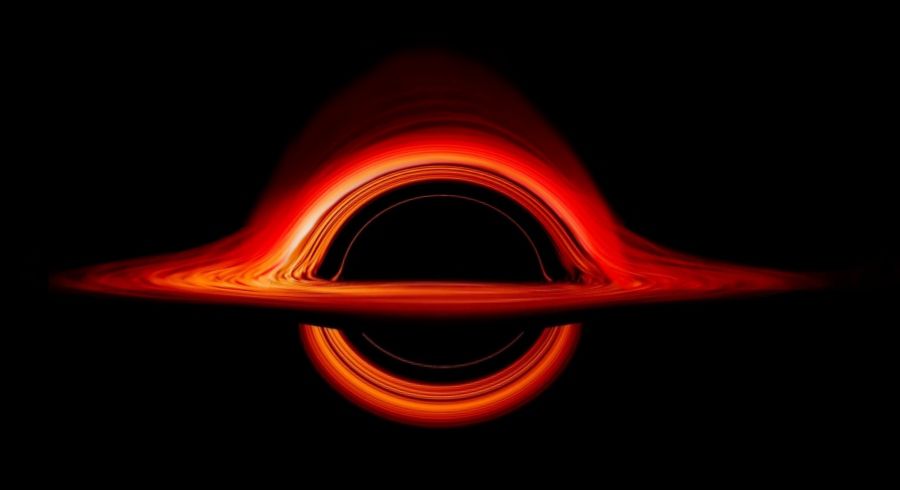
The theory of General Relativity, developed by Albert Einstein, predicted the existence of fascinating and extreme phenomena in the Universe: black holes. These mysterious regions of space-time are characterized by a gravitational force so powerful that nothing, not even light, can escape from them. The idea of these intriguing objects was first formulated in 1916, when solutions to the mathematical equations of General Relativity made it possible to describe these hypothetical entities.
Despite this, the reality of their existence has long been a subject of debate among scientists, sparking discussions and controversies for almost a century. It was not until 1965 that British mathematician Roger Penrose provided crucial theoretical proof by demonstrating that black holes inevitably form as a result of the gravitational collapse of massive stars.
This landmark work laid the foundation for a modern understanding of black holes. However, it was not until the 1990s that more direct observational evidence emerged. Thanks to the pioneering work of American astrophysicists Reinhard Genzel and Andrea Ghez, clues suggesting the presence of a supermassive black hole at the center of our galaxy, the Milky Way, were discovered. This fundamental work, combined with the contributions of Roger Penrose, was rewarded with the Nobel Prize in Physics in 2020.
Today, technological advances are allowing even more spectacular observations. Thanks to the international collaboration known as the Event Horizon Telescope (EHT), scientists have succeeded in capturing the image of the "shadow" of the black hole located at the heart of our galaxy. This scientific feat is a major step in validating the existence of black holes and in our understanding of these extreme objects.
Thus, the existence of black holes in the Universe is now firmly established thanks to converging theoretical and observational evidence. But the story does not end there: current research, based on the Standard Model of fundamental forces, suggests the possible existence of a new category of black holes as yet unknown, opening the way to exciting discoveries and new perspectives on the nature of the Universe.
The Origin of Black Holes
Today, it is widely accepted that black holes are ubiquitous in our Universe. In general, two main scenarios explain their formation.
First, there are stellar black holes, which are formed by the gravitational collapse of ordinary stars at the end of their life. This happens when these stars, having exhausted all their nuclear fuel, collapse under their own weight. Stellar black holes have masses that generally vary between 2 to 3 solar masses and can reach tens or even hundreds of solar masses.
Once formed, these stellar black holes can grow by absorbing surrounding matter. They can also merge with each other, emitting gravitational waves in the process. The first detection of these gravitational waves, the result of the merger of two stellar black holes, was honored with the Nobel Prize in Physics in 2017.
Second, it is possible that some black holes, called primordial black holes, formed shortly after the Big Bang, by the collapse of primary matter in the first second of the Universe. The masses of these primordial black holes can be extremely varied. Some can reach billions of solar masses, such as the supermassive black holes located at the centers of most galaxies.
Others may be much smaller, the size of planets or asteroids, with radii of less than a centimeter. It is therefore conceivable that the Universe is full of these tiny primordial black holes, whose detection would represent a major challenge for observational astrophysics. Even lighter primordial black holes would have evaporated very quickly according to the Hawking process, and thus not survived to the present day.
Current research suggests that some of these small primordial black holes that still exist today may have an intriguing new characteristic: being “hairy.” Traditionally, black holes are considered to “have no hair,” a metaphor for being completely defined by only three properties: their mass, their electric charge, and their angular momentum. However, the discovery of black holes with additional characteristics could revolutionize our understanding of these fascinating objects.
Unification of theories and ringed black holes
Researchers have just made another fascinating discovery: that of black holes with a magnetic charge and surrounded by a unique structure: a "hair" in the form of rings.
These rings are made up of elementary particles, in particular the W, Z and Higgs bosons. These particles form a Bose-Einstein condensate, a very special state of matter. This type of condensate occurs when particles behave as a single quantum entity, usually at extremely low temperatures or under very specific conditions. This phenomenon has already been observed in the laboratory for atoms cooled and trapped using lasers, a discovery that earned the Nobel Prize in Physics in 2001.
In the case of black holes, the electroweak condensate is created by the intense magnetic field surrounding the charged black hole. This condensate, itself magnetized, is repelled by the black hole's magnetic force and therefore cannot fall into it. However, it is also held nearby by the black hole's gravitational pull. Thus, it remains suspended, trapped in a stable region just outside the black hole.
Ringed black holes differ radically from classical black holes. They can be macroscopic in size, on the order of a centimeter, which is immense compared to the subatomic scale of the elementary particles that make up their rings.
Let's imagine a black hole (a black dot) surrounded by several successive layers. The gray region represents the intense magnetic field that surrounds the black hole. Around this area, there are three distinct rings. One ring carries part of the magnetic charge, while the other two rings correspond to electric currents formed by W bosons that circulate around the black hole. These structures are the direct result of the mathematical solutions that the researchers obtained.
These ringed black holes are described by theories that have been experimentally validated. This means that they are probably not simple mathematical constructs, but could indeed exist in reality as physical objects in the Universe.
It is unlikely that black holes of this type could form in the present Universe. On the other hand, the extreme conditions that prevailed in the very first moments after the Big Bang could have allowed their formation. These black holes would therefore be classified as primordial black holes , that is, objects formed in the extremely dense and fluctuating primordial plasma that characterized the early Universe.
A remarkable property of these ringed black holes is their stability. The presence of the rings actually reduces the overall mass of the black hole, making their energy dissipation unfavorable. This stability would allow them to survive until today, making them potential candidates to explain part of dark matter.
These hairy black holes, surrounded by electroweak rings, represent a major advance in our understanding of the Universe, notably offering a clue to solving the enigma of dark matter... |
|
|
|
| Paul Emison for DayNewsWorld |
|
A CELESTIAL SHOW
THE BEAVER SUPER MOON | 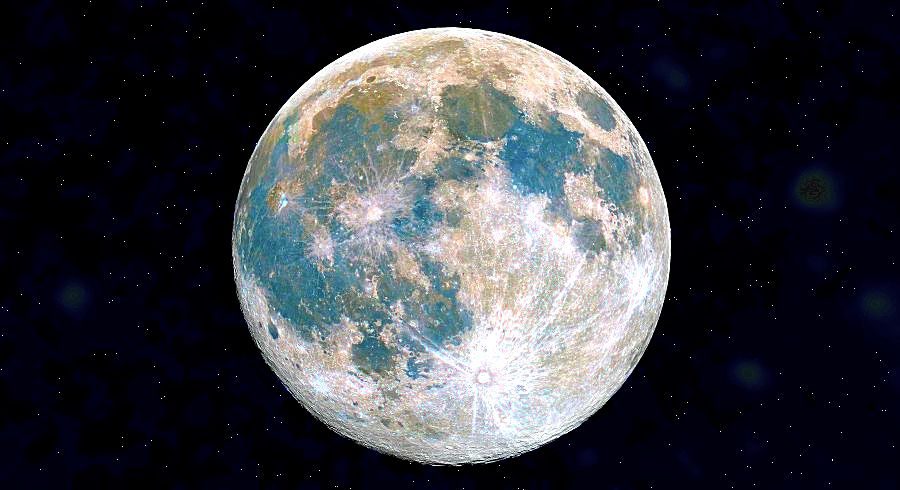 Get ready for a unique celestial spectacle: the very last Supermoon of the year 2024 arrives this Friday, November 15, 2024 at 10:28 p.m.! Get ready for a unique celestial spectacle: the very last Supermoon of the year 2024 arrives this Friday, November 15, 2024 at 10:28 p.m.!
Nicknamed the "Beaver Moon," this full moon will flood the sky with a more intense light and appear slightly more imposing than usual. In fact, its brightness will be such that it will be impossible to miss.
This "Supermoon" is not an official term in astronomy. It was invented by astrologer Richard Nolle, who uses it to designate the moment when the full moon is at its perigee, that is, at its closest point to Earth.
This phenomenon makes the moon approximately 7% larger and up to 16% brighter than a classic full moon.
And to fully enjoy it, the ideal is to find a place without obstacles on the horizon and to move as far away from city lights as possible.
As for the name "Beaver Moon", it comes to us from Native American tribes. These peoples named the full moons according to the seasons and natural events. November was the month when beavers redoubled their efforts to prepare for winter: they built dams and accumulated their food reserves.
This name could also refer to the hunting periods when trappers, at this time of year, set their traps to collect the fur of these animals.
So, when will the next Beaver Moon be?
We will have to wait until next November for this seasonal full moon to return, even if other full moons await us in 2025.
Don't miss this appointment with the sky on November 15 ! |
|
|
|
| Paul Emison for DayNewsWorld |
|
TSUCHINSHAN-ATLAS
THE SPECTACULAR COMET OF 2024
READY TO DAZZLE THE NIGHT SKY | 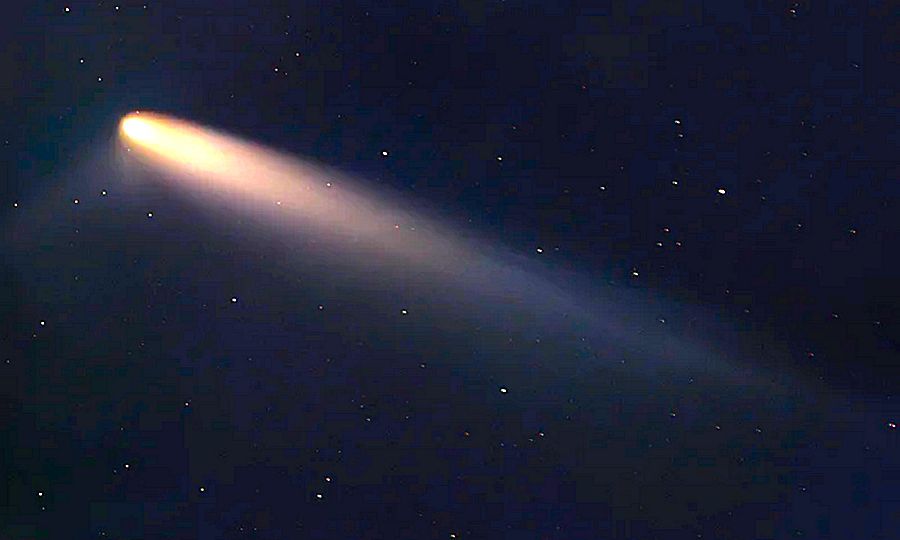 On September 27, 2024 at 5:00 p.m., a rare and fascinating event took place millions of kilometers from Earth: On September 27, 2024 at 5:00 p.m., a rare and fascinating event took place millions of kilometers from Earth:
Comet Tsuchinshan-ATLAS has reached its closest point to the Sun, a decisive milestone in its long journey that began several million years ago.
If it survives this perilous approach, this comet could offer a dazzling spectacle from mid-October 2024. Its fate remains uncertain, however, and everything will depend on its ability to resist the immense forces of gravity and heat exerted by our star.
 A discovery at the edge of the solar system A discovery at the edge of the solar system
Comet Tsuchinshan-ATLAS, also known scientifically as C/2023 A3, was discovered in January 2023 by the Purple Mountain Observatory in China, which gave it the first part of its name.
However, official confirmation of its existence was made by the ATLAS (Asteroid Terrestrial-impact Last Alert System) telescope in South Africa, which added the second name to this cosmopolitan comet.
These two astronomical installations, located on two continents, have collaborated to reveal the existence of this ancient traveler from the confines of our solar system.
Astronomers believe that C/2023 A3 likely originated in the Oort Cloud, a hypothetical region at the outer edge of the solar system, more than 100,000 astronomical units (AU) from the Sun (about 9,460 billion kilometers).
This gigantic reservoir of icy bodies and asteroids is thought to house billions of comets orbiting the Sun, some of which occasionally venture into the inner regions of the solar system, as is the case with Tsuchinshan-ATLAS.
A journey of millions of years
What makes this comet so captivating, beyond its mysterious origin, is the length and nature of its journey. Unlike planets or asteroids that follow well-defined orbits around the Sun, Tsuchinshan-ATLAS has a so-called "non-closed" orbit.
This means that, according to some astronomical models, this comet could have traveled a phenomenal distance, up to 400,000 times the distance between Earth and the Sun, before approaching us.
Lucie Maquet, an astronomer at the Institute of Celestial Mechanics and Ephemeris Calculation (IMCCE) at the Paris-PSL Observatory, explains that the data collected since its discovery do not allow its entire journey to be accurately reconstructed, due to the limited observation time.
However, its journey through space may have begun millions of years ago, at the dawn of the modern solar system, in regions far further away than the Kuiper Belt.
The Challenge of Survival : Tsuchinshan-ATLAS Facing the Sun
The closest approach to the Sun, or perihelion, is a critical moment for all comets. As Tsuchinshan-ATLAS approached its closest point to the star, it faced intense heat and extreme gravitational pull.
At this distance, the solar temperature causes the ices in the comet's nucleus to sublimate, releasing immense quantities of gas and dust into space.
It is this release that creates the coma, this luminous envelope which surrounds the nucleus, and its long tail, the visual signature of comets.
However, this spectacular phase also carries risks: if the comet loses too much mass or if the structure of its nucleus is too fragile, it could literally disintegrate under the effect of the Sun's gravity. This scenario is not uncommon in the history of comets, and it remains a possibility for Tsuchinshan-ATLAS.
"The whole question is whether this degassing will not be too significant," explains Lucie Maquet, recalling that such disintegration is always a potential danger.
However, there is some good news: Initial observations suggest that C/2023 A3 has a relatively massive core, increasing the chances that it will emerge unscathed from this encounter with the Sun.
A celestial spectacle to come : the comet visible to the naked eye in October 2024
If comet Tsuchinshan-ATLAS survives its passage near the Sun, it will offer a rare spectacle to Earthlings from October 13, 2024, this time in the northern hemisphere.
Until now, only observers in the southern hemisphere had a chance to see it with the naked eye, but now it will appear every evening above the western horizon, shortly after sunset.
For lovers of starry skies, this will be a unique opportunity to observe one of the brightest comets of recent decades.
As the comet moves higher into the sky each evening, its spectacular tail should become increasingly visible, offering a rare moment to admire this cosmic traveler.
Equipped with a pair of binoculars and a clear horizon, amateur and curious astronomers will be able to enjoy this astronomical "one shot" .
Uncertainties about the comet's brightness
It is difficult to predict with any precision how bright the comet will be. Early predictions suggested it could reach exceptional brightness, but those estimates have since been revised downward.
Despite this, Lucie Maquet remains confident: "It's a bit of a surprise at the last minute, but in any case it's going to be a brilliant comet, that's for sure."
The next few weeks of observation will tell us more about the size and beauty of Tsuchinshan-ATLAS' tail.
However, after its closest approach to Earth, its brightness is expected to decrease, so the optimal time to observe it will probably be in the second half of October.
Each evening, the comet will shine a little less, but it will continue to capture the attention of astronomy enthusiasts.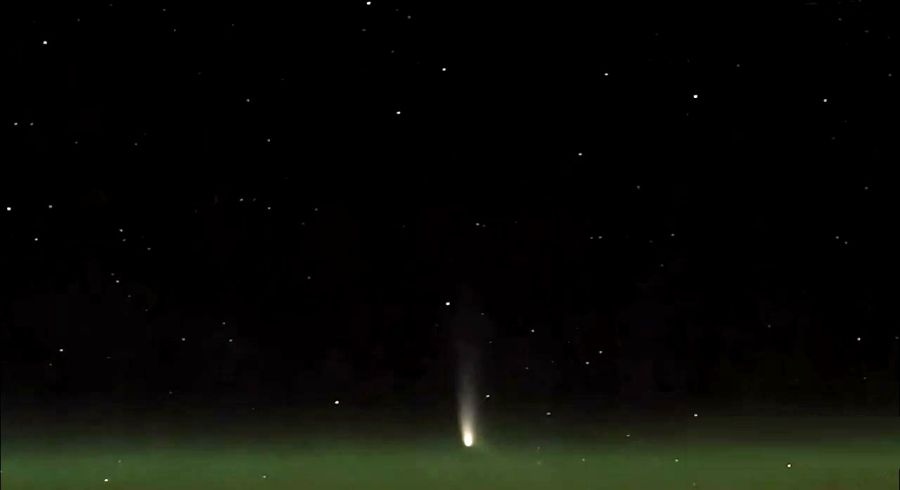
The uncertain future of Tsuchinshan-ATLAS : between stars and possible return
After its passage near the Earth and the Sun, the future of the comet is far from sealed. Its orbit, already complex, will be further disrupted by the gravitational forces of the other celestial bodies it will cross, as well as by the loss of mass suffered during its encounter with the Sun.
Some models predict that it could be ejected from the solar system, venturing into the interstellar depths, "getting lost among the stars," according to a bulletin from the Institute of Celestial Mechanics.
However, this ejection is not guaranteed. The Oort cloud, its place of origin, is an environment full of mysteries.
It only needs to encounter another celestial body during its long journey for it to be deflected, and perhaps one day return to the solar system for another close passage of the Sun in thousands, even millions of years.
A unique meeting not to be missed
In summary, Comet Tsuchinshan-ATLAS is a unique opportunity for humanity to observe an ancient and distant object in our solar system.
Whether you are a seasoned astronomer or just a curious observer, this encounter is not to be missed. It may well leave us forever after this luminous episode, merging into the vast cosmic expanses.
So, keep your eyes fixed on the western horizon starting October 13, 2024, as a magical window will open in our skies, reminding us that we are but humble spectators in the immense cosmic theater. |
|
|
|
| Paul Emison for DayNewsWorld |
|
EARTH WILL HAVE TWO MOONS
AROUND HER FOR TWO MONTHS | 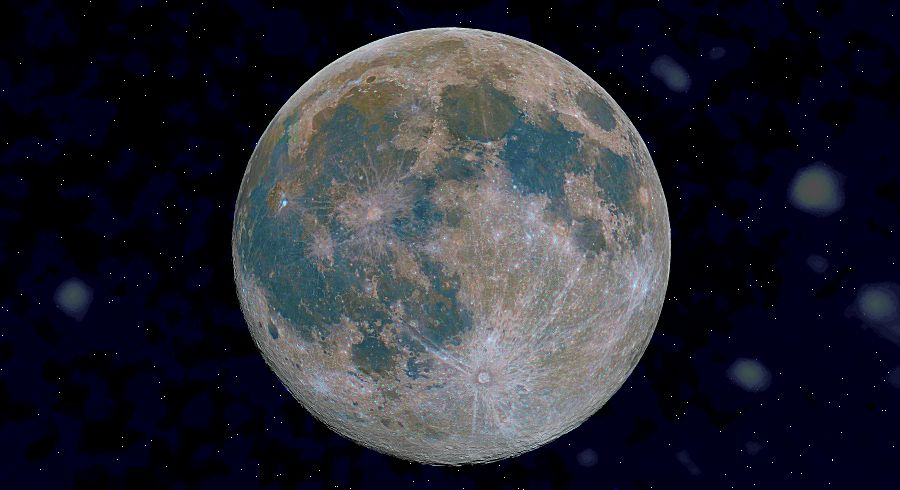
Earth will have two moons for two months: a mini-moon in temporary orbit
Starting September 29, 2024, Earth will no longer be accompanied only by its faithful Moon. For a period of two months, a small asteroid will be added to our sky as a "mini-moon," a temporary second moon.
This celestial object, named 2024 PT5, was captured by the gravitational pull of Earth and will complete a single orbit before escaping on November 25, 2024.
Although this phenomenon is rare, it is not entirely unprecedented.
2024 PT5: A discreet but fascinating mini-moon
Discovered on August 7, 2024 by the ATLAS (Asteroid Terrestrial-impact Last Alert System) observation system, which scans the skies for objects that could collide with Earth, 2024 PT5 is a relatively modest asteroid in size.
Measuring about 10 meters in diameter, it is much smaller than the Moon, and its presence will not be noticeable to the naked eye. However, despite its discretion, this asteroid is a subject of major interest for astronomers.
According to Tony Dunn, a well-known amateur astronomer on the X Network (formerly Twitter), 2024 PT5 will complete a single orbit around our planet before being thrown back into interplanetary space. 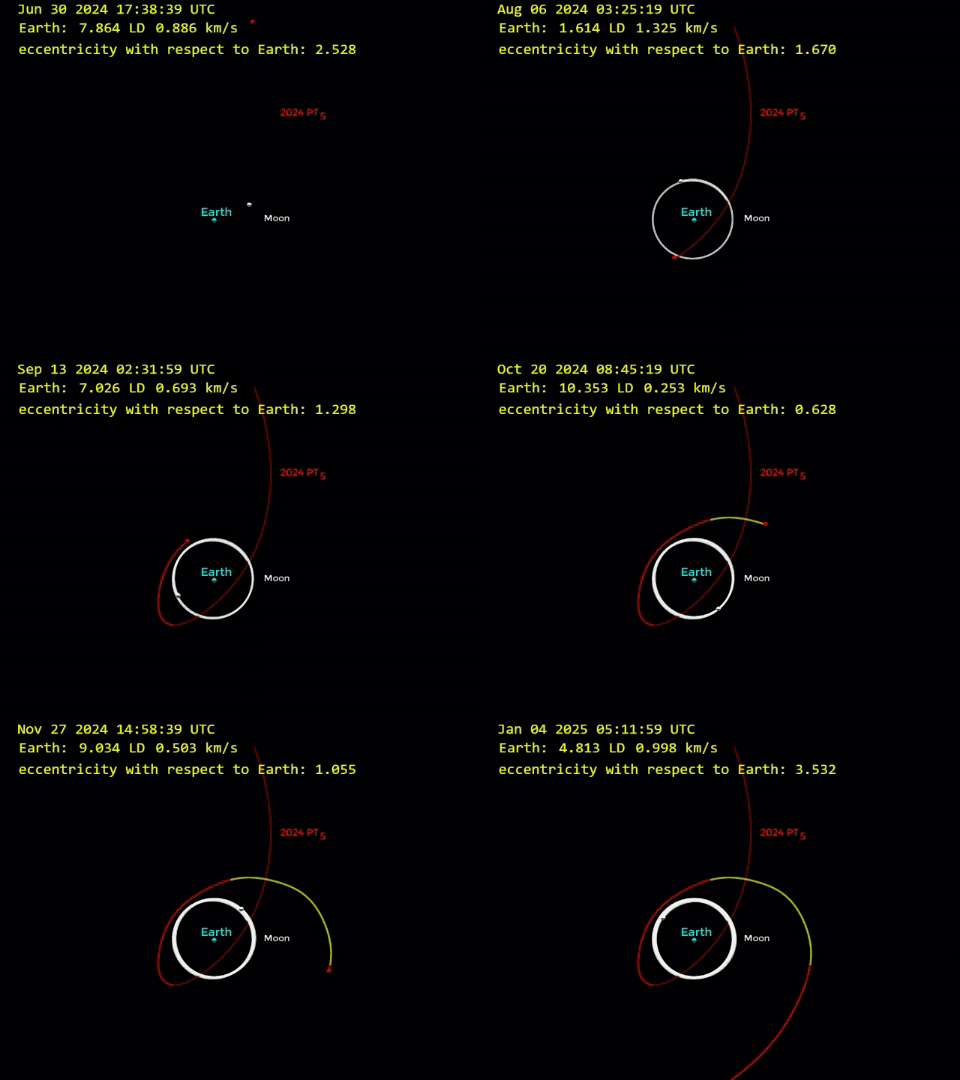 Calculations of its trajectory are being followed with great attention, not only to understand its dynamics, but also to anticipate its future appearances near the Earth.
A mysterious origin:
Arjuna's asteroid belt
According to researchers Carlos and Raúl de la Fuente Marcos, from the Complutense University of Madrid, 2024 PT5 could originate from the Arjuna asteroid belt.
This group of celestial objects is distinguished by orbits very close to those of the Earth, making their passages close to our planet more frequent than for other asteroids.
Objects in this group are often studied because they can occasionally be temporarily captured by Earth, before returning to the cosmos.
Rare but not unprecedented phenomenon: a look at past mini-moons
If the Earth will temporarily have a "double moon", this phenomenon, although rare, is not a first. In 2006, another small asteroid was also captured by the Earth's gravity and accompanied our planet for almost a year before returning to space.
More recently, another celestial object also orbited Earth for several years, until its escape in May 2020. These events allow scientists to better understand the gravitational interactions between Earth and objects near our planet.
Regular returns: 2024 PT5 will return
The story of 2024 PT5 with Earth will not end in November 2024. Calculations show that this asteroid will make another pass near our planet on January 9, 2025, although this time it will not be captured in orbit. In addition, it is expected to return even closer in 2055.
These periodic meetings are fascinating for the scientific community, which sees in these temporary mini-moons an opportunity to learn more about asteroids and their gravitational interactions with our planet.
Ultimately, the arrival of 2024 PT5 around Earth offers a window into a natural phenomenon that is both rare and spectacular, a reminder of the cosmic dance that binds Earth to the many objects that populate our Solar System.
Although we cannot observe this mini-moon with the naked eye, its study will undoubtedly provide valuable information to researchers and astronomy enthusiasts. |
|
|
|
| Paul Emison for DayNewsWorld |
|
SUCCESSFUL LAUNCH FOR THE EUROPEAN ARIANE 6 ROCKET | 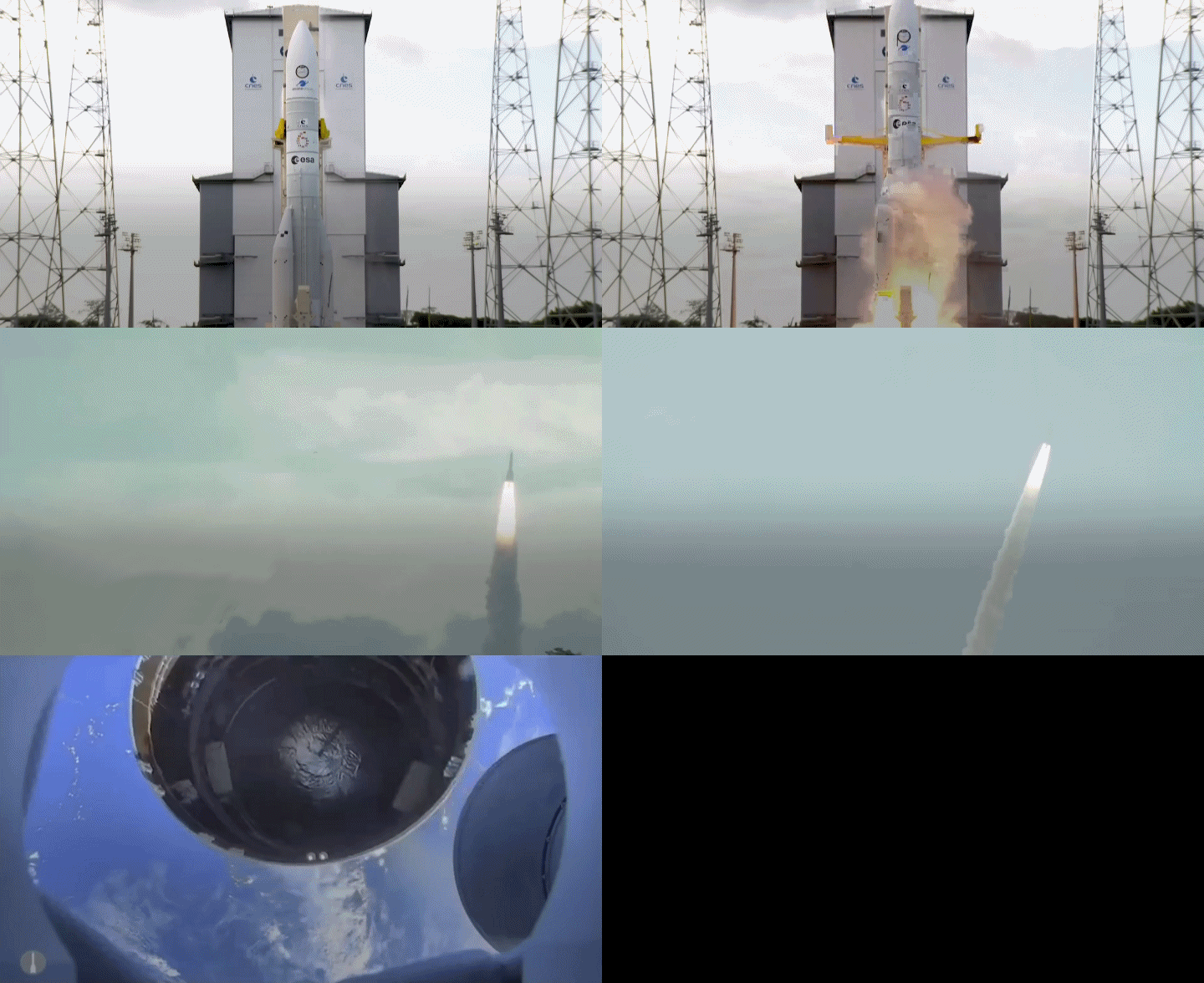
The new European launcher Ariane 6 had its maiden flight on July 9, 2024, a key milestone for our continent. At a time when the European Union is gaining considerable power in the space domain (Copernicus Earth observation programs, Galileo satellite navigation, Iris2 telecommunications constellation), Ariane 6 is an essential constituent of European sovereignty.
After around ten years of development (and four years of delay), the European Space Agency (ESA) launcher took off, one year almost to the day after the very last launch of Ariane 5, the July 5, 2023, after 27 years of service. Its predecessors Ariane 1/2/3/4 and Ariane 5 having each been operated for around twenty years, the Ariane 6 assets were built to allow the same duration of exploitation.
Its raison d'être is twofold: the reduction in launch costs compared to Ariane 5 and flexibility (version with 2 or 4 boosters and re-ignition of the upper stage).
With a height of 56 meters and a diameter of 5.4, capable of carrying 4.5 to 11.5 t of payload for the geostationary transfer orbit (10.3 to 20.6 t for low orbit) depending on its configurations (Ariane 62, equipped with two boosters and Ariane 64, equipped with four boosters), Ariane 6 was designed to be versatile, in a context of developments in the market for satellites and launchers, including the partially reusable and very competitive Falcon 9 from Space X. Due to the lack of a European rocket and due to the war in Ukraine which deprives the ESA of access to Russian Soyuz launchers, Elon Musk's launcher had also been mobilized for the launch of two satellites for the European Galileo GPS system , last April.
The evolving needs of the space sector
The needs of satellites have indeed evolved considerably. Indeed, in the era of Ariane 4 and Ariane 5, the vast majority of satellites aimed at geostationary orbit and asked to be placed on a transfer trajectory towards this orbit. This type of mission was carried out by direct injection after the single thrust of the last stage of the rocket.
Launch requests are now much more varied and most often require upper stage re-ignition capability. This is due to the arrival of electric propulsion of satellites (more efficient but which requires a different orbital injection strategy), but also to that of satellite constellations in low orbit, for example telecommunications constellations like Kuiper, d 'Amazon, or Iris2, of the European Union. The re-ignition of the upper stage of Ariane 6 will make it possible to offer better services for interplanetary missions, by enabling trajectories that were not possible until now.
This re-ignition capacity will also be used to deorbit the stage so that it disintegrates in the atmosphere at the end of its mission to limit the presence of waste from the space industry in Earth orbit.
The flexibility of Ariane 6 is also expressed through its modularity. Its two-propeller version makes it a medium launcher, of the Soyuz rocket class – which was launched from Guyana for Arianespace until 2021 – particularly suited to earth observation type missions of 3 to more than 5 tonnes or the European geolocation constellation Galileo.
Its version with four boosters makes it a heavy launcher of the Ariane 5 type, which can send satellites weighing more than 10 tonnes into geostationary orbit and around 20 tonnes into low orbit for a transfer vehicle to the international space station such as ATV, or for telecommunications constellations.
A successful launch
Ariane 6 is perfectly suited to institutional and commercial space missions. Its two versions A62 (2 additional lateral thrusters) and A64 (4 additional lateral thrusters), combined with its upper stage re-ignitable engine (that of Ariane 5 was not), therefore allow it to cover a wide range of performances and thus respond optimally to very varied orbiting demands:
Low orbit (< 2,000 km altitude) for Earth observation or telecommunications constellations;
Average orbit for Galileo (around 15,000-25,000 km altitude), the European satellite navigation system;
Geostationary orbit (36,000 km altitude), for telecommunications or meteorology satellites;
“Exotic” orbits for certain scientific missions;
Missions in the solar system.
For its maiden flight, Ariane 6 was loaded with small satellites, deployers and experiments, developed by companies, research institutes, universities, young professionals and agencies. Among these projects, the 3 Cat-4, a CubeSat (cubic nanostallite) for Earth observation developed by the Universitat Politècnica de Catalunya (Spain), which will have the particular mission of extracting information on ocean data such as ice cover and thickness. Another CubeSat, Robusta-3A, developed by the Montpellier University Space Center, will contribute to better anticipation of Cévennes episodes, which often cause intense rain and severe flooding, by helping to quantify the accumulation of water vapor above of the Mediterranean Sea.
The end of the launcher's mission was, however, marked by a technical anomaly. It will take time to understand in detail the reasons for the malfunction.
Even if a maximum of tests and simulations were carried out during the development of Ariane 6 to limit risks, it is during its maiden flight that a rocket is confronted for the first time with real conditions, such as vacuum space, strong accelerations and stage separations to name just a few examples.
The main players in the development of Ariane 6
The development and manufacturing of the Ariane 6 rocket is carried out by ArianeGroup. The ESA (European Space Agency) is the project owner but also the architect of the launch system, that is to say responsible for the coherence between the ground installations and the rocket.
CNES, for its part, is responsible for developing the ground installations at the Guiana Space Center: this is the ninth launch pad that it has designed. It is also responsible for carrying out “combined tests”, assists the ESA and ensures the safety of goods, people and the environment under the French Law on Space Operations. ArianeGroup and CNES rely on a group of European industrialists.
Finally, it is Arianespace which markets Ariane 6.
At the end of the so-called commercial mission, that is to say after the separation of the nanosatellites, this launch will be an opportunity to test more complex maneuvers, such as those that would be necessary for interplanetary missions.
After the first flight, the teams will analyze the measurements transmitted to the ground to authorize the next flight as soon as possible. Indeed, the ramp-up must be rapid to respond to the 27 launches already marketed by Arianespace.
An evolution of Ariane 6 is even already in preparation with an increase in its carrying capacity... without increasing its costs. |
|
|
|
| Kelly Donaldson for DayNewsWorld |
|
RETURN OF THE BOEING STARLINER NASA
STRIKE HARD FROM JUNE 26 2024 ! | 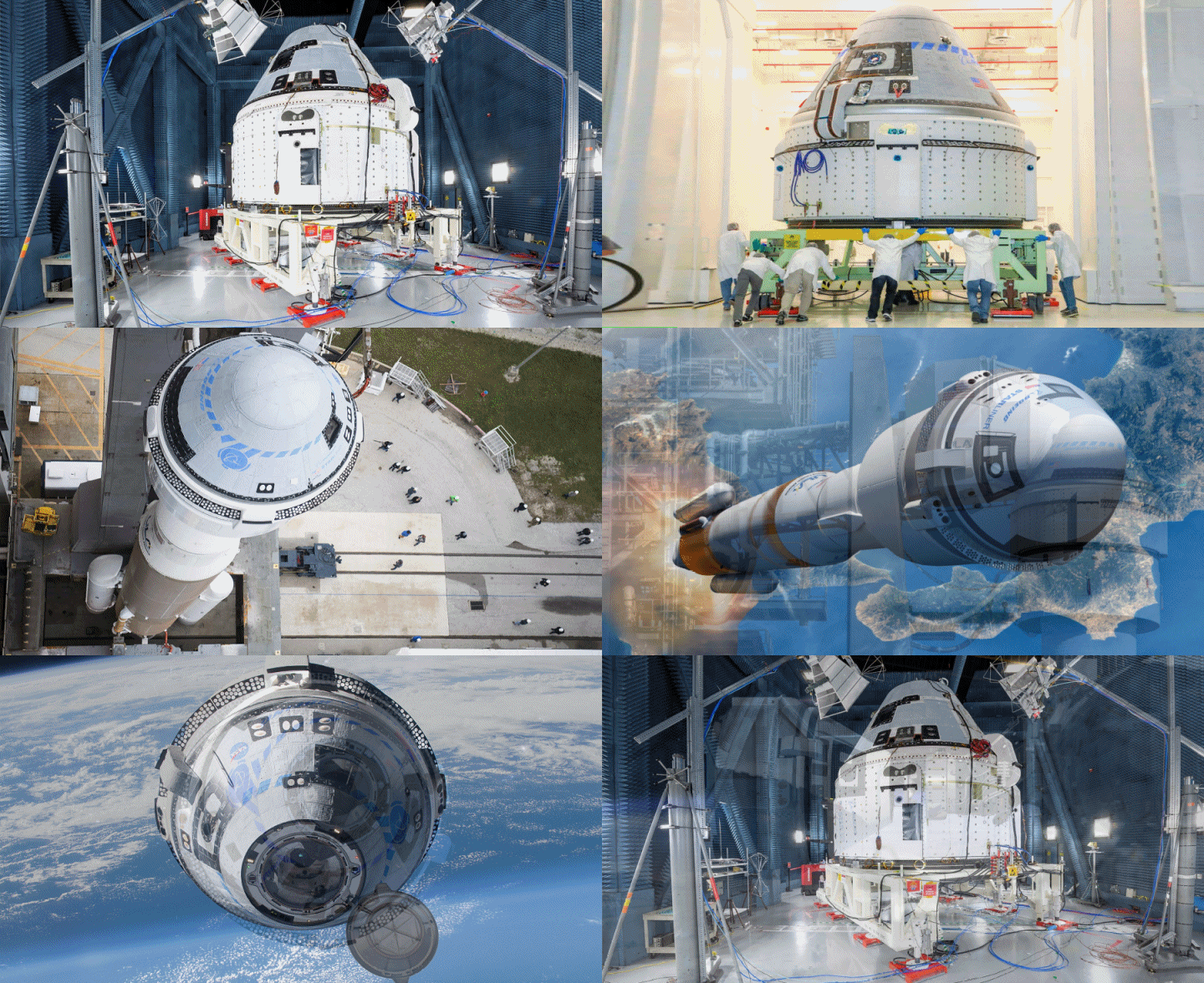
On June 5, a significant event took place in the field of space exploration: Boeing's Starliner spacecraft took off from Florida with two astronauts on board, Butch Wilmore, 61, and Suni Williams, 58. .
This launch, which experienced several years of delays and numerous last-minute postponements, represents a crucial step for Boeing's space program and for NASA.
A Crucial Demonstration Mission
The Starliner docked with the International Space Station (ISS) on June 6, 2024. Initially, the two astronauts' stay was scheduled to last eight days, but it was extended due to technical problems. These complications include propellant issues and helium leaks, problems that required extensive analysis to ensure the safety of the crew and the ship..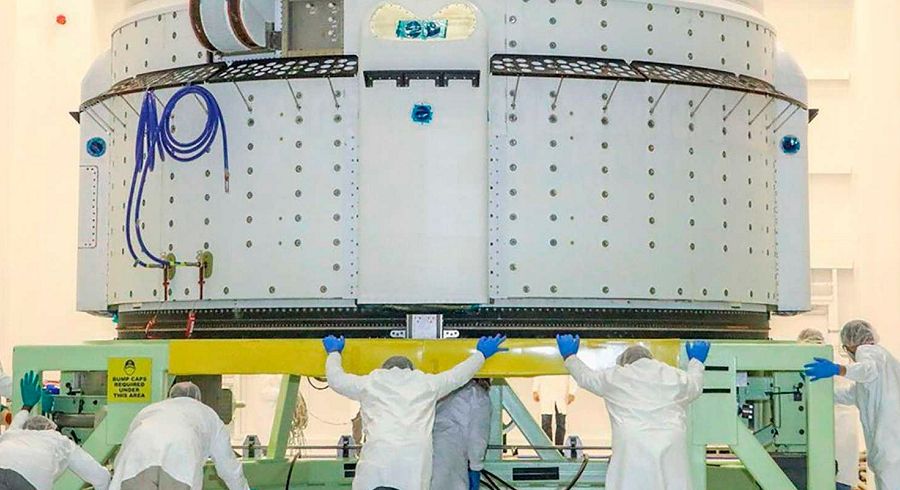
Technical Problems Encountered
Thruster failures and helium leaks caused major concerns. NASA and Boeing had to carry out additional checks to ensure that the spacecraft was ready to return to Earth safely. Steve Stich, a NASA official, said the extra time was needed so teams could "verify the data, do some analysis and make sure we're really ready to go back."
According to Boeing's Mark Nappi, the Starliner's thrusters have finally reached "a good level of performance" and helium leaks "have stabilized and are less significant." These improvements made it possible to set the return date for June 26, 2024.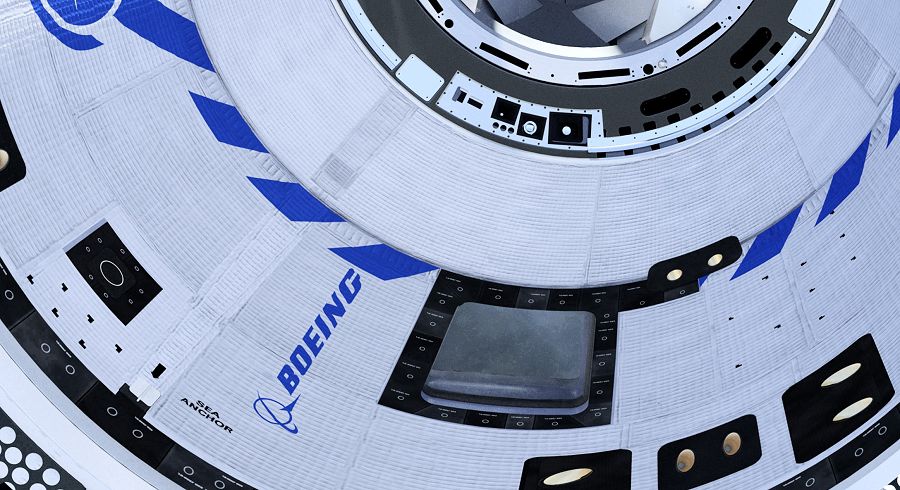 The Return of the Starliner
The Starliner's return is scheduled for June 26 at 02:10 GMT, with a planned landing in New Mexico, in the southwestern United States, at 08:51 GMT. This phase of re-entry into the atmosphere is critical and represents a major technological challenge. The Starliner's heat shield will have to withstand extreme temperatures, reaching around 1,650°C, due to friction with the Earth's atmosphere.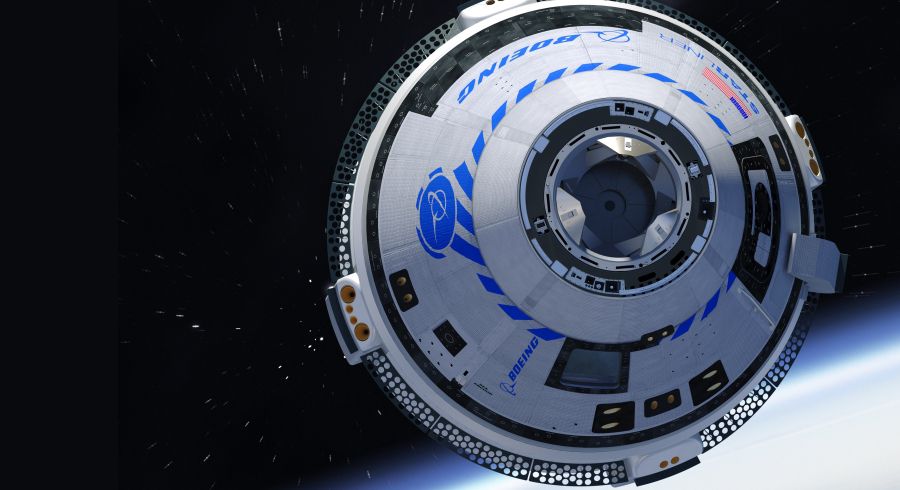 The Challenge for Boeing
This mission is of paramount importance to Boeing. The aeronautics giant, which faces production quality problems in its commercial aviation branch, must prove its ability to carry out manned space missions. A success would strengthen Boeing's position in the space sector and allow NASA to have a reliable alternative to SpaceX for transporting its astronauts to the ISS.
In 2014, NASA signed contracts with Boeing and SpaceX to develop vehicles capable of transporting astronauts to the ISS. SpaceX, with its Crew Dragon capsule, has already successfully accomplished this task and has been carrying out regular missions since 2019. Boeing, on the other hand, has experienced significant delays and technical failures which have pushed back the operational entry into service of its Starliner spacecraft.
A Future Partnership with NASA
Once the Starliner is fully operational, NASA plans to alternate flights between SpaceX and Boeing. However, given the lead SpaceX has taken, it is likely that it will continue to carry out the majority of transport missions to the ISS in the near future. However, the success of the Starliner remains crucial to diversifying space transportation options and increasing competition, which is beneficial for innovation and security in the sector.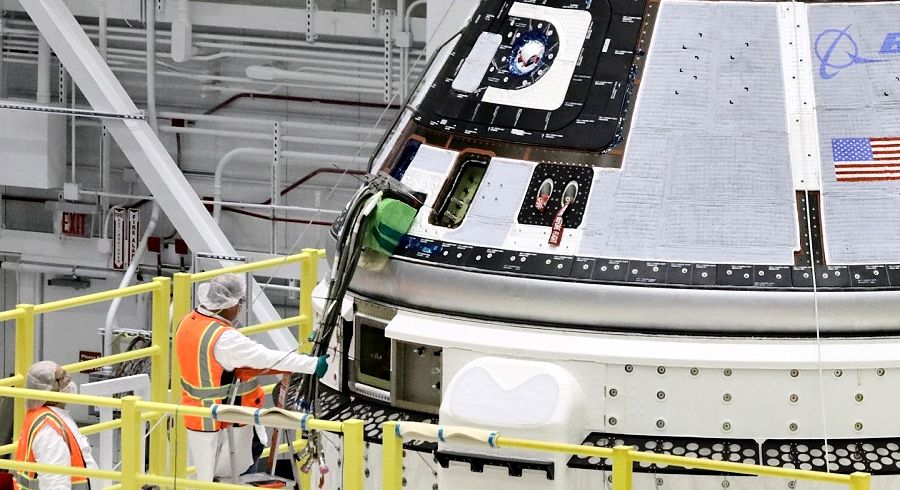
The atmospheric re-entry phase is undoubtedly the riskiest stage of this mission. At high speed, the Starliner capsule will have to penetrate the Earth's atmosphere, experiencing intense friction which generates extreme temperatures. The heat shield is designed to protect the capsule and its occupants from this infernal heat, but any failure at this point could be catastrophic.
The success of this phase depends on many factors, including the accuracy of the trajectories, the perfect functioning of the navigation and control systems, as well as the structural integrity of the heat shield. NASA and Boeing teams have worked tirelessly to simulate and prepare for this critical phase of the mission, hoping to avoid past mistakes.
Consequences for the Space Industry
The success of the Starliner's return will have significant implications for the space industry. Boeing, by proving the reliability of its vessel, will be able to claim a leading role in future manned missions from NASA and other international space agencies. Additionally, the Starliner could be used for commercial missions, providing an alternative to SpaceX for private companies wanting to send crews or payloads into orbit.
The competition between Boeing and SpaceX is also beneficial for the industry in general, as it incentivizes innovation and constant improvement in space technologies. Each company attempts to outperform the other in terms of reliability, cost and efficiency, which ultimately benefits space agencies and consumers of space services.
Future Outlook for Boeing and NASA
Boeing's future in space depends largely on the success of this mission. If the Starliner's return goes as planned, it will mark a major milestone for Boeing and NASA. This will mean that Boeing has overcome technical challenges and is ready to fully participate in manned space missions.
For NASA, having two reliable suppliers for transporting astronauts to the ISS is crucial. This reduces the risks associated with reliance on a single supplier and ensures mission continuity in the event of a problem with one of the ships. Additionally, the diversity of transportation options allows NASA to better plan and manage missions based on availability and specific needs.
The return of Boeing's Starliner spacecraft, scheduled for June 26, 2024, is a key event for the space industry.
After years of delays and technical challenges, this mission represents an opportunity for Boeing to demonstrate the reliability and safety of its vessel.
The success of this mission would benefit not only Boeing, but also NASA and the entire space industry, by increasing competition and providing more flexibility for future missions.
The Advancement and Reliability of SpaceX Machines
Since 2019, SpaceX has played a crucial role as the primary provider of space transportation services for NASA. With its Crew Dragon capsule, SpaceX not only met expectations but also exceeded predictions in terms of reliability and performance. Here are some key points that illustrate SpaceX's lead and how it could influence the space landscape despite the rise of the Boeing Starliner:
The SpaceX Success Story
SpaceX, founded by Elon Musk, quickly gained a reputation as a pioneer in commercial spaceflight. After years of intensive development, the Crew Dragon capsule has been certified by NASA to transport astronauts to and from the International Space Station (ISS). Since beginning operations in 2020, Crew Dragon has accumulated an impressive history of successful missions, establishing a high level of reliability.
Regular Operations Towards the ISS
SpaceX currently provides regular crew transport missions to the ISS, with rotations planned several times per year. This sustained pace allows SpaceX to consolidate its operational expertise and maintain consistency in the provision of space services. This consistency is essential for NASA, which can plan its missions with increased predictability and confidence in SpaceX's ability to meet deadlines and safety requirements.
Continuous Innovation at SpaceX
In addition to its operational reliability, SpaceX continues to innovate with advanced technologies such as the Falcon 9 rocket reusability system, which helps significantly reduce launch costs. This approach has allowed SpaceX to not only become competitive in the commercial market but also to push the boundaries of what is technologically possible in the space industry.
Impact on the Spatial Landscape
Despite the advancements of the Boeing Starliner and its potential to become a major player in the field of human spaceflight, SpaceX remains undeniably ahead in terms of mission volume and proven reliability. This reality could lead NASA to continue to favor SpaceX for the majority of its missions to transport astronauts to the ISS, while integrating the Starliner in a complementary role to ensure redundancy and operational flexibility.
SpaceX's significant advance in human spaceflight, with its Crew Dragon capsule, is a testament to its commitment to innovation and safety.
As the Boeing Starliner takes its first steps toward operationality, it remains to be seen how it will position itself in the competitive landscape against SpaceX. In the meantime, NASA benefits from a diversity of space transportation solutions that enhance its ability to maintain a continuous human presence on the ISS and beyond.
While awaiting the outcome of this mission, all eyes are turned to the sky, hoping for a safe return for the astronauts aboard the Starliner. |
|
|
|
| Paul Emison for DayNewsWorld |
|
FEEDBACK ON THE LAUNCH OF THE MS-27 CARGO | 
The Russian Progress MS-27 cargo ship, carrying essential supplies for the International Space Station (ISS), was launched on Thursday, May 30, 2024 from the legendary Baikonur Cosmodrome, Kazakhstan.
This event, which is part of a long tradition of resupply missions, once again demonstrates the robustness and reliability of Russian space programs. The careful preparation, launch precision and flawless execution of space travel are the result of decades of experience and technical mastery.
Launch from Baikonur
Launch site number 31 of the Baikonur cosmodrome was the scene of this launch. At 12:42 p.m. Moscow time, the Soyuz-2.1a rocket, carrying the Progress MS-27 cargo ship, was launched into space. The Baikonur Cosmodrome, located in the vast steppes of Kazakhstan, is an emblematic site in space history. From the launch of the first artificial satellite, Sputnik, in 1957, to modern missions to the ISS, Baikonur remains a pillar of space exploration.
The Soyuz-2.1a Rocket
The Soyuz-2.1a rocket is a modernized version of the Soyuz launcher, known for its reliability and efficiency. With a height of 46.3 meters and a diameter of 2.95 meters, the Soyuz-2.1a can carry up to 7,800 kg of payload into low Earth orbit. This three-stage launcher uses kerosene and liquid oxygen as fuels for its first and second stages, while the third stage, called Blok I, uses a similar mixture to provide orbital insertion of the cargo craft.
Theft and Separation
Once launched, the rocket followed a precise upward trajectory. Every step of the flight, from engine ignition to jettison of spent stages, was executed with meticulous precision. Separation of the third stage took place without problems, allowing the Progress MS-27 spacecraft to deploy into orbit. The antennas and solar panels deployed correctly, providing the power and communications needed for the remainder of the journey.
The Progress MS-27 Cargo Ship
The Progress MS-27 ship is an upgraded version of the Progress series of ships, designed specifically for resupply missions to the ISS. With a total mass of 7,300 kg, the Progress MS-27 is capable of carrying various types of cargo, including fuel, water, provisions and scientific equipment.
Resupply for the ISS
On June 1, 2024, at 2:47 p.m. Moscow time, the Progress MS-27 spacecraft successfully docked with the ISS. The vessel delivered a total of 2,504 kg of cargo. This cargo included 1,290 kg of devices and equipment for the station's systems, packaging for scientific experiments, clothing, food, as well as medical and sanitary products for the crew. In addition to these items, 754 kg of fuel were provided to resupply the station, as well as 420 kg of potable water and 40 kg of nitrogen.
The Importance of Supplies
Supply deliveries like this are vital to maintaining operations aboard the ISS. The equipment and devices delivered make it possible to maintain and improve the station's vital systems. Food and medical supplies are crucial to the well-being of astronauts and cosmonauts, while scientific supplies are essential for the continuation of the many ongoing experiments. The delivered fuel is used to adjust the station's orbit and for debris avoidance maneuvers, ensuring the safety of the station and its crew.
Crew Members
On board the ISS, an international team of seven astronauts and cosmonauts was ready to receive supplies. Among them are Roscosmos cosmonauts Oleg Kononenko, Nikolay Chub and Aleksandr Grebionkin, as well as NASA astronauts Matthew Dominic, Michael Barratt, Jeanette Epps and Tracy Dyson. Each of these members plays a crucial role in the daily operations and scientific research carried out aboard the station.
Historical and Technical Context
This was the eighth Russian space launch of the year 2024 and the fourth from Baikonur. This flight was also the 68th for the Soyuz-2.1a launcher and the 180th for a Progress family ship in history, including 91 missions to the ISS. These figures illustrate the frequency and reliability of Russian resupply missions, which are key elements of international space logistics.
Russian Space Mechanics
Russian space mechanics are renowned for their reliability and efficiency. Repeated successful launches and dockings without incident reinforce this reputation. The Soyuz-2.1a, in particular, is a launcher whose design dates back several decades but which has evolved over time thanks to continuous technological improvements. This reliability is a source of inspiration and comparison for other space agencies and private companies such as Ariane Espace and Boeing.
The launch of the Progress MS-27 is a perfect example of the synergy between experience, innovation and technology in the Russian space domain. Each resupply mission is a demonstration of the ability of Russian engineers and scientists to sustain complex space operations and contribute significantly to humanity's exploration and use of space. With missions like these, international collaboration in space continues to flourish, ensuring that the ISS remains a premier research laboratory and a base for future deep space exploration.
The Russian Progress MS-27 cargo ship, carrying supplies for the International Space Station (ISS), was launched Thursday, May 30, 2024 from the Baikonur cosmodrome, Kazakhstan.
The Soyuz-2.1a rocket, carrying the Progress MS-27 cargo spacecraft, was launched on Thursday at 12:42 p.m. (Moscow time) from launch site number 31 at the Baikonur cosmodrome.
The Progress MS-27's launch into a given orbit, its separation from the rocket's third stage, and the deployment of the ship's antennas and solar panels proceeded as usual, and smoothly as usual.
The cargo ship will dock with the ISS on June 1 at 2:47 p.m. Moscow time.
The Progress MS-27 delivered 2,504 kg of cargo to the ISS, including 1,290 kg of devices and equipment for the station's systems, packaging for scientific experiments, clothing, food, medical and sanitary products for the crew, 754 kg of fuel for supplying the station, 420 kg of drinking water and 40 kg of nitrogen.
Roscosmos cosmonauts Oleg Kononenko, Nikolay Chub and Aleksandr Grebionkin, NASA astronauts Matthew Dominic, Michael Barratt, Jeanette Epps and Tracy Dyson are currently on board the ISS.
This is the 8th Russian space launch in 2024 and the fourth from Baikonur. This flight was the 68th for the Soyuz-2.1a launcher and the 180th for the Progress family spacecraft in history (91st to the ISS).
One thing is certain, Russian space mechanics are well established, efficient, reliable, which should give food for thought to others (Nasa, Ariane Espace, Boeing, etc.). |
|
|
|
| Paul Emison for DayNewsWorld |
|
STARLINER THE BOEING SPACESHIP
CANCELED FLIGHT | 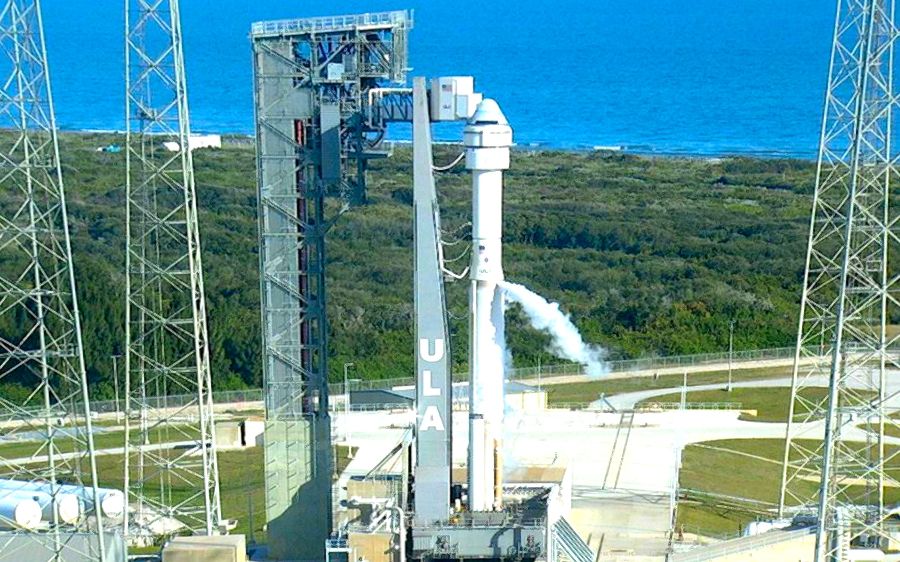
Behind the scenes of the long-awaited launch of Boeing's Starliner, a palpable electric energy permeates Cape Canaveral. Engineers, technicians and astronauts all work with minute precision, aware of the historical importance of this event.
But as tensions rise, a shadow looms over the launch site:
A technical problem compromises the takeoff.
On May 7, 2024, a day that should have marked a major milestone in space exploration, NASA and Boeing were forced to cancel the Starliner spacecraft's first manned flight to the international station.
Just two hours before the scheduled launch time, the dream faded, postponed to May 17, 2024.
The Starliner, designed to transport humans to distant celestial destinations, was to lift astronauts Butch Wilmore and Suni Williams to the ISS.
The preparations seemed impeccable:
The Atlas V rocket was fueled, the weather was clear, and the astronauts were ready to embark on this historic journey.
But technology, so often a source of pride and wonder, chose that day to demonstrate its fragility.
A faulty valve on the Atlas V rocket was identified as the cause of the setback, plunging Boeing and NASA into a race against time.
United Launch Alliance (ULA), the rocket's manufacturer, quickly announced that a new attempt would be considered after careful analysis of the anomaly. But this is not enough to calm the anxious minds of those involved in this mission.
For Boeing, this postponement represents much more than just a delay in the schedule.
It is a crucial test, a last chance to prove the reliability and safety of the Starliner before venturing on regular missions to the ISS.
The aerospace giant has invested years of hard work, considerable resources and immeasurable hopes into this ambitious project. The success of this test mission is therefore vital for the future of the company in the space sector.
But the stakes are just as important for NASA.
For a decade, the US space agency has pinned its hopes on the Starliner, seeking to diversify its options for transporting astronauts to the ISS. With SpaceX as a lead partner in this endeavor, the addition of the Starliner to its arsenal represents a welcome redundancy, providing crucial operational flexibility in the event of an emergency or outage.
Dana Weigel, ISS program manager, emphasizes the strategic importance of having multiple means of transportation to the space station.
She emphasizes that this would make it possible to better respond to various unforeseen scenarios, thus ensuring the continuity of operations and the safety of astronauts.
However, despite the ambitions and efforts made by Boeing and NASA, it is impossible to ignore SpaceX's undeniable dominance in the space domain.
With its Crew Dragon spacecraft already operational and several successful missions to the ISS under its belt, SpaceX has taken a considerable lead in the race to conquer inhabited space.
The postponement of the Starliner launch raises important questions about Boeing's competitiveness in the space sector, as well as NASA's ability to maintain a balance between its various partners.
As SpaceX continues to set new standards in performance and innovation, Boeing faces a significant challenge:
Prove your worth in a cutthroat competitive environment.
Despite these challenges, the very essence of space exploration remains unchanged:
Pushing the boundaries of our understanding, exploring new horizons and achieving the impossible.
Delays and obstacles are an integral part of this daring human adventure, but they must not dampen our resolve to continue our quest for knowledge and discovery in the vast expanses of infinite space.
For the moment, we can only note that only SpaceX, which has a great head start both technically and in terms of reliability, remains the master in terms of launches to get to the international space station. |
|
|
|
| Paul Emison for DayNewsWorld |
|
SPACEX CRUSHES COMPETITION AND EMERGESAS THE UNDISPUTED LEADER IN THE GLOBAL SPACE INDUSTRY | 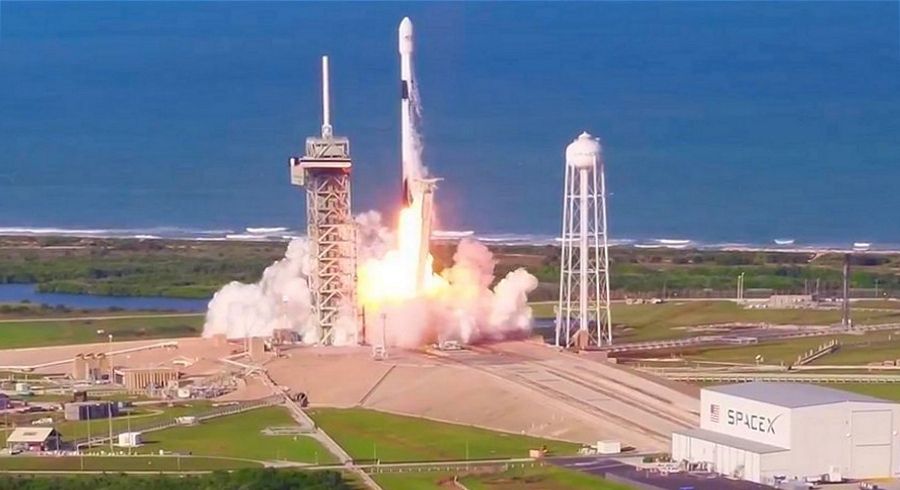 April 27, 2024, will be etched in the history of aerospace as the day SpaceX demonstrated its supremacy by successfully launching two Galileo satellites aboard its Falcon 9 rocket, thereby overshadowing European space pride. April 27, 2024, will be etched in the history of aerospace as the day SpaceX demonstrated its supremacy by successfully launching two Galileo satellites aboard its Falcon 9 rocket, thereby overshadowing European space pride.
SpaceX's Overwhelming Victory:
While Europe's space sector grapples with delays in the Ariane 6 program and issues with the Soyuz and Vega launchers, SpaceX has once again proven its ability to innovate and push the boundaries of space technology. SpaceX's successful deployment of the Galileo satellites highlights the undisputed superiority of American space technology and marks a turning point in space exploration history.
SpaceX has distinguished itself from its competitors with remarkable technological advancements and its ability to achieve previously unimaginable feats. SpaceX was able to complete three rocket launches within 24 hours from three different launch sites, a feat that demonstrates the reliability and efficiency of its launchers. Furthermore, SpaceX has developed technology enabling the reuse of a rocket's core twenty times, a major breakthrough revolutionizing the field of space flight.
SpaceX's resounding success in the space sector extends beyond satellite launches. The American company has also succeeded in developing a reusable space capsule, the Crew Dragon, which was recently used to send astronauts to the International Space Station as part of NASA's Commercial Crew program. This achievement reflects SpaceX's commitment to reducing costs and making space travel more accessible.
Decline of Europe's Space Sector:
Faced with SpaceX's repeated successes, Europe's space sector is experiencing alarming decline. The delay in the Ariane 6 program has left Europe without a means to launch new Galileo satellites, jeopardizing Europe's goal of space independence. While SpaceX continues to achieve remarkable feats in the space sector, Europe is facing significant delays in the development of its own launchers, calling into question its leadership position in the aerospace industry.
Europe's space situation is even more worrying as SpaceX continues to innovate at a rapid pace. The American company has recently developed the Starship technology, a fully reusable rocket capable of transporting passengers and cargo to the Moon, Mars, and beyond. While SpaceX prepares to launch the first manned flights to Mars in the coming years, Europe struggles to launch satellites into Earth orbit.
Challenges for Europe to Overcome:
Despite this setback, Europe remains determined to regain its space sovereignty. A new shipment of two Galileo satellites is scheduled for July 2024, this time aboard the Ariane 6 rocket. However, the delay accumulated by this program raises concerns about its reliability and its ability to meet Europe's needs for access to space. As SpaceX continues to push the boundaries of space technology, Europe must redouble its efforts to develop its own space capabilities and ensure its sovereignty in this crucial domain for its future.
Europe's space sector must also address the challenge of economic competitiveness. While SpaceX offers significantly lower rates than its European competitors, Europe must find ways to reduce its production and operating costs to remain competitive in the global space launch market.
Global Impact:
SpaceX's resounding success in the space sector marks a turning point in space exploration history and raises important questions about the future of Europe's aerospace industry. As SpaceX continues to push the boundaries of space technology, Europe must quickly adapt to remain competitive in an increasingly competitive market. By demonstrating its supremacy in the space sector, SpaceX is paving the way for a new era of space exploration, where innovation and technology will be the keys to success.
SpaceX's success in the space sector also has significant geopolitical implications. As the United States strengthens its position as a leader in space exploration, other powers such as China and Russia are also intensifying their efforts to dominate space. Europe, on the other hand, must find its place in this new space race and ensure its sovereignty in a crucial domain for its future.
The Need to Invest in Research and Development:
SpaceX's success in the space sector reflects the power and capacity for innovation of the American space industry. As SpaceX continues to push the boundaries of space technology, Europe must redouble its efforts to remain competitive in an increasingly competitive market. By investing in research and development, Europe can hope to regain its leadership position in the aerospace industry and ensure its sovereignty in space.
Europe's space sector must also collaborate more closely with the private industry to stimulate innovation and accelerate the development of new space technologies. By encouraging public-private partnerships, Europe can leverage the expertise and experience of space companies like SpaceX to strengthen its position on the global space stage.
SpaceX's resounding success in the space sector marks a turning point in space exploration history and raises important questions about the future of Europe's aerospace industry. While SpaceX continues to push the boundaries of space technology with private funding, Europe's space sector struggles to compete with the spectacular advancements of the American company, despite massive investments from European states and taxpayers.
SpaceX, a private company founded by Elon Musk, has demonstrated unprecedented innovation and efficiency in the space sector. By using private funds and avoiding the bureaucratic burden often associated with public projects, SpaceX has succeeded in achieving remarkable feats, pushing the boundaries of what was previously considered possible in space exploration.
In contrast, Europe's space sector, mainly represented by Ariane Espace, has faced numerous obstacles and delays in the development of its launchers. Despite massive investments from European states, Ariane Espace has been unable to compete with the speed and efficiency of SpaceX, leaving Europe in an increasingly precarious position on the global space stage.
Faced with this reality, Europe must rethink its space strategy and adopt a more agile and innovative approach. By investing in research and development and encouraging public-private partnerships, Europe can hope to regain its leadership position in the aerospace industry and ensure its sovereignty in space.
It is time for Europe to learn from SpaceX's success and adopt a more dynamic and ambitious approach for the future of its space program before it's too late!! |
|
|
|
| Paul Emison for DayNewsWorld |
|
WILL TARDIGRADES COLONIZE THE MOON ? | 
On February 22, 2019, a space probe, that is to say without a crew, was placed in orbit around the Moon with the objective of landing on the moon. It was a first because a private spacecraft had never landed on lunar soil. Additionally, the probe carried tardigrades in a dehydrated and inactive, but viable, form.
Everything was going as planned when suddenly on April 11, the probe experienced a problem with its propulsion as it began its descent. The speed was too great to slow down enough so that it crashed at over 3,000 km/h into our satellite
What happened to the tardigrades after the crash ? Are some still viable, buried under regolith, lunar dust whose depth varies from a few meters to a few tens of meters ?
Animals proof against almost anything
Tardigrades, these tiny creatures, occupy a unique place in the animal kingdom. Their size of less than a millimeter in no way reflects their remarkable complexity. Equipped with two eyes and a neuronal structure, they also have a mouth orifice at the end of a retractable proboscis, an intestine housing a microbiota, and four pairs of legs devoid of joints but equipped with sharp claws.
Their relationship with arthropods, such as insects and arachnids, is undeniable, testifying to a common evolutionary past.
Although most tardigrades live in aquatic environments, their presence is felt in all environments, including the most inhospitable of urban areas.
These beings fascinate mainly because of their incredible ability to withstand extreme conditions, far surpassing those encountered on Earth or the Moon. They can suspend their metabolism, losing up to 95% of their body water without apparent harm.
Some produce trehalose, an antifreeze sugar, while others synthesize proteins that transform cellular constituents into a glassy matrix, providing vital protection.
Dehydration causes a dramatic reduction in their size, sometimes up to half, with the legs disappearing, leaving only claws.
In this state, called cryptobiosis, they patiently wait for more lenient conditions to return to life.
However, specimens vary in their ability to withstand this desiccation, and not all are capable of resuscitation. Adult tardigrades can survive several minutes at extreme temperatures, reaching up to –272°C or 150°C, and are resistant over the long term to gamma ray doses of up to 1000 or 4400 Gray (Gy) , depending on the species. This unparalleled ability to survive defies the limits of biology and continues to amaze scientists to this day.
But difficulties...to survive
First of all, they must have survived the impact. Laboratory tests showed that frozen specimens of the species Hypsibius dujardini were intact after a vacuum impact at 2600 km/h on sand but were mutilated above 3000 km/h.
They must then resist the absence of water and withstand a cold of –170 to -190°C during the lunar night and a heat of 100 to 120°C during the day. A lunar day or night lasts a long time, a little less than 15 Earth days. Even the probe was not designed to withstand such amplitudes and had to cease all activity after only a few Earth days.
Finally, the surface of the Moon is not protected from solar particles and cosmic rays, particularly gamma rays. But there the tardigrades would be able to resist. Indeed, Robert Wimmer-Schweingruber, Professor at the University of Kiel in Germany, and his team showed that the doses of gamma rays striking the lunar surface were permanent but low compared to the doses cited previously. According to him, 10 years of exposure to gamma rays would correspond to a total dose of around 1 Gy.
Regardless, without water, oxygen or microalgae, the tardigrades will never be able to reactivate. Thus the colonization of the Moon by these animals is impossible. But specimens are on lunar soil and their presence raises ethical questions, as Matthew Silk, an ecologist at the University of Edinburgh, points out. Among these questions, there is one on the scientific level.
At a time when space exploration is taking off again in all directions, will contaminating other planets make us lose the possibility of looking for extraterrestrial life ?
|
|
|
|
| Kelly Donaldson for DayNewsWorld |
|
PSYCHE MISSION ON THE METAL ASTEROID
SCIENTIFIC ADVANCE AND COMMERCIAL INTEREST
IN A LEGAL FRAMEWORK TO BE DEFINED | 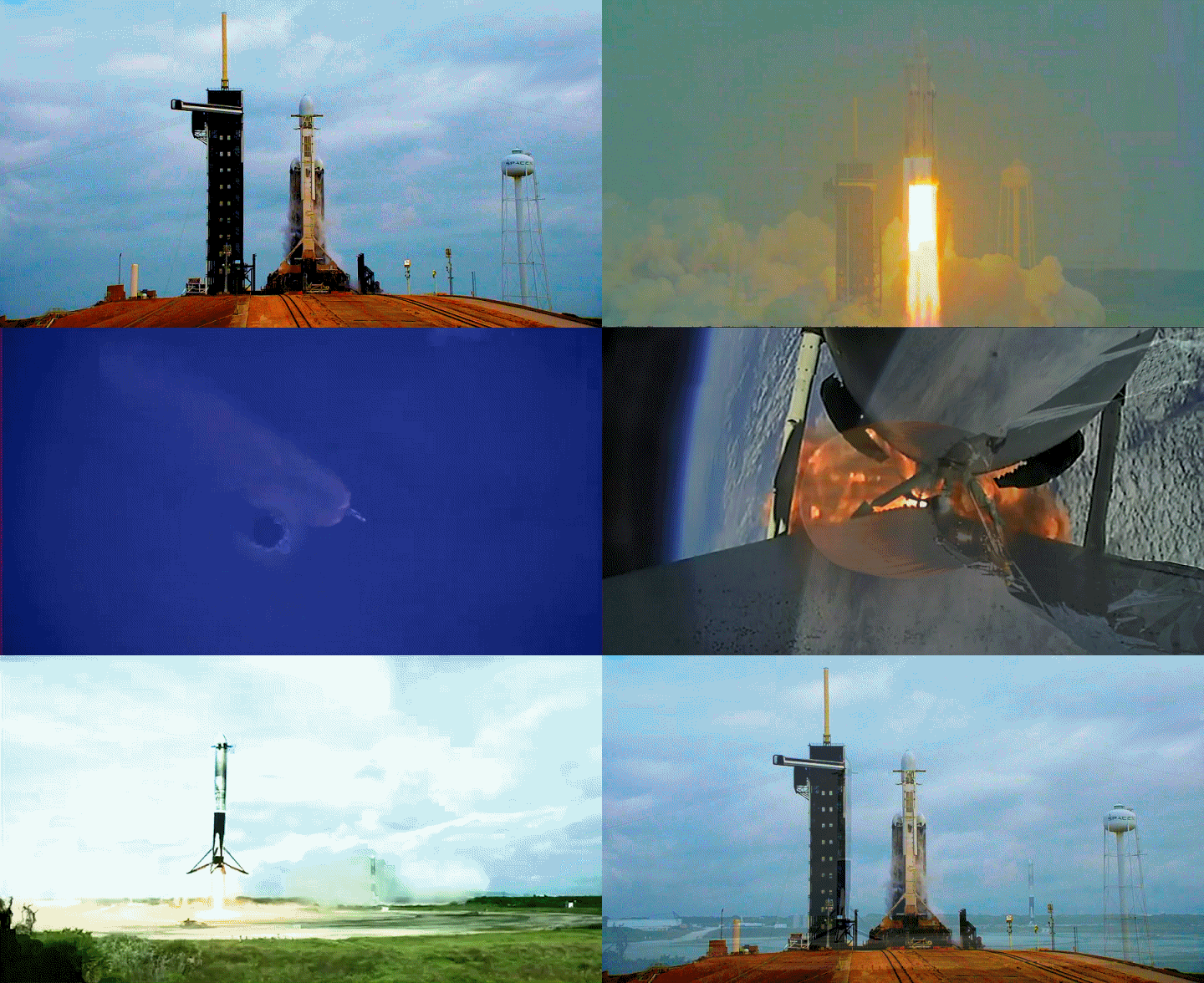
Initially scheduled for October 5, 2023, the launch of the probe was postponed by a week in order to check the proper functioning of the small thrusters equipping the device. Laurie Leshin, director of NASA's Jet Propulsion Laboratory, stressed the importance of these devices, although they are not the main propulsion system, they are crucial, especially right after launch, to ensure their reliability when they are launched. required. These thrusters will help the device to orient itself correctly in relation to Earth.
Powered by two large solar panels, the probe will be propelled by four ion engines expelling xenon at high speed, ensuring a six-year journey. In May 2026, Psyche will receive a gravitational boost from the planet Mars before heading towards the asteroid belt between Mars and Jupiter.
Why return to observe an asteroid when the Japanese Hayabusa-2 and American Osiris-REx missions have already collected numerous data on two of these celestial bodies, Ryugu and Bénou, and brought back samples? Because the term "asteroid" actually encompasses a whole diversity of stars, and Psyche, the target of NASA's mission, differs considerably from its counterparts.
First by its size:
This 280 km diameter asteroid is worth so much because it is one of the “M-type” asteroids, meaning it is mainly composed of metals.
Then, by its composition: Psyche is made up of nickel, iron and gold. This type of asteroid is quite rare in our solar system and could allow us to answer many questions about the origin of planets like Earth, which is why NASA is sending a space probe to Psyche this Friday October 13, 2023.
Studying the heart of our planet
The main interest of this mission is to collect as much information as possible on this stellar object, similar to the earth's core. All rocky planets, including Earth, have a metallic core, but we still know little about ours due to access limitations imposed by extreme heat and pressure. Jules Verne's novel “Journey to the Center of the Earth” unfortunately remains pure fiction.
This makes it easier for scientists to observe Psyche and her exposed heart. “One of the existing theories is that it was in the bowels of a forming planet,” explains David Oh, engineer and project manager at NASA's Jet Propulsion Laboratory. "Psyche may have been the metallic core that was forming inside a baby planet, which then collided with another planet, which tore away that rocky mantle, leaving only a piece of that core in the 'space ".
So by studying Psyche, scientists could study the Earth's core of planets like ours in detail for the first time. Even more, since scientists assume that these are the remains of a planet from the beginning of our solar system, the information collected could shed light on how planets formed.
In particular, since scientists assume that Psyche is a remnant of a planet from the early days of our solar system, the data collected could shed light on the process of planetary formation. This will be the first exploration not only of an asteroid of this type, but also of a whole new world made of metal.
A value of 10,000 billion dollars
While the contribution to science promises to be enormous, the commercial attractiveness and legal framework of these new missions for the exploration and exploitation of space resources still raise questions.
Although this mission is primarily scientific in scope, the value of the asteroid could arouse envy and trigger a gold rush.
With a diameter of around 220 km, the asteroid Psyche could indeed represent a value of 10,000 billion dollars (or approximately 9,534 billion euros), according to estimates relayed by the American magazine Forbes.
This exceeds the accumulation of global economies, sparking keen interest and raising questions about the exploitation of space mining resources to compensate for the scarcity of certain metals on Earth. In addition, many H-type asteroids, which have a much higher metal composition than that of Earth, are found in abundant quantities.
A sector already very invested
The senators of the foresight delegation underline in a report published in June that the exploitation of space resources is no longer a science fiction scenario, but a reality.
Players, particularly from the private sector, are already mobilizing to position themselves on this future market. The sector is not at the embryonic stage since players, particularly in the private sector, are already working to ensure a place on this (future) market. Especially since the hope of exploiting minerals from space is fueled by the latest scientific advances. For example, the Osiris-Rex mission returned to Earth in September with 250 grams of samples from the asteroid Bennou, the largest quantity of such a celestial body ever reported on our planet.
At the beginning of the 2010s, American companies set the ambition to achieve this. Google executives Larry Page and Eric Schmidt, as well as Avatar director James Cameron, invested in one of these companies in 2012. The Duchy of Luxembourg also acquired, in 2016, 10% of one of these start-ups. The blow was over in 2018.
Some companies in the sector have gone bankrupt or been bought out to reorient themselves towards other space domains. Recent scientific advances fuel hopes of exploiting minerals from space. Companies like AstroForge in the United States, Asteroid Mining Corporation in the United Kingdom and ispace in Japan are positioning themselves as pioneers of this movement.
The American company AstroForge is increasing its tests with autonomous prospecting space robots in order to exploit extraterrestrial resources. It hopes to be able to launch its first real mission at the end of 2025 and bring it back to Earth by 2030, Matt Gialich, co-founder of the start-up, told the American channel CNN in April. AstroForge claims to have 31 platinum-rich asteroids in its sights
The essential stage of the moon
With the signing of the Artemis Accords in 2020, providing for a human return to the Moon, the installation of a base and the exploitation of its resources, the prospect of exploiting extraterrestrial minerals has become more concrete."The Moon, c is clearly the essential step" before going further in the exploration of Mars and exploiting celestial bodies, summarizes Florian Vidal, recalling that the return to our natural satellite gives rise to a new global race involving China , Russia, India and the United Arab Emirates.
However, technological, financial and legal challenges remain, particularly regarding the repatriation of minerals to Earth. Some experts suggest exploiting asteroid resources there for scientific purposes. This could be used to power probes to extend their lifespan . For example, the Juice mission, which left in mid-April to explore the icy moons of Jupiter. The resources could also be brought back to our planet.
The urgency of the legal framework
Alongside technical and scientific considerations, there is the thorny question of ownership of resources from space. But is it even possible to take over an asteroid ?
On this, Armel Kerrest, professor of space law and vice-president of the ESA European Center for Space Law, is categorical: “On a legal level there are rules which were set in the 1967 treaty , which provides that celestial bodies cannot be the subject of appropriation.”
Several countries, such as the United States, Luxembourg, Japan and the United Arab Emirates, have adopted texts to regulate these activities. China, Russia and even Saudi Arabia are also in the starting blocks.
Indeed, the treaty stipulates that “outer space, including the Moon and other celestial bodies, cannot be the subject of national appropriation by proclamation of sovereignty, nor by way of use or occupation , nor by any other means".
On a global scale, these legal questions "must be addressed urgently in order to avoid space wars for natural resources, estimates Ifri in a note from May 2023. These questions should ideally be resolved before embarking on mining and energy exploitation of space." |
|
|
|
| Larry Ricky for DayNewsWorld |
|
SPACEX DISAPPEARANCE OF 212 SATELLITES
|
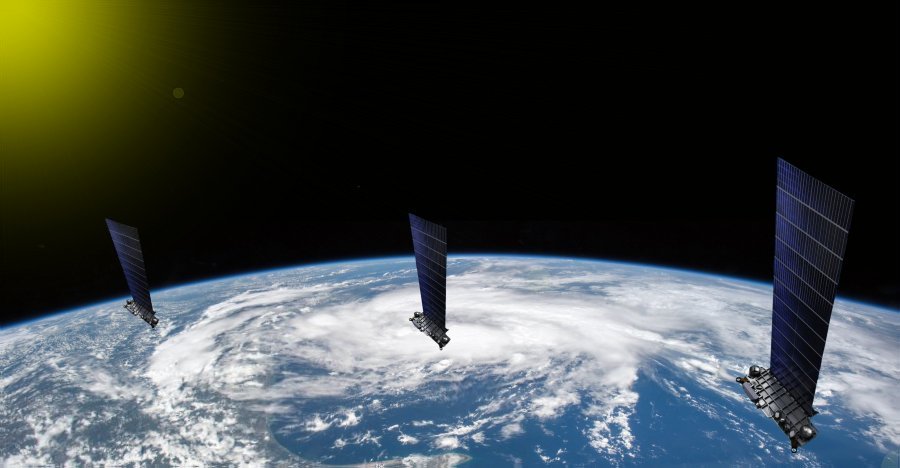
SpaceX, Elon Musk's visionary company, is currently at the heart of a growing concern. Over the past few months, troubles have been piling up, with the inexplicable disappearance of 212 satellites from the Starlink constellation, a high-profile project intended to provide high-speed Internet access through thousands of satellites in low orbit around the Earth.
Starlink, which has long been SpaceX's flagship, seeks to eliminate digital deserts by bringing good web connectivity to underserved areas. While the company launched its Starlink V2 satellites to great fanfare in March, others simply seem to evaporate into the skies.
A mysterious escape
For three years, SpaceX has regularly reported satellite losses, but this time the disappearance peaked between July 18 and September 18, 2023.
Some experts question the reliability of this data, particularly that accessible in real time on sites such as Satellite Map
However, figures from public sources like space-track.org support these statistics. For the moment, SpaceX has remained silent about these losses, leaving doubt as to their nature: are these losses planned as part of the Starlink project, or are they the result of technical failures?
Technology or natural phenomenon, who is the culprit ?
It is important to note that the satellites in the Starlink constellation are not intended to last indefinitely. SpaceX predicted a lifespan of approximately five years for these satellites, before their natural disintegration in the Earth's atmosphere. Since the inaugural launch in 2019, more than 5,000 satellites have been put into orbit, of which 4,500 are still operational.
Another factor, in addition to technical failures, must be taken into account: solar activity and its potential electromagnetic disturbances. Satellites are particularly vulnerable to these phenomena, and this summer the Sun has been particularly turbulent, generating intense solar storms.
This could provide part of the explanation for the mysterious disappearances.
Already last year, Starlink admitted the loss of 40 satellites due to violent solar winds. It is therefore possible that this new series of disappearances is attributable to the same causes. SpaceX will certainly have to provide clarification in the coming weeks, but for now, the mystery remains intact.
The situation that currently concerns SpaceX cannot be underestimated.
The eyes of the world are now on SpaceX, eagerly awaiting answers to these cosmic riddles. |
|
|
|
| Paul Emison for DayNewsWorld |
|
TRIP FOR THE NIGHT OF THE STARS
|
|
First arrival at McClellan-Palomar airport (KCRQ) is 4:05 local time.
Here is our little team Luc our pilot, scientific expert and journalist, Joanne and me (Mia) journalists for our expedition to Mount Palomar almost arrived at their destination finally almost !
Problem the keys of the helicopter that Luc must then use are not there !
Whoever dropped off the Bell 206 left with it by mistake.
So we're going to rest in the jet, the keys will be the subject of a short round trip to San Diego airport which is not far from here.
Second arrival we are in final 24 on McClellan-Palomar (KCRQ) with a turbulent crosswind, my photo taken with my smartphone is not my best !
Satisfaction all the same because undoubtedly the Mont Palomar awaits us, to us the stars !
After a telephone contact we are authorized to land near the observatory to leave the standard landing zone (zone H) free in case another helicopter needs to come on site.
Before installing on board the Bell 206, Luc as a good Pilot weighs everything!, because there are three of us on board plus the equipment and in the event of overweight, safety would be engaged.
Yes hard for me because my wardrobes will stay in the jet, but that's the price of safety. .
Takeoff and after a short flight here we are at Mount Palomar.
As soon as we arrived, at work, but what a joy to be there, what an unobstructed view of a cloudless blue sky that promises us success.
We have installed photo equipment outside to do astrophotography. Night falls with it, the magic of the stars begins.
In turn we go to the observatory to look at the wonders of the sky through the telescope.  
 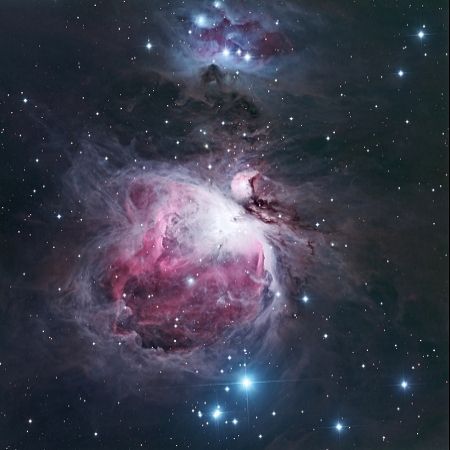
I I
I attach to this article some photos taken on the spot but, for technical reasons on our online newspaper it is not possible to deposit high resolution versions, part of our readers are with smartphones, others with a connection not top..... 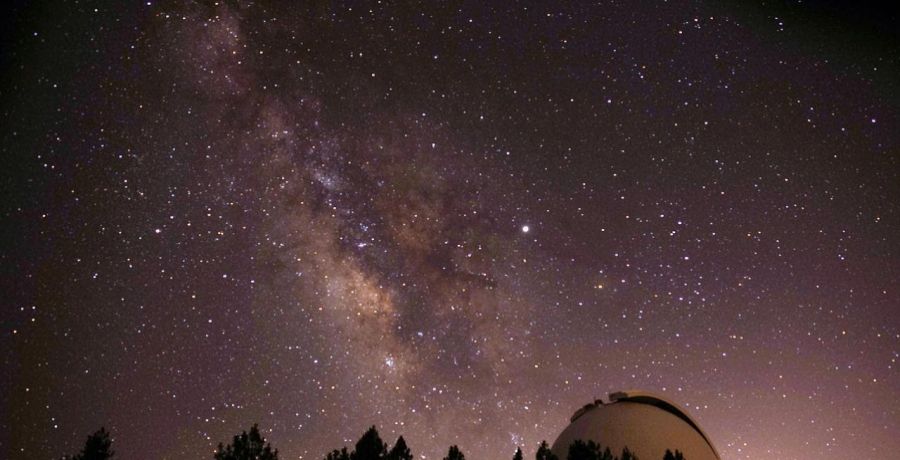
 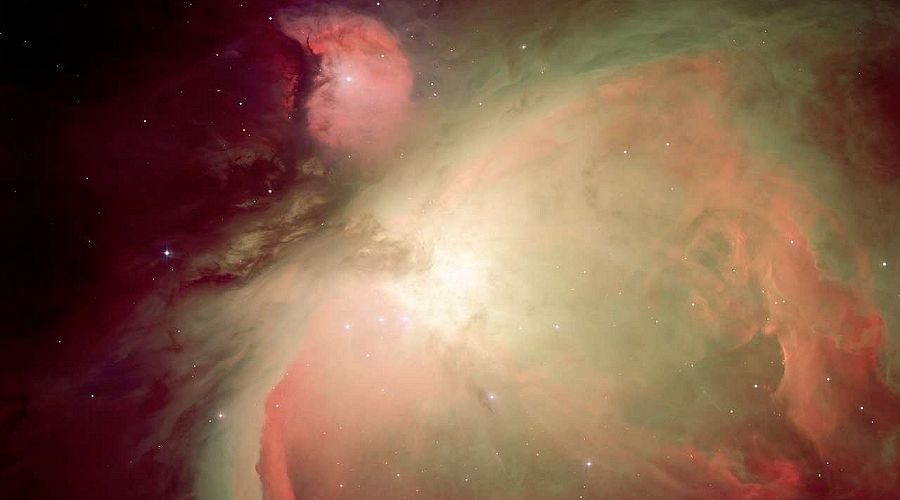 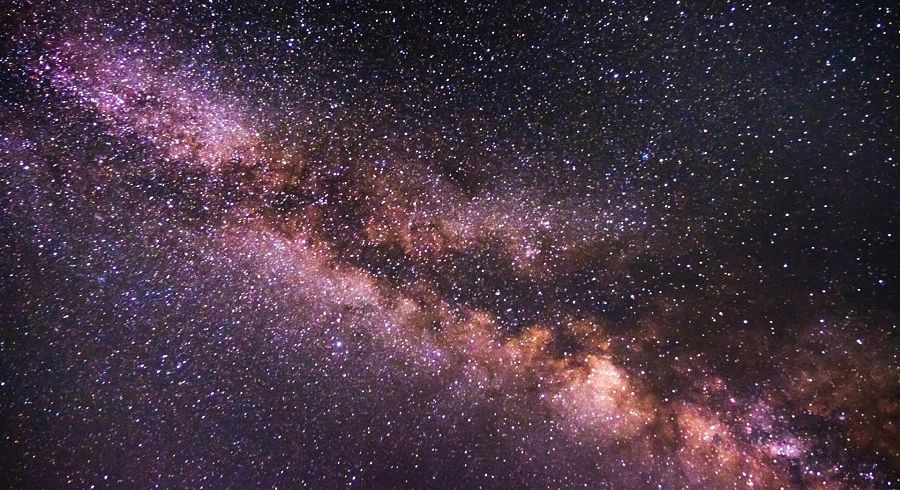 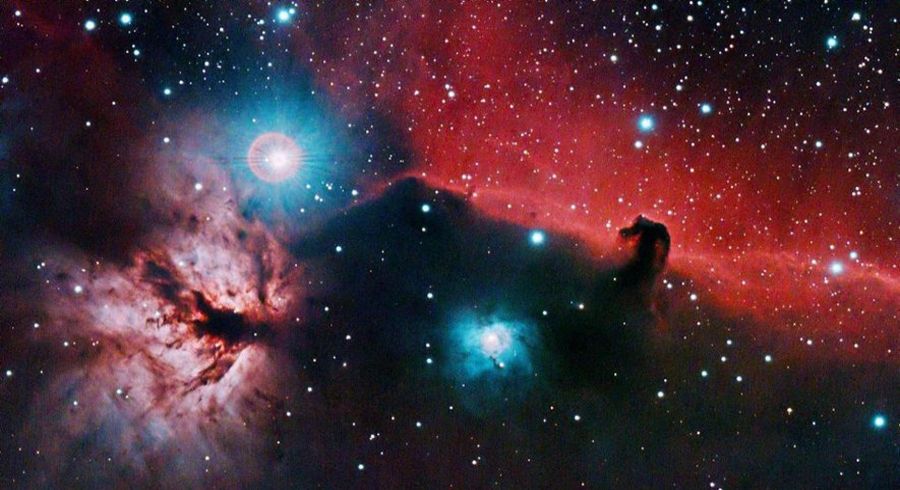
However, I hope you will be amazed by the beauty of the sky and the stars, the images speak for themselves.
We would like to thank the whole team who received us and welcomed us so well and without whom our expedition would not have been the same.
I am composing this article on my laptop sitting in the back of the jet, hoping that this expedition carried out for you, our readers, will make you discover a starry sky which is too often invisible to citizens living in cities where observation is almost impossible. |
|
|
|
| Mia Kennedy / Joanne Courbet / Luc T for DayNewsWorld |
|
THE STARLINER SHIP WILL BE READY
IN MARCH ANNOUNCEMENT BOEING | 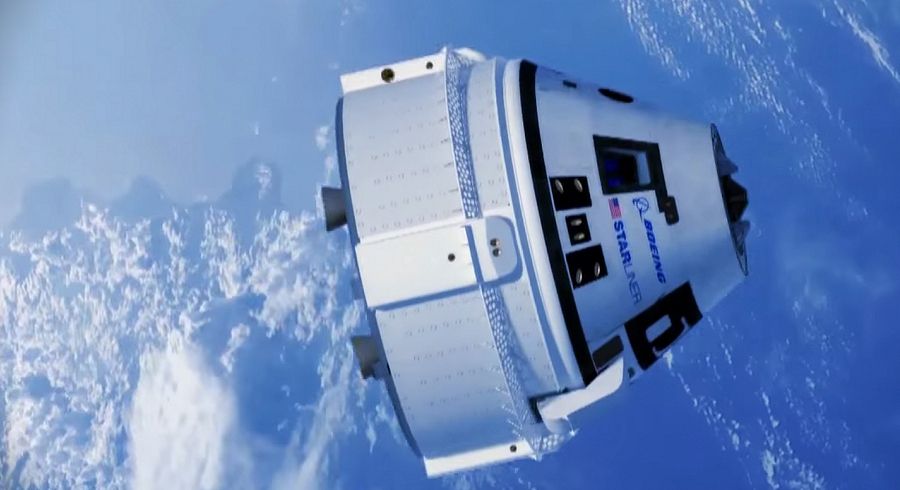
In the endless quest for the stars, the iconic American company Boeing continues to push the limits of innovation and space technology with its Starliner spacecraft.
Although the road has been rocky, there is no denying that the determination and commitment of the Boeing team has paid off, offering a ray of hope for future space travel.
Indeed, several challenges emerged during the development of the capsule, but this series of trials only reinforced Boeing's determination to meet these challenges with flying colors.
Recent developments indicate that the Starliner spacecraft should be fully operational by March 2024, according to recent company statements in August.
Mark Nappi, the program manager at Boeing, cautiously pointed out that setting a precise lift-off date has yet to be determined, due to variable factors such as the opportunities offered by the United Launch Alliance (ULA) industry group for the launch of the rocket, as well as the availability of seats on board the International Space Station (ISS).
As an essential partner of NASA, Boeing aims to meet the ambitious mission of providing a second provider for the transport of astronauts to the ISS, in addition to the services of SpaceX which have been used successfully since 2020.
The importance of diversifying transportation options to the ISS is a priority for NASA, helping to ensure reliable and continuous access to this crucial space station.
After an unsuccessful test flight in 2019, Boeing's Starliner capsule finally successfully crossed the threshold of the ISS in May 2022, ushering in a new era of exploration and opportunity.
Although this flight was unmanned, it marked a crucial step towards the spacecraft's final certification for manned flight.
Boeing is about to perform a decisive manned test to obtain this certification, before diving into its long-awaited operational missions.
The inevitable delays experienced by Boeing have been a source of continuous learning and development for the team.
The most recent hurdle, announced last June, was twofold. On the one hand, it was to perfect the parachutes that play a vital role in slowing the capsule down on its return to Earth.
Boeing experts have shown ingenuity in modifying the design to ensure optimal robustness, and a crucial test is scheduled for November to validate these improvements.
Passing this test is essential for the progress of the program and to ensure the safety of the astronauts.
On the other hand, a challenge related to the capsule's internal electrical cables was also diligently met. The tape used for the cables was found to pose a flammability hazard, requiring careful re-evaluation.
Boeing experts responded quickly by removing a substantial amount of tape and putting in place appropriate protective measures. This move demonstrates Boeing's unwavering commitment to crew safety and the reliability of its spacecraft.
Joel Montalbano, NASA's program manager, emphasized the critical importance of the Starliner vehicle to the future of the space station.
This spacecraft represents a major step in NASA's space strategy, with ambitious plans for its first manned flight.
The Starliner's maiden voyage will carry astronauts Barry Wilmore and Sunita Williams to the ISS, where they will settle for a week-long mission. Liftoff will take place from scenic Cape Canaveral in Florida, symbolizing a new and exciting chapter in the history of space exploration.
In sum, the challenges Boeing overcame in developing the Starliner spacecraft have carved a history of resilience, innovation and perseverance.
Lessons learned from each hurdle have reinforced Boeing's resolve to deliver a safe, reliable and innovative space transportation solution for years to come.
With continuous efforts and strong collaboration with its partners, Boeing is poised to write a new chapter of thrilling space adventures, leaving a lasting mark in the exploration of the infinite cosmos. |
|
|
|
| Luc T. for DayNewsWorld |
|
EXTREME SOLAR STORM
RISK OF BLACKOUT FOR SEVERAL DAYS | 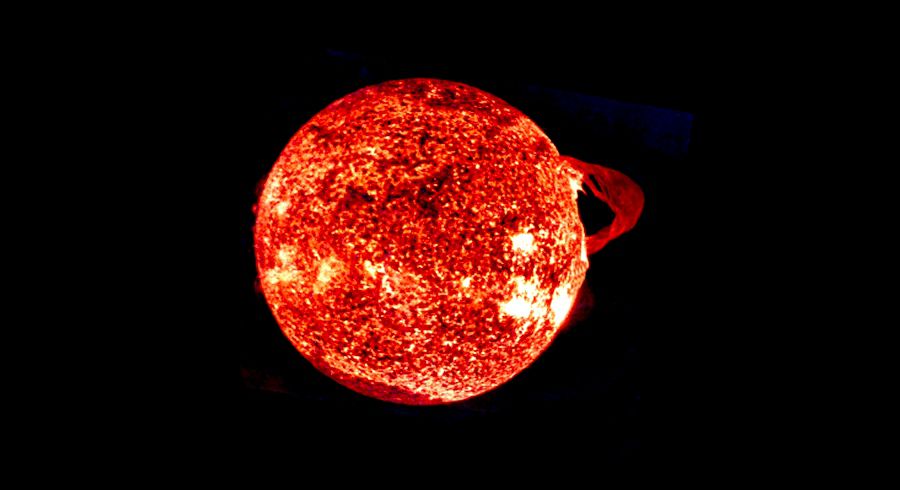
Beyond our atmosphere, the Sun rumbles with terrifying power, capable of unleashing solar storms of fearsome intensity.
These storms, though rare, could wreak devastating havoc if our modern civilization is not prepared to face their fury.
Scientists are sounding the alarm as a solar storm of unprecedented magnitude, unseen in 200 years, threatens our interconnected world.
A joint study by the University of Reading and Apollo Academic Surveys found that 90% of 144 experts consulted believed that without an accurate space weather forecast, Earth would be exposed to massive damage in the event of a solar storm.
These events, as powerful as the historic Carrington storm in 1859, could occur with increasing frequency, surpassing even the largest storms of the past two centuries, with potentially disastrous consequences for our infrastructure and technologies.
The Carrington Event, a cataclysmic solar phenomenon, had plunged the world into darkness, massively disrupting telegraphy networks and illuminating the night sky with glorious auroras visible across the globe.
According to specialists, a similar scenario could repeat itself in the next 10 years, posing a serious threat to our civilization, which is highly dependent on electricity and communications.
The urgency of adequate preparation is undeniable, as a lack of appropriate measures would lead to widespread power cuts for several days.
Dr Luke Barnard, a space weather expert at the University of Reading and co-author of the survey, highlighted the potentially devastating consequences of such blackouts:
"Imagine without electricity for several days. Transport, communication, essential services would be paralyzed. Our modern way of life would be put to the test".
The consequences would not just be limited to terrestrial infrastructure, as solar storms can also cause critical malfunctions in space.
Satellites, which play a vital role in GPS navigation, telecommunications, weather forecasting, and other vital areas, could be damaged, causing major disruption to our communication and geolocation systems.
Scientists denounce the lack of precision of current space weather forecasts, which do not allow adequate anticipation of major solar storms.
To remedy this shortcoming, they recommend the deployment of constellations of satellites closer to the Sun, in order to obtain more precise measurements of the solar wind, responsible for storms.
Faced with this imminent threat, the researchers stress the importance of increased international collaboration in space surveillance and the establishment of emergency backup systems to deal with power outages.
Coordinated and effective preparation could prove vital to protect our connected world and avoid a prolonged blackout with potentially catastrophic consequences.
In a world where technology and communications are everywhere, such an extreme solar storm could shake our modern society, reminding us of our vulnerability to the powerful and unpredictable forces of the universe.
Preparing to face this eventuality therefore becomes an absolute priority to ensure the stability and resilience of our hyperconnected world. |
|
|
|
| Pamela Newton for DayNewsWorld |
|
"SCIENCE" OR "NATIONAL SECURITY"
THE EXISTENCE OF UFOS INFLATE AMERICA | 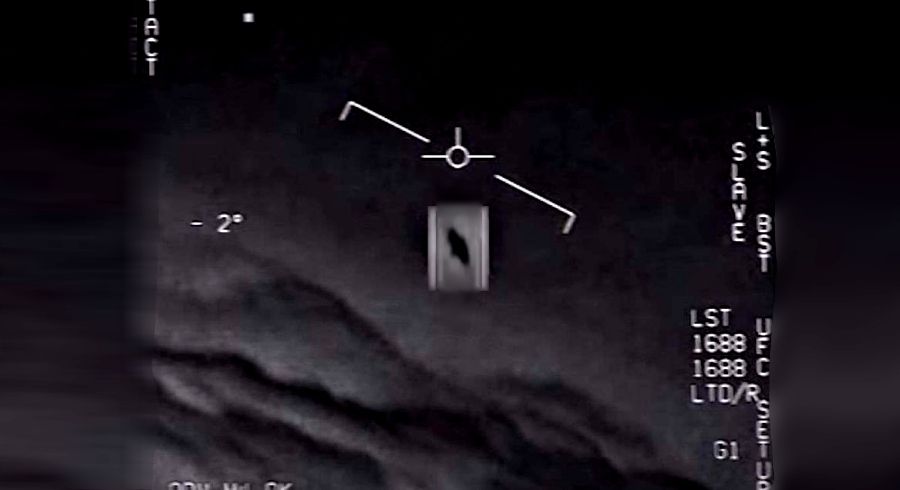
What if we weren't alone in the universe ?
In recent years, ufological studies have experienced unprecedented enthusiasm, fueled by the courageous testimony of many "whistleblowers" who have seized the opportunity of digital transparency to share their revelations in broad daylight. These testimonies, striking in many respects, have now acquired greater credibility.
Congress itself conducts hearings, highlighting the testimonies of fighter pilots confronted with very real and recurring incidents.
During a hearing before a committee of the United States Congress on Wednesday, July 26, 2023, Mr. David Grusch, a resigning former agent of the National Geospatial Intelligence Agency, having elected "whistleblower" status, maintained that our governments concealed many realities from us... "We are not alone in the universe, and the authorities hide the evidence of the existence of extraterrestrials, including the remains of an unidentified object, affirmed Mr. Grusch, emphasizing being "absolutely" convinced that the United States has a UFO.
Colonel decorated during the war in Afghanistan, David Grusch spent 14 years of his life within the National Geospatial Intelligence Agency (NGA) under the aegis of the American Department of Defense. From 2019 to 2021, he was a member of a team responsible for investigating UFOs, then appointed co-head of the Agency for the analysis of "unidentified aerial phenomena", a term officially used by the American authorities. During this period, he had access to images captured by American air pilots, revealing objects with "unknown characteristics".
Last April, David Grusch left the Ministry of Defense to start a "whistleblower" procedure.
This procedure forced him to hand over to the ministry his classified documents intended for the American Congress.
On July 26, 2023, before this national institution, he confirmed his sensational comments previously made on television:
"In the course of my duties, I learned that there was a program (...) aimed at recovering the remains of an unidentified device and analyzing it. This testimony is based on information that I were passed on by individuals with a proven track record of legitimacy and service to this country, and many have provided me with compelling evidence, in the form of photographs, official documents and classified oral testimony."
Decades of observation, including military
Awaiting evidence, remain the disturbing testimonies of two other witnesses called by Congress:
David Fravor, ancien commandant de la marine, et Ryan Graves, ancien pilote. Ryan Graves n’a pas hésité à exhorter la représentation à "mettre de côté la stigmatisation et à aborder le problème de sécurité et de sûreté que ce sujet représente", faisant aussi part des "multiples rencontres" expérimentées par plusieurs pilotes lors de vols d’entraînements.
"Si les ovnis sont des drones étrangers, c’est un problème urgent de sécurité nationale ; s’il s’agit d’autre chose, c’est un problème pour la science.
Dans les deux cas, les objets non identifiés sont une préoccupation pour la sécurité des vols", a-t-il aussi déclaré.
En avril, Sean Kirkpatrick, le responsable du service du Pentagone chargé d'enquêter sur ces phénomènes et les risques qu'ils posent pour la sécurité nationale, avait quant à lui assuré qu'aucun signe d'activité extraterrestre n'avait été recensé.
Le bureau "n'a détecté aucune preuve crédible d'une activité extraterrestre, de technologie non terrestre ou d'objets défiant les lois de la physique", avait-il affirmé.
Le gouvernement américain prend, toutefois, au sérieux ces phénomènes et la Nasa a récemment appelé à davantage d'efforts pour les étudier scientifiquement, tout comme le Pentagone qui, lui, s'inquiète de possibles activités d'espionnage chinoises.
Un certain nombre de cas déroutants
In the United States, these phenomena have been analyzed very closely since the 1940s, various projects having been set up over time, the best known being Grudge, Blue Book and the Condon report. Blue Book thus allowed the examination of 10,147 cases of which 9,501 were explained.
Of the 3,201 cases retained for the final statistical analysis, the confirmed but still unexplained cases represented a total of 22% of the total.
In July 2020, scientist Ravi Kopparapu and astrobiologist Jacob Haqq-Misra, both working for NASA, wrote in Scientific American magazine about the need to revisit the conclusions of the report that ended the "Blue Book" project, considering that "beyond military aircraft and strange weather formations, there are still a number of truly puzzling [unidentified anomalous] cases that might be worth investigating."
A little later, an assessment, mandated by the United States government, was published on June 25, 2021 just after Barack Obama said "there are images and recordings of objects in the sky, which we do not don't know exactly what they are".
This report was compiled by the Unidentified Aerial Phenomena Task Force and consisted of 144 sightings of unidentified phenomena between 2004 and 2021. Of these 144 phenomena, 18 exhibited objects with "unusual flight characteristics" and "appeared to remain stationary in winds aloft, moving against the wind, maneuvering suddenly or moving at considerable speed, without discernible means of propulsion".
More surprisingly, some of these objects emitted radio frequency energy detected by US Air Force planes.
For some authors of parapsychology, UFOs are the angels and gods of our myths.
For others, UFOs are a fascinating anthropological case study, not extraterrestrials, but perhaps time travelers or manifestations from the supersensible world...Others, more prosaic, consider the hypothesis of military technologies developed in secret.
The fact remains that, extraterrestrial or not, unexplained aerial phenomena are indeed a reality that the American government takes seriously enough to communicate regularly about them.
Research into this exciting topic continues, ushering in a new era where the possibility of encounters of the third kind is no longer relegated to fantasy, but is a scientific and security challenge that authorities are determined to understand.
And if, finally, the authors of science fiction were right ?
|
|
|
|
| Simon Freeman for DayNewsWorld |
|
SECRET RESEARCH PROGRAMS
ON UFO'S IN THE UNITED STATES ? |
An step closer to the discovery of extraterrestrial life ?
In an article from the scientific site The Debrief (in English) published Monday, June 5, a former American intelligence agent claims that programs are underway in the United States to exploit material from UFO crashes, "unidentified flying objects ", now referred to as "PAN" ("Unidentified Aerospace Phenomena").
Experiments that would have been hidden from Congress.
David Charles Grusch served in the armed forces in Afghanistan, before working at the National Geospatial Intelligence Agency (NGA).
He was notably assigned, from 2019 to 2021, to the team responsible for investigating UFOs. The ex-soldier assures that the American authorities have collected, in recent decades, "intact and partially intact" devices. These are "non-human" elements, that is to say of unknown or extraterrestrial origin, "according to their shape" and their "unique" characteristics, such as "their radiological signature".
In a file dated April 6, 2023, stamped "Department of Defense (DOD)", the officer explains that he tried to inform his hierarchy about the existence of secret American programs. According to him, these works have been practiced for decades.
As early as July 2021, the whistleblower is providing classified information to the Inspector General of the Department of Defense (DOD-IG). Almost a year later, in May 2022, David Charles Grusch filed a complaint with the intelligence department. The reason ?
He was allegedly pressured to remain silent.
Also according to the whistleblower, this "classified information" would have been "abusively withheld" or "hidden" from Congress by agents "to deliberately and intentionally thwart the legitimate monitoring", by parliamentarians, of the UFO analysis program .
Not all experts are convinced.
“So far, Grusch has only reported hearsay and documents he has seen, tempers Avi Loeb, physicist at Harvard, To make scientific progress, we need access to data and materials.
These revelations come three years after the publication of a Pentagon report on UFOs.
This document confirmed the existence of more than a hundred unexplained "aerial phenomena" over the past twenty years.
|
|
|
|
| Andrew Preston for DayNewsWorld |
|
ARTEMIS 1 SUCCESSFUL RETURN TO EARTH
|
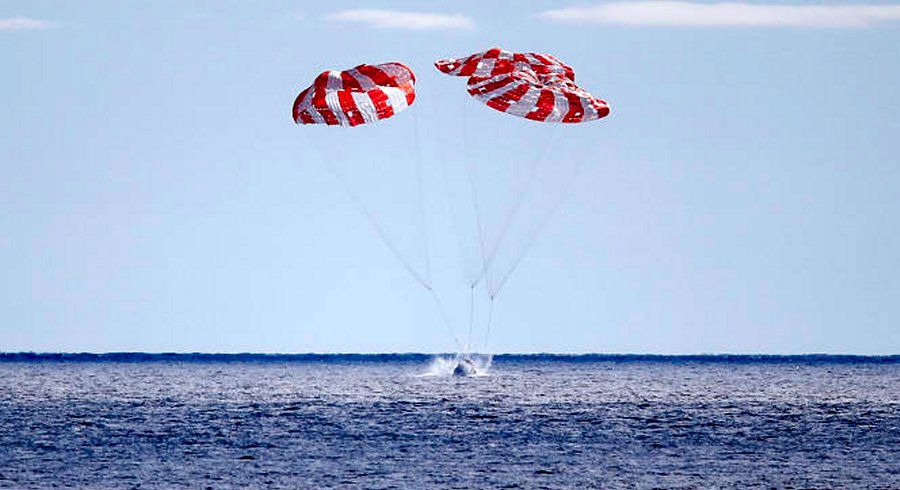
The Artemis 1 mission successfully concluded yesterday with the safe landing in the Pacific of NASA's Orion capsule, after a dreaded crossing through the Earth's atmosphere at a speed of 40,000 km/h.
The Orion capsule landed after a journey of just under a month around the Moon.
It was a question of evaluating whether the heat shield will be able to withstand the 2800 degrees Celsius implied by the return of the capsule which contains mannequins fitted with sensors.
This ambitious program aims to return to the Moon by 2025. The American space agency aims to send four astronauts around the Moon on the next flight, in 2024, and to land humans there as early as 2025.
Our country the United States should invest nearly 100 billion dollars in this program. Reconnecting with a project initiated more than fifty years ago. |
|
|
|
| Andrew Preston for DayNewsWorld |
|
CHINA LAUNCHES SHENZOU 15 MISSION
TO HIS SPACE STATION | 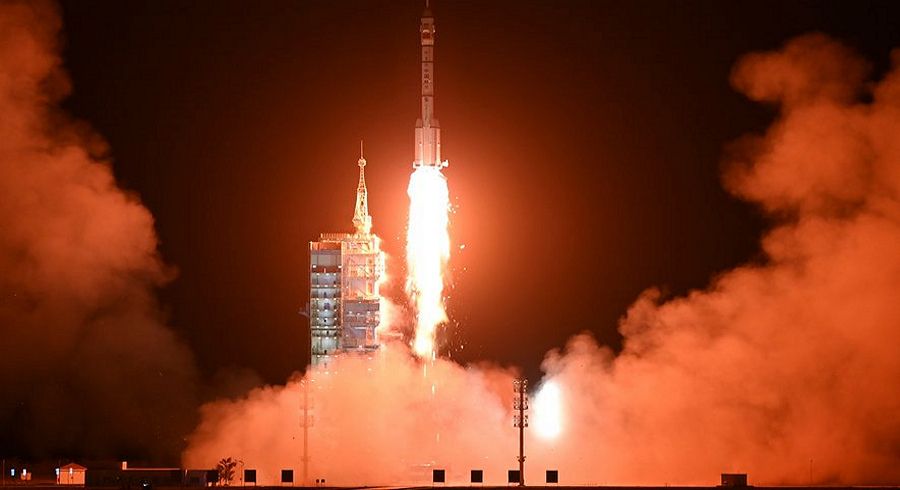
The Chinese space station is already being renewed
China is launching the Shenzhou-15 space mission to China's space station today, the first since the structure's assembly was completed three weeks ago. Its launch takes place on November 29, 2022.
Shenzhou 15 (simplified Chinese: 神舟十五号; pinyin: Shénzhōu shíwǔ hào; lit. "Godship 15") is the tenth Chinese manned space mission and the fourth to the China Space Station (SSC). Long March 2F is expected to take place from Jiuquan Launch Base
The Shenzhou spacecraft is launched by a CZ-2F or Long March 2F rocket from the Jiuquan Satellite Launch Center. This launcher is 62 meters high and weighs 477 tons. It can place 8.5 tons to an orbit of 500 km.
Three taikonauts will take place on board to replace the three occupants of the station. The trio, led by Mission Commander Fei Junlong accompanied by two space newcomers, Deng Qingming and Zhang Lu, will transfer directly into orbit with the crew of Shenzhou-14 to the China Space Station currently under construction, which will mark a first in Chinese aerospace history.
Goals.
The mission should last six months, during which its members will be able to take full advantage of the three modules of the Chinese space station to carry out experiments. According to the mission plan, the Shenzhou-15 spacecraft will perform rapid and automated rendezvous and docking with the space station at the front port of the Tianhe core module, and then form a new combination of three spacecraft and three modules.
It will be the largest structure of the Chinese Space Station to date, with a total mass of nearly 100 tons. For comparison, the international space station can accommodate seven people and has 16 modules.
The Chinese Space Station is the first of its kind to be open to all UN member states. So far, several scientific experiment projects from 17 countries, including Switzerland, Poland, Germany and Italy, have been included in the selected projects of the Chinese Space Station, Zhao said.
Like the United States, China has great space ambitions. Behind, Russia is left behind. “For Beijing, space is above all a vector of prestige.
China aspires to become the world's leading power in all areas by 2049,” explains Marc Julienne, head of China activities at the French Institute for International Relations.
|
|
|
|
| Simon Freeman for DayNewsWorld |
|
THE CURIOSITY MISSION
AFTER TEN YEARS ON MARS | 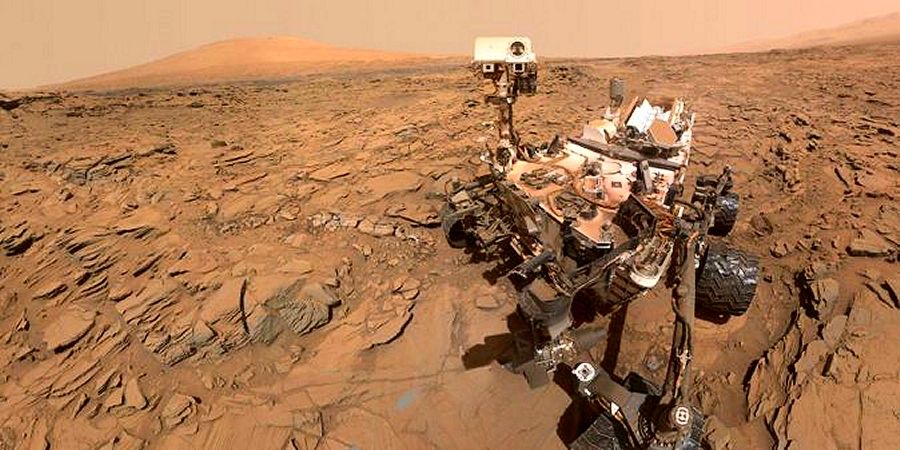
We will celebrate ten years since Curiosity landed on the planet Mars. Indeed, it was on August 6, 2012 that this 900-kilogram rover landed in the middle of the Gale Crater, 150 km in diameter, dug about 3.6 billion years ago by the impact of a meteorite.
On Mars, days are called sols, numbered from landing (Sol 0); August 6, 2022 therefore corresponds to Sol 3555, or 3652 Earth days.
This anniversary gives us the opportunity to draw up a technical and scientific assessment of this mission and to discuss the discoveries made with the instruments on board Curiosity.
Curiosity: an international adventure that began long before landing
Curiosity took ten instruments on board, two of which were Franco-American: ChemCam and SAM.
ChemCam is the result of the work of more than 300 people in France (CNRS, universities, CNES and industries) under the technical and scientific responsibility of the Institute for Research in Astrophysics and Planetology (IRAP) in cooperation with the Los Alamos National Laboratory ( LANL – USA) and under the project management of the National Center for Space Studies (CNES), which finances the French contribution to the project.
The ChemCam instrument was selected to analyze the chemical composition of the Martian rocks around the rover, by firing lasers at them and collecting the returned light (this is called laser-induced plasma spectrometry or LIBS). The principle is to heat the rock very strongly (>10,000°C) on a small surface (less than a square millimeter) so that a very small fragment is sublimated (passes from the solid state to the gaseous state) then ionized in the plasma state.
It is with the spectral analysis of the light from this spark that the atomic composition of the rock is determined and that the scientists deduce the nature of the rock.
SAM meanwhile is a large analytical chemistry laboratory, weighing nearly 40kg, or half of all the rover's instruments. It allows the rover's environment to be analyzed at the molecular level. It is also a Franco-American contribution to the mission, and results from the work of nearly 100 people in France (CNRS, universities, CNES and industry) under the responsibility of the Laboratoire Atmosphères Observations Spatiales (LATMOS) and under the supervision work of CNES. It was developed in collaboration with NASA Goddard Space Flight Center and NASA Jet Propulsion Laboratory (JPL). The latter also designed, developed and assembled Curiosity.
SAM makes it possible to heat the samples taken by the rover up to more than 850°C, and to finely analyze the chemical nature of the gases produced with the three additional instruments it contains. This makes it possible to provide information on the nature of the minerals and organic compounds present in the samples analyzed. SAM also has the ability to analyze the composition of the atmosphere to understand the present and past climate of the planet.
SAM is made up of three different instruments that search for and measure the organic compounds often associated with the presence of life on a planet. NASA
For 10 years, at CNES in Toulouse, the Martian Operations Center, named FOCSE (French Operation Center for Science and Exploration), has been welcoming French teams working directly with NASA (American Space Agency) every other week. Every evening, the engineers and scientists who operate the ChemCam and SAM instruments meet at CNES to ensure the monitoring and programming of the instruments, the recovery and processing of scientific data.
Mars: A once habitable planet
During the first soils following its landing, a phase of verification of the good health of the scientific instruments (ChemCam, SAM, etc.) was carried out. Then Curiosity began exploring the crater. We thought we would find there alluvium (sedimentary deposits) transported by one or more rivers, one of which flowed from the surrounding plateau. The rover was then looking for traces of these past flows.
Stupor: a sample, taken from the Cumberland drilling site, revealed that Mars had met, at one point in its history, all the conditions required for its habitability: liquid water, organic matter and a source of energy. A simple life form could have existed there, but we cannot say whether or not Gale Crater ever hosted a life form.
The various on-board tools have also made it possible to discover the presence of organic matter that has been sought for nearly 40 years. The teams are also studying the origin of the sediments present and their transformation into rocks when the water flowed on the Red Planet...
Observing all the conditions of habitability exhaustively is not common. To date, this has only been possible on Earth and Mars.
Confronting “ground truth” with orbital data
The Mars adventure nominally took place during the first Martian year (almost 2 Earth years). NASA then decided to extend the mission to explore other geological formations.
In the middle of the Gale crater, rises the central peak which culminates at more than 5500 meters above the floor. It is called Aeolis Mons, more familiarly called Mont Sharp. It exposes on its sides many geological layers whose stacking constitutes an open book on the history of the planet. Within 10 km of Curiosity's landing site, there are access routes to Mount Sharp that the rover takes around Sol 750.
Martian mountain landscape
One of the first notable layers encountered on this climb is called Vera Rubin Ridge, after astronomer Vera Rubin.
According to data collected in Martian orbit, this area is rich in a mineral called “hematite”. It is an iron oxide frequently formed in aqueous medium. Observing this layer from the ground thanks to the rover allows us to acquire what in geology we call the ground truth.
Orbital data remains important because it allows global coverage of the planet, but will never be as accurate as data acquired directly on the ground. However, contrary to what the orbital data suggested, this area is not much more enriched in hematite than the surrounding terrain. This highlights the complementarity of the two types of data, in orbit and on the ground, to analyze the history of the planet.
The second area of interest for the Curiosity mission is what has been called the clays unit. Clays are of great interest for exobiology, which is interested in pre-biotic (before the appearance of living things) and biological processes in the universe. They protect the organic matter because they preserve it between the layers that constitute them.
We could see clays a little like the mille-feuille of minerals because they are made up of a stack of sheets, between which slips organic matter. The data acquired in this clay zone are still being analyzed and the scientific articles concerning them are gradually being published in various specialized journals. This area therefore characterizes the humid period of the history of Mars with remains of lakes and rivers.
Finally, the third area of interest that constitutes Mount Sharp is the sulphate layer. They are potentially the witnesses of an environmental transition: the passage from an era rich in liquid water towards an increasingly arid era. The rover is currently heading to this area to test this hypothesis, and the results are yet to come.
All of these discoveries show that Mars has a complex and rich geological history dating back more than 3 billion years.
After ten years, despite the many challenges (significant diurnal thermal changes, dust and radiation), Curiosity and its instruments are still working. Precautions are taken to preserve the material so that the scientific mission can continue.
Today, at the entrance to the impressive Gediz Valley, Curiosity finds itself in a breathtaking landscape and the mission has just been renewed for three years.
martian landscape
To date, Curiosity is no longer alone in surveying the surface of Mars since the Perseverance rover joined it on February 18, 2021 with the mission of searching for prebiotic traces and collecting samples that will be brought back to Earth.
The Insight lander also landed on Mars in November 2018 to "listen" to the planet's tremors, thanks to the French seismometer SEIS, and thus study the heart of Mars. Knowledge of the structure of Mars is important to understand its evolution, for example to know the reasons for the disappearance of the magnetic field which once surrounded Mars and is closely related to the habitability of the planet.
Should have been added to this Rosalind Franklin, the first European rover which also includes French participation, as part of the Exomars mission. It was supposed to take off in September 2022 with a Russian launcher, but its launch has been delayed until further notice following the outbreak of the war in Ukraine, the political consequences of which impact scientific cooperation.
This rover should dig up to two meters deep to analyze rocks better protected from the harsh conditions prevailing on the surface. They are therefore supposed to contain more information about the pre-biotic chemistry of Mars than the samples analyzed so far.
All these extremely complementary space missions for the study of Mars are designed with this in mind, and are the result of international cooperation. But if they allow us to better understand the history of the planet Mars, they also inform us about the history of the young Earth.
Indeed on Earth, the very old rocks, witnesses of the appearance of life, have been obliterated by plate tectonics. On the other hand, this tectonics did not exist on the planet Mars or was very limited: we therefore have access to rocks that have been preserved for billions of years, and which were probably formed in an environment close to that of our Earth. at the time.
In view of the similarities of the two planets, better understanding the geological history of Mars will allow us to understand our genesis as well as our possible evolution.
Cyril Szopa, University Professor, Exobiologist at the Atmospheres Modeling and Spatial Observations Laboratory (LATMOS), University of Versailles Saint-Quentin-en-Yvelines (UVSQ) – University of Paris-Saclay
Éric Lorigny, Head of MSL/ Curiosity and Perseverance Operations at CNES, National Center for Space Studies (CNES)
Olivier Gasnault, Researcher at the CNRS, Institute for Research in Astrophysics and Planetology, National Center for Space Studies (CNES)
Valérie Mousset, Project Manager for the French participation in the Mars Science Laboratory project, National Center for Space Studies (CNES) NASA
Article published in The Conversation |
|
|
|
| Paul Emison for DayNewsWorld |
|
BACK TO THE MOON WITH
THE NEXT ARTEMIS MISSION | 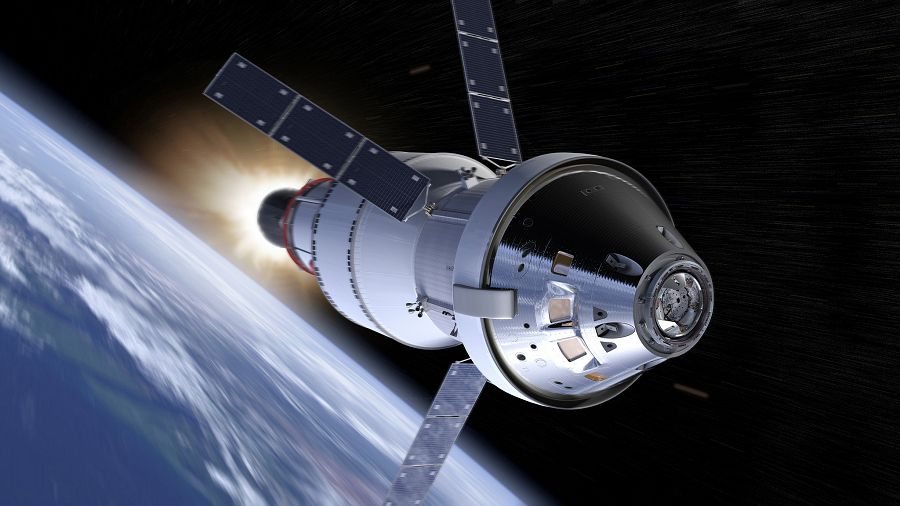 The great return of man to the Moon is soon underway: Monday, August 29, 2022 must take off the Artemis mission of the new American lunar program. Artemis is a program of NASA, the American Space Agency, which collaborates with the European Space Agency, the space agencies of Canada and Japan, as well as several commercial partners (Airbus and Lockheed Martin, in particular). The great return of man to the Moon is soon underway: Monday, August 29, 2022 must take off the Artemis mission of the new American lunar program. Artemis is a program of NASA, the American Space Agency, which collaborates with the European Space Agency, the space agencies of Canada and Japan, as well as several commercial partners (Airbus and Lockheed Martin, in particular).
The take-off of Artémis 1 is scheduled for Monday August 29, 2022. The NASA mission must last 42 days in total. It's a trip to the Moon, but without an astronaut on board (that will be for Artemis 3). Meticulously choreographed, it should make it possible to collect spectacular images as well as valuable scientific data.
SLS, like Space Launch System, is NASA's new giant rocket. With its 70 tons and almost 100 meters high, it will be the most powerful launcher ever built, surpassing the emblematic Saturn V which carried 24 American astronauts to the Moon between 1968 and 1972. It will make its first flight from the Launch Complex 39B at Kennedy Space Center, Florida. Its four RS-25 engines, and two white boosters on each side, will produce 39 meganewtons of thrust - 15% more than the Apollo program's Saturn V rocket.
After two minutes, the thrusters will fall back into the Atlantic Ocean. After eight minutes, the main stage (orange in color) will detach in turn. There will then only be the Orion spacecraft, whose solar panels will then be deployed, attached to the upper stage of the rocket (ICPS). After circling the Earth, the latter will provide the final push that will place Orion on the Moon's trajectory, approximately 1.5 hours after takeoff - before also being released.
The journey, without an astronaut, of the Orion capsule
The ship will then only consist of the capsule where the astronauts will be in the future, powered by a service module built by the European Space Agency (ESA). It will take several days to reach the Moon, which it will approach on arrival at only 100 km. The Orion capsule will go up to 64,000 km behind the Moon - a record for a habitable capsule.
But initially, an empty Orion ship will be launched by the SLS to test all the stages of the mission. It will remain in orbit around the Moon for several days to allow NASA engineers to verify its performance.
Orion's "passengers"
The capsule will carry a dummy called Moonikin Campos, installed in the commander's seat and dressed in the new NASA suit. It will record the acceleration and the vibrations undergone. Also on board: two busts of women, named Helga and Zohar, and made of materials imitating bones or even human organs. One will be wearing a radiation jacket, the other will not. Sensors will make it possible to evaluate the levels of radiation received, in particular in deep space, where they are much more important.
If this dress rehearsal is successful, a first crewed flight will follow during the Artemis II mission, currently scheduled for mid-2024. Like their Apollo 8 predecessors, the mission's four astronauts will fly over the Moon but not land on it. We will therefore have to wait for Artemis III to see the real return of a crew to the surface of our satellite. After leaving Orion to land aboard the HLS (Human Landing System), two astronauts, including the first woman to walk on the Moon, will spend nearly a week on the surface, more than double the record set during the Apollo missions. . Scheduled for 2025, the mission could however experience several years of delay according to the latest report from NASA's Inspector General.
Goal Mars
The objective of the whole program is to establish a sustainable human presence on the Moon, which will go through an essential stage: the construction of the Deep Space Gateway (DSG) , a space station hosting a habitation module around the Moon, capable of accommodating crews for a period of 42 days. The space station, the Gateway, will be assembled in orbit around the Moon from the end of 2024. Much smaller than the International Space Station (ISS), it will rely on a similar partnership between American, European and Japanese space agencies. and Canadian, but this time without Russia.
The Gateway is one of the big differences between the Artemis and Apollo programs. By offering a transit point and a place of experimentation between the Earth and the Moon, it is presented as an ingredient for the sustainability of the return to the Moon, the motivations of which today are less geopolitical than economic. The Artemis agreements, which France has just joined, for example explicitly provide for the possibility of extracting resources from the Moon (such as helium 3, essential for the nuclear fusion reactors of the future, or rare earths useful for the manufacture new technology...).
In the longer term, the idea behind the Artemis program is to reuse the developments made for a first trip to the planet Mars by 2040., confirms these indirect objectives that the Artemis mission is preparing:
“It is clearly with a view to preparing a mission on the planet Mars, in the much longer term, around 2040, 2050, since a return to the Moon will first be necessary”, confirms Emmanuel Jehin, Doctor in astrophysics at the 'ULiège. |
|
|
|
| Luc T. pour DayNewsWorld |
|
JUPITER AS SEEN BY THE JAMES WEBB SPACE TELESCOPE | |
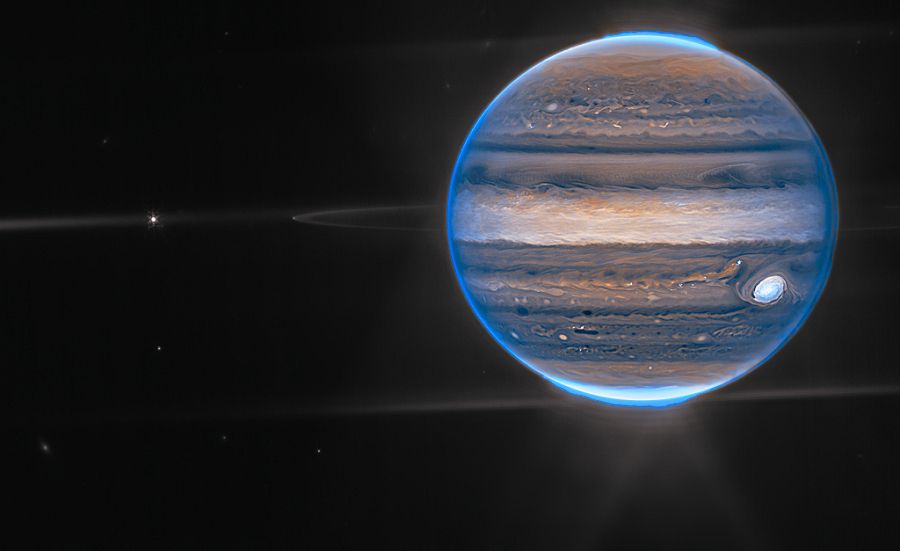
Jupiter with giant storms, powerful winds, auroras and extreme temperature and pressure conditions.
Now NASA's James Webb Space Telescope has captured new images of the planet.
Webb's observations of Jupiter will give scientists even more clues about Jupiter's inner life.
The images obtained with Webb are truly remarkable, we can see details of Jupiter with its rings, its tiny satellites and even its galaxies in a single image.
In the stand-alone view of Jupiter, created from a composite of several Webb images, the auroras extend to high altitudes above Jupiter's north and south poles.
The aurora glows in a filter mapped to more red colors, which also highlights reflected light from lower clouds and upper mists.
A different filter, mapped to yellows and greens, shows mists swirling around the north and south poles.
A third filter, mapped to blue, presents light reflected from a deeper main cloud.
The Great Red Spot, a famous storm so big it could swallow Earth, appears white in these views, like other clouds, because they reflect a lot of sunlight.
Brightness here indicates high altitude, so the Great Red Spot has high altitude haze, as does the equatorial region.
Numerous bright white "spots and stripes" are observed which are likely very high level cloud tops of condensed convective thunderstorms.
In a wide-field view, Webb sees Jupiter with its faint rings, which are a million times fainter than the planet, and two tiny moons called Amalthea and Adrastea.
The blurry spots in the lower background are probably "photobombing" galaxies.
Information from the James Webb Telescope arrives at the Space Telescope Science Institute (STScI), Webb's science and mission operations center, as raw data.
STScI processes the data into calibrated files for scientific analysis and forwards it to the Mikulski Archive for Space Telescopes for dissemination.
Discoveries about the universe thanks to the James Webb space telescope should allow us to take an extraordinary leap in knowledge. |
|
|
|
| Luc T. for DayNewsWorld |
|
THE NIGHT OF THE STARS
|
|
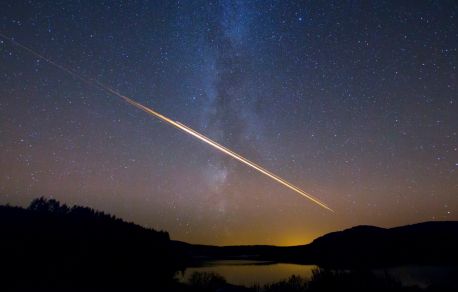
The Night of the Stars.
This year it is from August 5 to 7, 2022 that you may have the chance to make a wish to see a shooting star.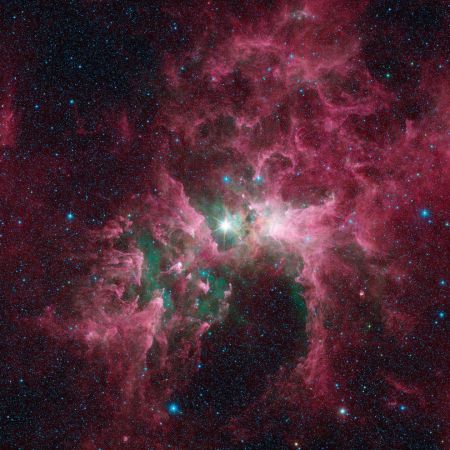
To contemplate the heavenly vault you have to, a telescope if you can or go to an observatory.
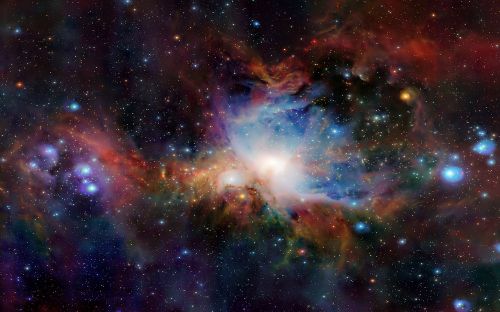
Inquire: sites are open to observe these stars but you can see them with the naked eye.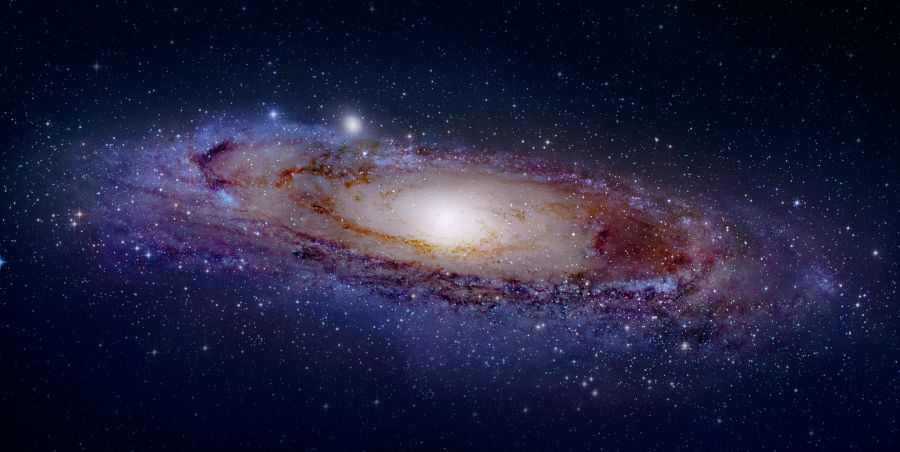
. 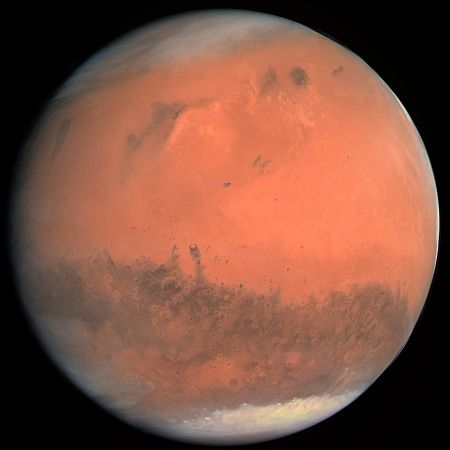
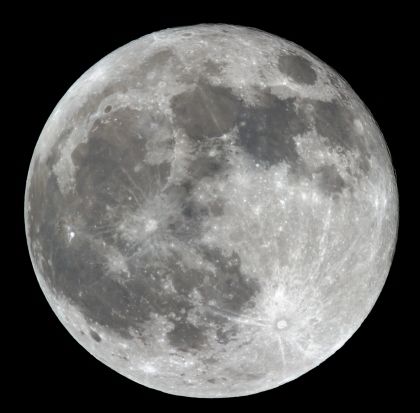 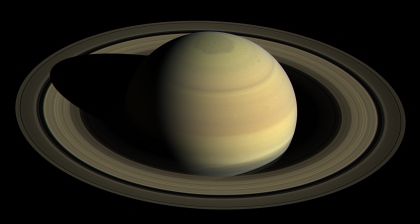
Find out: sites are open to observe these
stars but you can see them with the naked eye.
A site has been opened to understand stars like the Great Bear, Jupiter, Saturn's rings, etc.
Tap on your tablets ''Nights of the Stars'' and meet on August 12 and 13 for the rain of shooting stars. 
I leave you I go to the observatory of Mount Palomar to watch them.
|
|
|
|
| Mia Kennedy for DayNewsWorld |
|
THE JAMES-WEBB TELESCOPE TAKES US
13 BILLION YEARS IN THE PAST | 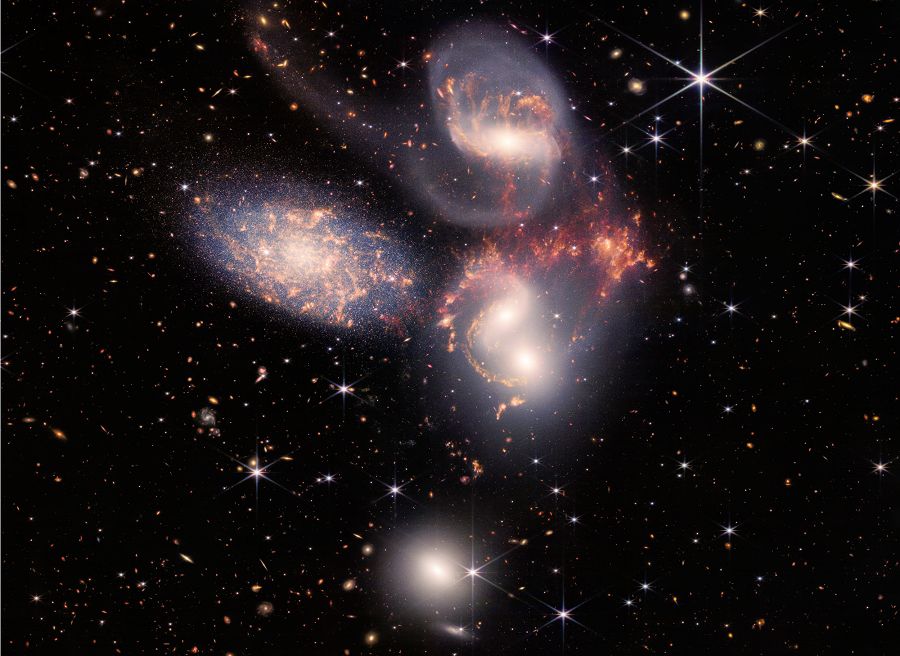
Yesterday evening, President Biden presented the first image taken by the James-Webb telescope or JWST (its English acronym). Since its launch on December 25, 2021, and even before, the community of astronomers and astrophysicists has been very impatient. And there is reason, because this telescope promises major advances in astronomy, particularly in the study of the origins of the universe or exoplanets.
Take pictures of the origins of the universe
In the photo taken by the JWST, we see a lot more as shown in the comparison below. The bright dots with crosses are stars in our galaxy. These “peaks of light” are due to the configuration of the telescope mirror, segmented into small hexagons. Everything else is galaxies. On the other hand, the biggest difference lies in the time it takes to take it. It took several weeks for Hubble to produce this image, but only twelve and a half hours for Webb. This is due to the large size of its mirror, collecting more light faster.
Some of the galaxies visible in this image are 13 billion light-years away. This means that light has taken 13 billion years to travel to us since it was emitted from the galaxy, meaning that we see the universe as it was shortly after the Big Bang. If this could have been possible with Hubble, the James-Webb telescope has a much better resolution, making it possible to detect the shapes of galaxies in a much more detailed way.
These galaxies are of various morphologies and colors. The colors tell us about their distances, the furthest being those with the longest wavelength, therefore the reddest. These are also simpler forms, less structured, because they are "younger". Galaxies take on increasingly complex shapes as they interact with other galaxies.
There is still a huge field to photograph with the Webb, because the part of the universe that we see in this image is tiny: we could hide it by holding a grain of sand at arm's length.
Infrared to understand the formation of galaxies
One of the big differences between Hubble and the Webb is their spectral range: Hubble sees mainly in the visible while the Webb is an infrared telescope. Stars near the Big Bang, although long dead, emitted ultraviolet radiation. Their distance, due to the expansion of the universe, shifts their wavelengths towards the infrared.
The Webb will also make it possible to observe stardust. This substance exists in two forms: carbonaceous, similar to soot, and in the form of silicate, resembling sand. It forms around stars at the end of their life, then passes through the interstellar medium, eventually forming new stars. And eventually, new galaxies.
This dust has the crucial property of being visible in the infrared and opaque in the visible, making it impossible for Hubble to analyze it. The Webb's observation of dust should lead to a better understanding of the mechanisms of formation of stars and galaxies. This will be done in particular by observing the Carina Nebula, the Austral Ring Nebula and Stephan's Quintet.
Finally, the images from the Webb telescope, freely accessible to scientists and the general public, will make it possible to scrutinize exoplanets and their atmosphere. Indeed, several molecules are observable in the infrared – the water molecule for example.
This article is part of the series "The great stories of open science", published with the support of the Ministry of Higher Education, Research and Innovation. Published in The Conversation newsletter. |
|
|
|
| Simon Freeman for DayNewsWorld |
|
CONTROL OF THE MOON A STRATEGIC CHALLENGE BETWEEN
THE UNITED STATES AND CHINA | 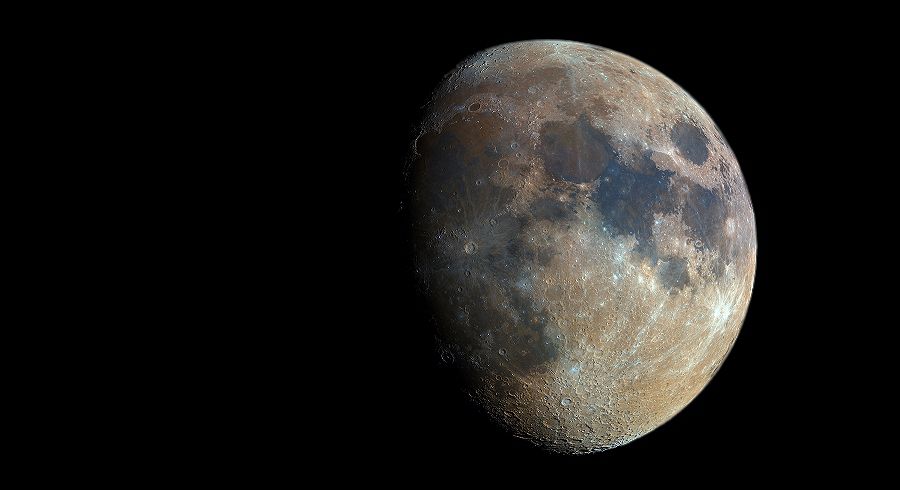
Would China want to “take control” of the Moon as part of a military program ?
This is what NASA administrator and former astronaut Bill Nelson told German newspaper Bild in an interview published on Saturday.
The head of the US space agency has indeed declared that China's space program is a military program. He added that China had stolen some ideas and technologies.
But this Monday, the Chinese Foreign Ministry clearly responded to Bill Nelson. “This is not the first time a NASA chief has made irresponsible remarks against China.
When it comes to our space program, which is completely normal and reasonable, our country is constantly the victim of smear campaigns. Even though we have always called for the construction of a community of nations in space and we have always firmly opposed its militarization. »
China is defending itself against accusations by NASA administrator Bill Nelson. It is absolutely not in his plans to "take control" of the Moon.
But over the past decade the pace of China's space program has picked up with a program that focuses on the moon. China has in fact never hidden its intention to embark on the conquest of space, quite the contrary. Since the 1990s, it has been developing an independent space program, on the fringes of international cooperation. It must be said that China was excluded from the ISS because the United States forbids NASA any collaboration with Beijing. A reason that pushed her to build her own station.
After a first unmanned landing in 2013, China was the first to land a rover on the far side of the Moon. And she hopes to send astronauts to our natural satellite before the end of the decade. It also plans uncrewed missions to the moon's south pole by 2025.
The President of China Xi Jinping is also the biggest promoter of this program which he baptized “Space Dream”. A dream that is becoming reality. On April 29, the central module Tianhe "Heavenly Harmony" of the future Chinese space station was successfully launched from the base of Wenchang, located on the island province of Hainan. A decisive step in the creation of the future Chinese space station Tiangong “Heavenly Palace”. A base that will consist of three parts, including the central Tianhe module, will be the management and control center. Two other 14.4m long modules, Wentian "Heavenly Quest" and Mengtian "Heavenly Dream", will be attached to Tianhe.
This is enough to worry NASA, as part of its Artemis program, which plans to send a crewed mission into orbit around the Moon in 2024 and to make a crewed landing near the lunar south pole in 2025.... |
|
|
|
| Paul Emison for DayNewsWorld |
|
There are no translations available.
UN ETRANGE OBJET DANS LA VOIE LACTEE
|
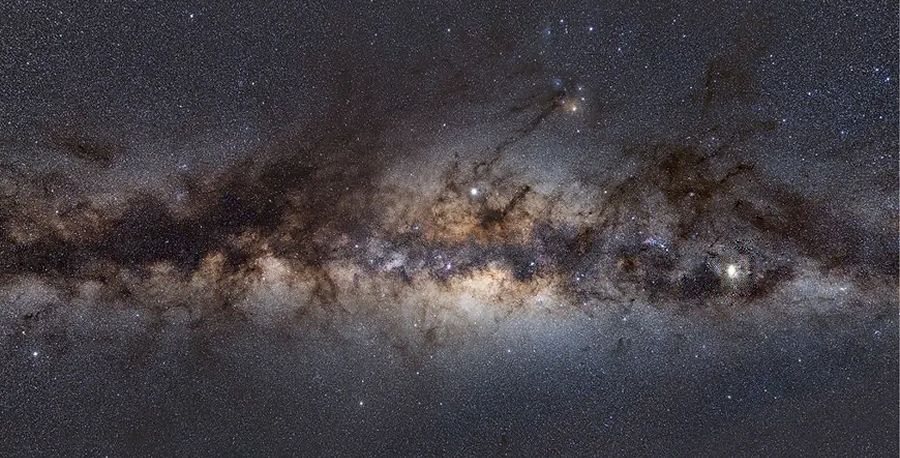 Une découverte « un peu effrayante », selon l’astrophysicienne Natasha Hurley-Walker ? Une découverte « un peu effrayante », selon l’astrophysicienne Natasha Hurley-Walker ?
Des astronomes australiens ont observé un étrange objet tournant dans la Voie lactée qui, selon eux, ne ressemble à rien de déjà vu, selon une publication scientifique publiée dans la revue Nature. Un objet mystérieux qui illumine le ciel de ses ondes radio comme aucun autre.
L’objet, repéré pour la première fois par un étudiant, produit un important rayonnement électromagnétique trois fois par heure. Les ondes sont émises toutes les 18,18 minutes, explique Natasha Hurley-Walker, qui a observé le phénomène dans l’Outback australien. « Il n’y a rien de connu dans le ciel qui fasse cela ». Une source d'ondes radio comme il n'en avait jamais observé auparavant.
A seulement 4.000 années-lumière de la Terre.
« C'est presque effrayant, commente Natasha Hurley-Walker, chercheur à l'université Curtin (Australie) dans un communiqué de l’Icrar. Parce qu'il n'y a rien de connu dans le ciel qui fasse ça ». Rien de connu qui libère autant d'ondes radio régulièrement, toutes les 20 minutes.
Cette source, les chercheurs l'ont débusqué grâce d'une part au large champ « de vision » du Murchison Widefield Array (MWA, Australie) et à son extrême sensibilité. Une combinaison qui permet de « sonder l'ensemble du ciel et de détecter l'inattendu ». Mais ne nous y trompons pas. Les astronomes ont l'habitude d'observer des objets qu'ils appellent transitoires. Des objets qui semblent clignoter dans le ciel.
Ce qui rend ce nouvel objet vraiment particulier c'est qu'il s'allume pendant une minute trois fois par heure. Les autres transitoires connus, eux, peuvent émettre pendant quelques jours -- c'est le cas des supernovae -- ou pendant seulement quelques millisecondes ou peut-être quelques secondes -- lorsqu'il s'agit de pulsars.
Les astronomes avancent aussi que l'objet est incroyablement brillant -- dans le domaine des ondes radio, s'entend -- et pourtant, plus petit que notre Soleil. Et qu'il émet des ondes radio hautement polarisées. De quoi suggérer non seulement qu'il s'accompagne d'un champ magnétique particulièrement puissant, mais aussi qu'il est capable de convertir cette énergie magnétique en ondes radio d'une manière bien plus efficace que tout ce que nous connaissons par ailleurs.
L’équipe a donc établi que l’objet se trouve à environ 4 000 années-lumière de la Terre, qu’il est incroyablement brillant et doté d’un champ magnétique extrêmement puissant.
Les hypothèses ?
« Si vous faites tous les calculs, vous trouvez qu’il ne devrait pas avoir assez de puissance pour produire ce genre d’ondes radio toutes les 20 minutes. Cela ne devrait tout simplement pas être possible », a déclaré Natacha Hurley-Walker.
Il pourrait s'agir là du tout premier « magnétar » -- une étoile à neutrons, issue de l'effondrement d'une étoile massive en fin de vie, entourée d'un champ magnétique intense -- à ultra longue période jamais observé. L'objet a bien déjà été imaginé par les théoriciens. Ou encore d’une « naine blanche », une étoile vieillissante d’une température en surface deux fois plus élevée que celle du soleil.
Un type d'objet nouveau ?
« Bien sûr, il pourrait s'agir de quelque chose auquel nous n'avons jamais pensé. Il pourrait s'agir d'un type d'objet entièrement nouveau », affirme Natacha Hurley-Walker.
L'équipe de recherche a pu observer le signal sur une large gamme de fréquences. « Cela signifie qu'il doit s'agir d'un processus naturel, ce n'est pas un signal artificiel », a assuré la scientifique à la question de savoir si ce signal radio puissant et cohérent provenant de l'espace pourrait avoir été envoyé par une autre forme de vie.
|
|
|
|
| Simon Freeman pour DayNewsWorld |
|
There are no translations available.
LE TELESCOPE SPATIAL JAMES WEBB
A ACHEVE SON DEPLOIEMENT
|
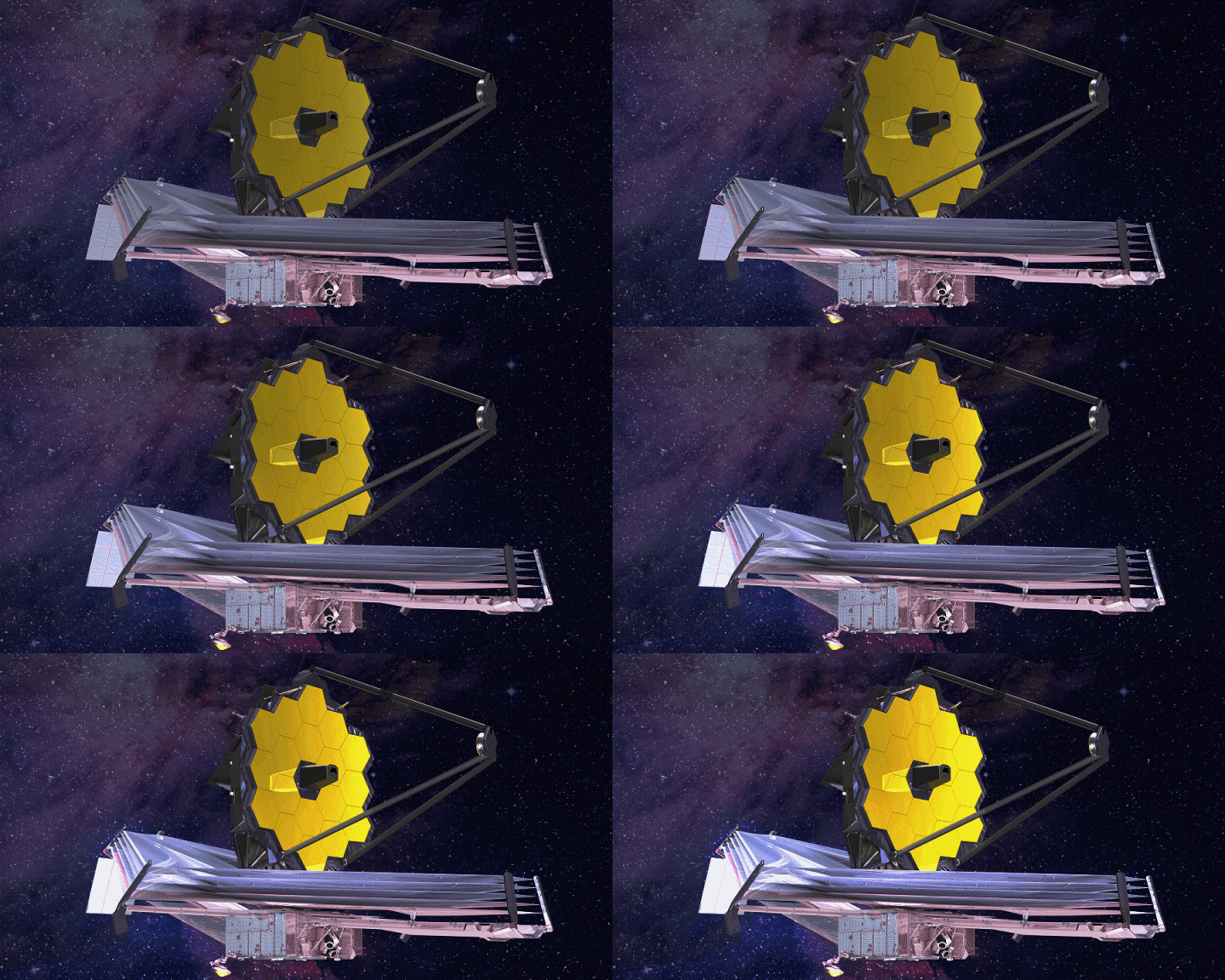 Des dizaines d’étapes au millimètre près, à des kilomètres de la Terre, sans plan B. Le James Webb Telescope, successeur de Hubble, est entièrement déployé dans l’Espace deux semaines après son lancement depuis Kourou, en Guyane, annonce l’agence spatiale américaine. Des dizaines d’étapes au millimètre près, à des kilomètres de la Terre, sans plan B. Le James Webb Telescope, successeur de Hubble, est entièrement déployé dans l’Espace deux semaines après son lancement depuis Kourou, en Guyane, annonce l’agence spatiale américaine.
Le télescope spatial a achevé avec succès ce samedi 8 janvier 2022 la dernière étape de son déploiement, avec celui de son miroir principal, et il se trouve désormais dans sa configuration finale pour pouvoir commencer, dans un peu plus de cinq mois, son exploration du cosmos.
L'emblématique miroir principal du télescope mesure environ 6,5 mètres de diamètre, et était donc trop grand pour entrer tel quel dans une fusée lors de son décollage, il y a deux semaines. Ses deux côtés avaient ainsi dû être repliés vers l'arrière.
La première de ces deux ailes a été déployée vendredi, et la seconde s'est ouverte samedi matin, comme prévu, a annoncé la Nasa. Les équipes de l'agence spatiale continuaient toutefois à la verrouiller en place, afin de la sécuriser de façon définitive.
La Nasa retransmettait samedi matin en direct les images de la salle de contrôle, où des dizaines d'ingénieurs ont applaudi de joie à l'annonce du déploiement complet.
« Je suis ému », a déclaré en direct par vidéo Thomas Zurbuchen, responsable des missions scientifiques à la Nasa. « Quelle étape extraordinaire. »
Observer les premières galaxies
Le déploiement dans l'espace d'un tel télescope, non seulement de ses miroirs mais aussi de son bouclier thermique plus tôt cette semaine, était une procédure ultra-périlleuse qui n'avait jamais été réalisée par le passé.
Le télescope spatial le plus sophistiqué jamais créé entre désormais dans une phase « d'alignement et de calibrage » qui doit durer cinq mois, avant les premières prises de vue, explique la Nasa.Avant d'être opérationnel, le télescope devra toutefois encore atteindre son orbite finale à 1,5 million de kilomètres de la Terre.
Observatoire spatial le plus puissant jamais conçu, James Webb doit notamment permettre d'observer les premières galaxies, formées seulement environ 200 millions d'années après le Big Bang.
|
|
|
|
| Paul Emison pour DayNewsWorld |
|
There are no translations available.
LE LANCEMENT DU TELESCOPE SPATIAL JAMES WEBB POUR UN LONG VOYAGE JUSQU'AU POINT L2
|
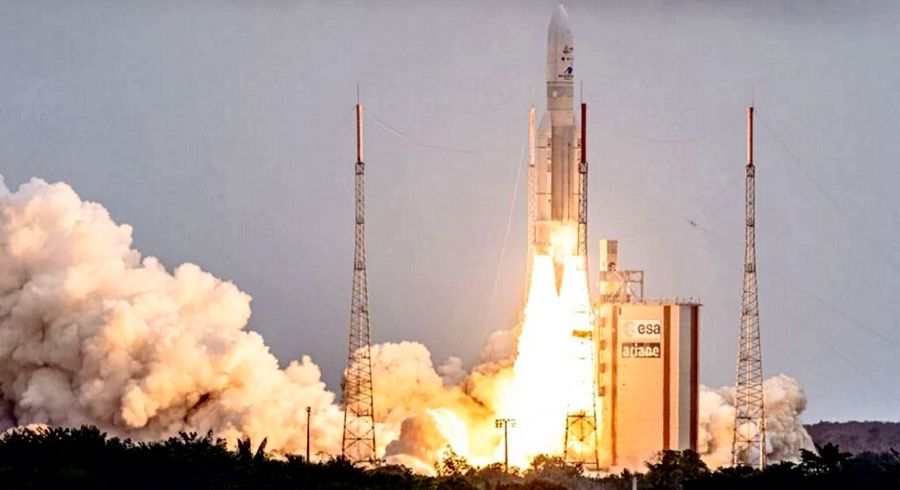 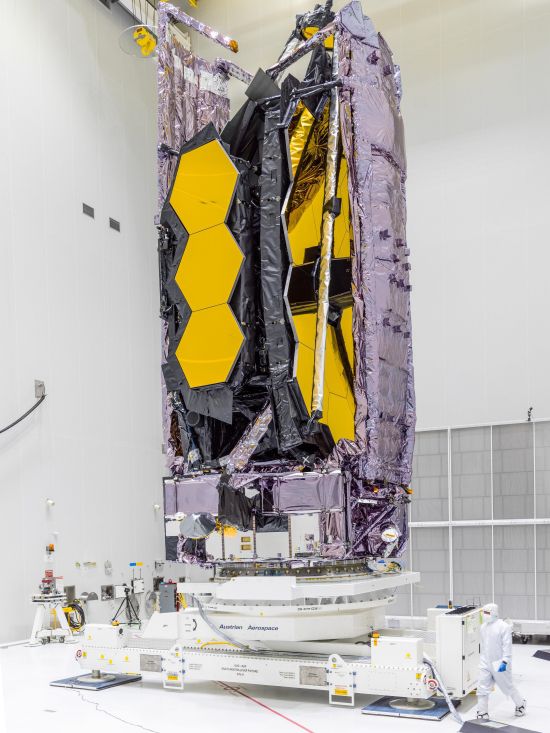 Après plusieurs années d’attente, c’est enfin fait ! Ce samedi 25 décembre à 13h20, heure française, de nombreux ingénieurs, astronomes et passionnés ont retenu leur souffle pendant plusieurs minutes alors que s’élançait Ariane 5 depuis la Guyane. Après plusieurs années d’attente, c’est enfin fait ! Ce samedi 25 décembre à 13h20, heure française, de nombreux ingénieurs, astronomes et passionnés ont retenu leur souffle pendant plusieurs minutes alors que s’élançait Ariane 5 depuis la Guyane.
Dans sa coiffe se trouvait le plus grand et le plus puissant observatoire spatial de toute l’histoire. Plié pour tenir dans la coiffe d'Ariane 5, comme une chrysalide d'un peu plus de 4 mètres de diamètre, l'engin fabriqué par Northrop Grumman doit déployer un miroir primaire de 6,5 m, et un bouclier thermique souple de 14 mètres sur 20, l'équivalent d'un court de tennis.
Le lancement dans l'espace du télescope spatial James Webb s'est déroulé parfaitement, mais il lui reste une série de manœuvres critiques à accomplir avant de pouvoir fonctionner dans quelques mois. Et il a encore du chemin à faire, 1,5 million de km à couvrir en un mois, avant d'atteindre le point de Lagrange 2, à quatre fois la distance séparant la Terre de la Lune.
Pour atteindre ce poste d'observation final, le James Webb a effectué la première, et la plus importante, de trois corrections de trajectoire. La grande impulsion que lui a fournie la fusée pour atteindre son but a été sciemment minimisée pour éviter que l'instrument, qui ne peut freiner sa course, dépasse son objectif, sans véritable espoir de retour.
La semaine qui vient va s'avérer cruciale.
Environ deux jours et demi après le lancement et une deuxième correction de trajectoire, les ingénieurs du centre de contrôle du télescope, à Baltimore, vont superviser le relâchement des deux « palettes » contenant le bouclier solaire.
Cet empilage de cinq grandes voiles d'un tissu aussi fin qu'un cheveu, est la condition sine qua non au bon fonctionnement du James Webb et de ses instruments, dont la température de travail demande un froid minimum de -230°C. 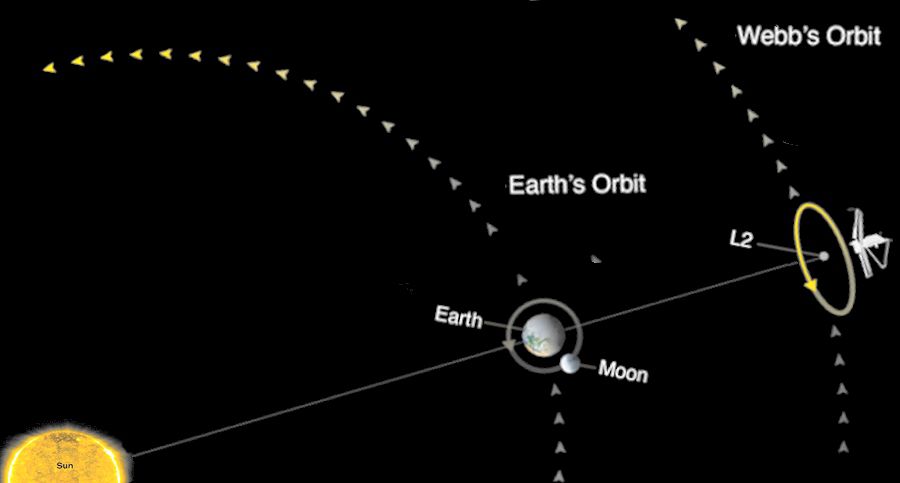 Son objectif :
étendre nos savoirs sur l’Univers et pourquoi pas lever le voile sur certains des mystères les plus persistants de l’astrophysique.
En attendant, il convient d’arriver sur place, autour du point de Lagrange 2, à plus d’1,5 million de kilomètres de la Terre. Au cours de ce voyage, le Webb Telescope devra par ailleurs opérer plusieurs manœuvres essentielles.
Correction de trajectoire
L’une d’elles a été exécutée avec succès environ 12,5 heures après le lancement. Alors qu’il se trouvait à environ 160 000 km de la Terre, l’observatoire a en effet exécuté une brûlure de ses propulseurs pour corriger sa trajectoire, s’assurant ainsi qu’il atteindrait sa destination en toute sécurité.
La correction de trajectoire est une opération assez courante dans les heures qui suivent le lancement d’un vaisseau.
En général, ces manœuvres impliquent de se retourner dans le but de ralentir. Dans le cas du Webb Telescope, cela était impossible, car ses instruments ultrasensibles auraient été exposés au Soleil.Ainsi, l’observatoire ne pouvait qu’augmenter sa vitesse.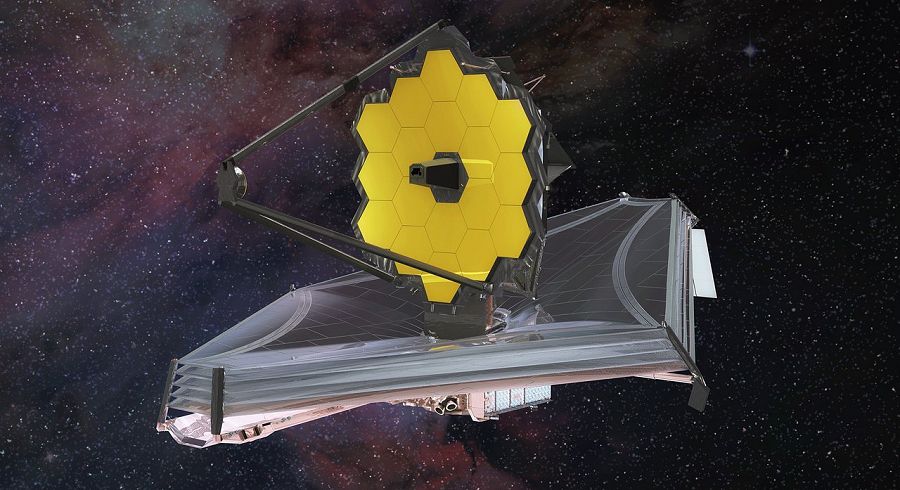
En prévision, la séquence de lancement de l’observatoire a été conçue pour fournir juste un peu moins de puissance que nécessaire plutôt que juste un peu plus. Cette brûlure, surnommée Mid-Course Correction Burn 1a (ou MCC1a), a donc été l’occasion pour l’observatoire d’affiner sa trajectoire vers L2.
Selon la NASA, il s’agissait de la plus importante des trois brûlures prévues au cours de ce voyage et la seule qui devait être soigneusement chronométrée.
La suite du programme
Dès le troisième jour, ce mardi, le Webb Telescope commencera à déployer son pare-soleil dans l’optique d’empêcher la lumière du soleil d’atteindre les capteurs infrarouges du télescope, les pièces les plus essentielles de cette mission.
Pour sonder les profondeurs du cosmos, l’observatoire doit en effet fonctionner à des températures extrêmement basses. Cette manœuvre cruciale devrait normalement s’opérer en trois jours, impliquant environ 7 000 pièces.
Après six jours de vol, le miroir secondaire du télescope devra à son tour se déployer avant l’ouverture du miroir principal tapissé d’or le lendemain. Là encore, tout devra fonctionner correctement au risque de faire échouer la mission.
Enfin, un mois après le lancement, le Webb Telescope devrait atteindre le point de Lagrange L2.
|
|
|
|
| Paul Emison pour DayNewsWorld |
|
There are no translations available.
UNE MISSION RUSSE ENVOIE UN MILLIARDAIRE JAPONAIS DANS L'ESPACE
|
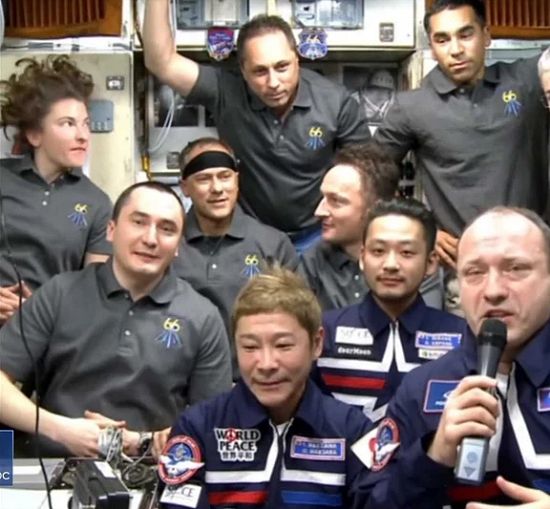 Ce mercredi 8 décembre 2021 à 8h38, une fusée Souyouz a décollé de Baïkonour pour emmener le milliardaire Yusaku Maezawa, son assistant et un cosmonaute russe vers l'ISS, marquant une nouvelle étape dans la course au tourisme spatial. Ce mercredi 8 décembre 2021 à 8h38, une fusée Souyouz a décollé de Baïkonour pour emmener le milliardaire Yusaku Maezawa, son assistant et un cosmonaute russe vers l'ISS, marquant une nouvelle étape dans la course au tourisme spatial.
Un milliardaire japonais a décollé ce mercredi 8 décembre au matin à bord d'une fusée russe pour un séjour de douze jours à bord de la Station spatiale internationale (ISS), un voyage marquant le retour de Moscou dans le tourisme orbital.
Le fantasque Yusaku Maezawa, âgé de 46 ans et qui a fait fortune dans la mode en ligne, et son assistant Yozo Hirano sont partis comme prévu du cosmodrome de Baïkonour au Kazakhstan à 7h38 GMT.
Il est prévu que leur vol dure six heures, avec un arrimage attendu au module Poïsk du segment russe de l'ISS à 13h41 GMT.
Un voyage de douze jours
Le cosmonaute Alexandre Missourkine, qui fait partie de la mission, a jugé que ses compagnons auraient un programme chargé. Il a prévu avec eux un tournoi "amical" de badminton en apesanteur. Le milliardaire, qui s'est fixé 100 tâches à accomplir dans l'espace, a prévu de documenter en vidéo son séjour sur sa chaîne YouTube qui compte plus de 780 000 abonnés.
Sept personnes se trouvent actuellement à bord de l'ISS, dont deux Russes et un Japonais.
Dans la matinée, le milliardaire, son assistant et le cosmonaute Alexandre Missourkine, qui pilotera le Soyouz, ont quitté leur hôtel à Baïkonour au son d'une chanson soviétique qu'on met traditionnellement pour tous les cosmonautes avant le vol. Cette chanson, sur les cosmonautes nostalgiques de leur maison, a été partiellement chantée en japonais.
"Les rêves se réalisent", a tweeté mercredi matin Yusaku Maezawa. "Je suis excité comme un enfant avant un voyage de classe", a-t-il dit lors d'une conférence de presse à la veille du départ.
Avant cela et pendant de longues semaines, lui et son assistant se sont préparés à la Cité des étoiles, ville construite près de Moscou dans les années 1960 pour former des générations de cosmonautes.
Un secteur concurrentiel à exploiter pour la Russie
Le secteur des vols privés spatiaux, très lucratif, est actuellement dynamisé par la récente entrée dans la course des sociétés des milliardaires américains Elon Musk (SpaceX) et Jeff Bezos (Blue Origin), ainsi que celle du Britannique Richard Branson (Virgin Galactic).
En septembre, SpaceX a organisé un vol de trois jours en orbite avec un équipage composé intégralement d'amateurs. Elle prévoit aussi d'emmener plusieurs touristes faire le tour de la Lune en 2023, dont M. Maezawa, qui finance cette opération.
Après un hiatus d'une décennie, le vol de mercredi marque dès lors le retour dans l'arène de l'agence spatiale russe, Roscosmos, alors que l'industrie aérospatiale du pays est minée par des scandales de corruption et des difficultés techniques et financières.
En 2020, avec la mise en services des fusées et capsules de SpaceX, la Russie a perdu son monopole des vols habités vers l'ISS et les dizaines de millions de dollars que la NASA et d'autres agences spatiales payaient pour chaque place à bord des Soyouz.
La mission des deux touristes japonais est organisée par Roscosmos et son partenaire américain Space Adventures. Entre 2001 et 2009, ces deux partenaires avaient déjà envoyé de richissimes entrepreneurs dans l'espace à huit reprises.
Signe de la volonté du secteur spatial russe de faire peau neuve, Roscosmos a dépêché en octobre un réalisateur et une actrice à bord de l'ISS pour y tourner le premier film long-métrage de l'histoire en orbite, avant un projet concurrent de la star hollywoodienne Tom Cruise.
|
|
|
|
| Britney Delsey pour DayNewsWorld |
|
SUCCESSFUL TAKEOFF FOR SPACEX'S FIRST TOURIST MISSION |
The space tourism passes a new milestone. Elon Musk's company, SpaceX, sent four passengers for three days in space on Wednesday, September 15. At 2:02 am that night, the launch of SpaceX's fourth manned mission, the first entirely with civilian passengers, without any professional astronauts, went as planned. The four Americans aboard the Crew Dragon capsule will remain in orbit for three days.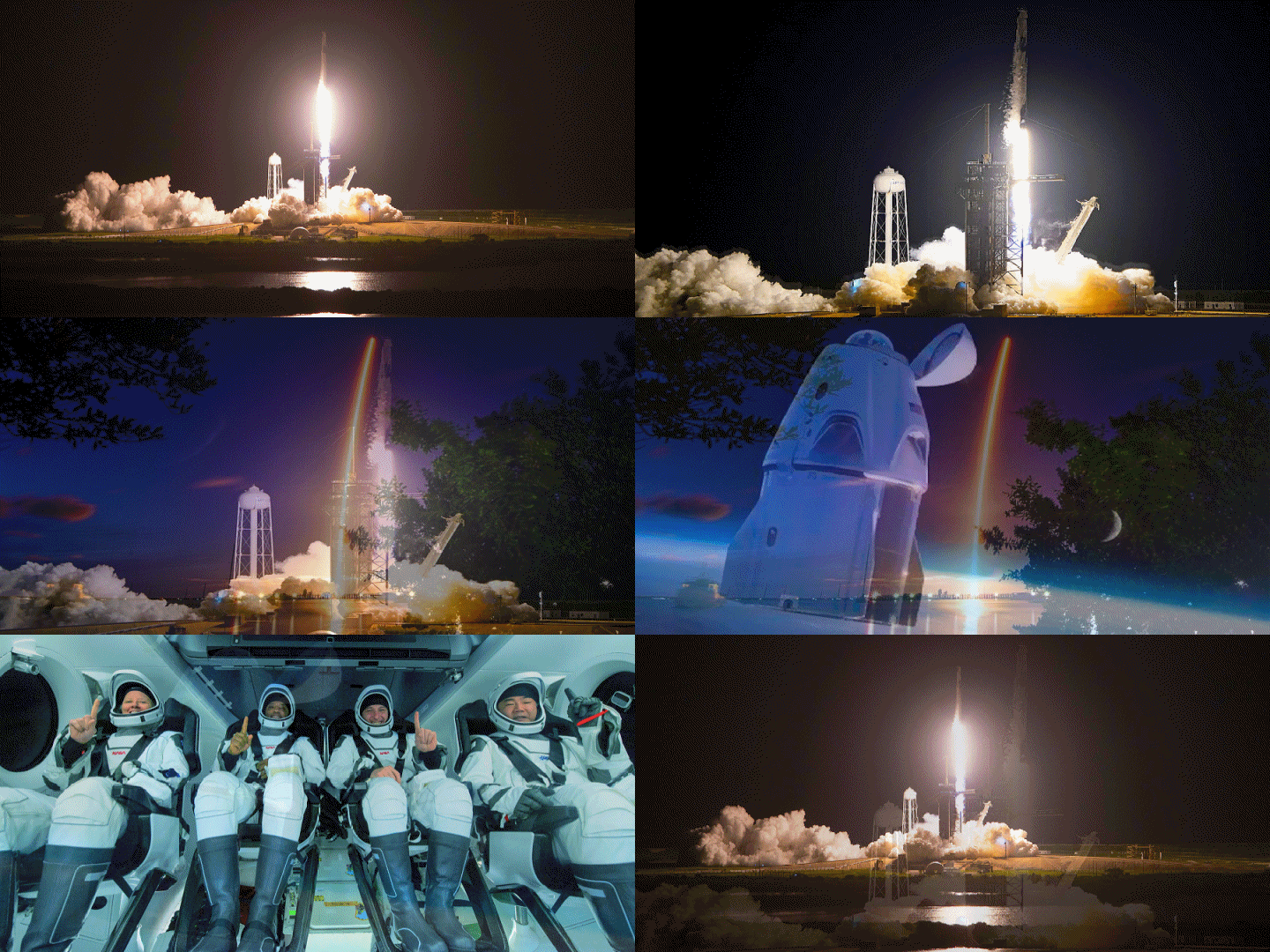 Passengers took off from the legendary Launch Pad 39A at NASA's Kennedy Center, Florida, where the Apollo missions took off to the moon, boarding a Falcon 9 rocket. Atop the Falcon 9 rocket, which measures 70 meters high, is perched the Dragon capsule, where the crew is located. This spacecraft has already taken 10 astronauts to the International Space Station (ISS) on three separate missions.
The Dragon capsule (8m high, 4m in diameter) has been modified here: a huge glass dome has been installed to offer passengers a 360 ° view of the vacuum of space. It replaces the system normally intended to dock with the ISS. The Dragon capsule will then remain in space for three days. It will go further than the ISS, which rotates at an altitude of 400 km, aiming for an orbit of 575 km. It will then begin a vertiginous fall towards the Earth, and will land off the coast of Florida, slowed down by immense parachutes. This time, it is about going to fly further than the International Space Station. "The risk is not zero", recognizes Jared Isaacman in one of the episodes of the documentary broadcast by Netflix on the mission. “You are traveling in a vessel at 28,000 km / h around the globe.This kind of environment is associated with some risk. "
Called Inspiration4, this mission is to conclude a summer marked by the flight of billionaires over the final frontier: first Richard Branson on July 11, aboard the Virgin Galactic ship, then a few days later Jeff Bezos, with his company Blue Origin.
A crew of novices
This 100% tourist mission was chartered by billionaire Jared Isaacman, at his expense. This 38-year-old American, married with two daughters, is the CEO of the company Shift4 Payments, which offers a service for processing bank card transactions to stores and restaurants. He created it when he was 16, from the basement of the family home. Passionate about piloting, he holds a record for circumnavigating the world in a jet and is qualified to fly on military aircraft. He is a captain on board.
Three anonymous are on the trip, selected by the billionaire through an original process that began with an advertisement projected during the Super Bowl halftime. Each seat is meant to embody a value. Hayley Arceneaux, survivor of pediatric cancer, represents "hope". The 29-year-old was selected because she works as a medical assistant at St Jude's Pediatric Hospital in Memphis, Tennessee. She is the youngest American to be sent into orbit around the Earth and the first person with a prosthesis to go to space, and she is the medical lead of the mission.
Chris Sembroski, 42, got the seat of “generosity”. He is a former US Air Force employee who now works in the aviation industry and was selected after making a donation as part of the fundraiser for St Jude's Hospital. Its role is to help manage cargo on board, and communications with Earth.
Finally, the last seat represents "prosperity", and was offered to Sian Proctor, a 51-year-old professor of earth sciences who, in 2009, almost became an astronaut for NASA. She took part in an experiment in Hawaii simulating life on Mars, and twice applied to NASA to become an astronaut. In 2009, she arrived among the finalists (a few dozen out of more than 3,500 candidates at the start). She is the fourth African American woman to go to space. She is the mission pilot, assisting the commander. It won its seat by creating an online sales site linked to the space, as part of an entrepreneurial competition organized by Jared Isaacman's company.
None are professional astronauts.
A training of several months
All four of them trained for just under six months, compared to years for astronauts. They experienced the g-force to which they will be exposed thanks to a centrifuge, a rapidly rotating arm of several meters. On board parabolic flights, they have already tasted a feeling of weightlessness. They also did a high altitude snow trek on Mount Rainier in the northwestern United States.
Finally, although the flight will normally be fully automated, the passengers have been trained by SpaceX to be able to take control in the event of an emergency.
Science
During the three days in orbit, their sleep, heart rate, blood and cognitive abilities will be analyzed. Tests will be carried out before and after the flight, to study the effect of the trip on their body.
A Netflix series to follow the adventure
Inspiration4 can be followed in a documentary series called Countdown on Netflix. Five episodes are planned in total on this mission. Four episodes of this series have already been put online on the platform presenting first the four members of the crew, then the training and the final preparations before the flight. The last, which will be broadcast at the end of September, "just a few days" after the end of the mission.
The start of space tourism on a larger scale
The stated goal of the mission is to open the doors of space to more people.
Several tourist mission projects are already underway. In January 2022, three businessmen will travel to the ISS alongside an experienced astronaut. SpaceX is also planning another trip to orbit for four private clients, organized by intermediary company Space Adventures. Finally, the Japanese billionaire Yusaku Maezawa must also take a trip around the Moon, a priori in 2023, this time aboard the Starship rocket, still under development by SpaceX.
As for Virgin Galactic, the start of regular commercial operations is scheduled for 2022. Russia, for its part, will send an actress and a director to the ISS, aboard a Soyuz rocket. The goal: to shoot the first fiction film in orbit and in zero gravity.
Elon Musk, boss of Space X, believes that humans have a vocation to become a multiplanetary being.
|
|
|
|
| Paul Emison for DayNewsWorld |
|
INTERNATIONAL SPACE STATION
A FIRE AND CRACKS IN THE RUSSIAN ZVEZDA MODULE |
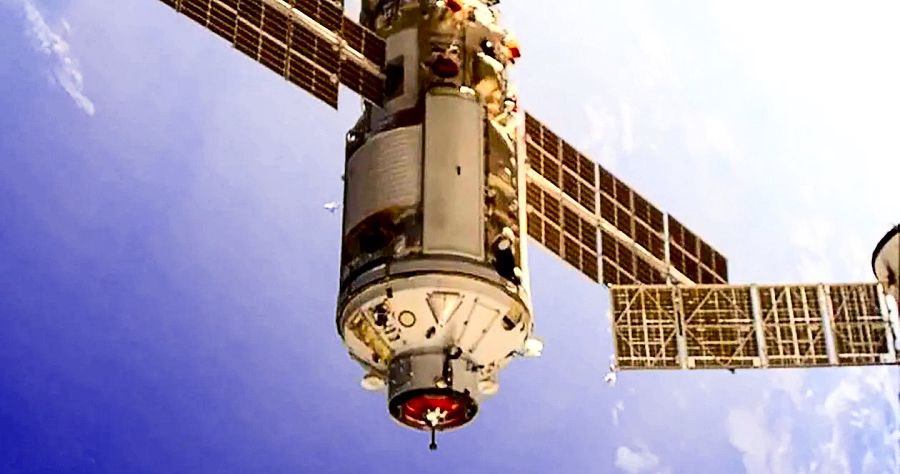
Could the life of the ISS be extended until 2030, as the Russian “segment” flight director Vladimir Soloviev said on Monday 6 September 2021, aware however that an “avalanche of failures ”would take place after 2025? As late as Thursday, September 9, astronaut Thomas Pesquet reported that a smell of burning plastic had spread through some modules of the International Space Station.
A fire is said to have started in the Zvezda service module, which is part of the Russian wing of the station. The kind of thing you don't like to see 400 kilometers above Earth, in a capsule stuffed with oxygen and therefore highly flammable.
This incident, which certainly did not damage anything, follows several other incidents on board the ISS in recent months. In 2019 and early 2021, the Zvezda module had notably experienced air leakage problems. On the Zvezda module which dates from 1998, the oldest, two cosmonauts spotted mini-cracks at the end of August. Vladimir Soloviev, chief engineer of RKK Energuia - a company responsible for maintaining the Russian part of the station -, also shared the cracks detected on the Zvezda cargo module.
"About 80% of flight systems are at the end of their service life, which means that once all the systems have exhausted their service life, the next day irreparable breakdowns could occur," he said. -he adds. What revive the question of the obsolescence of the Russian module on which cracks appear.
However, Roscosmos does not plan to do major works in the ISS. And for good reason: Russia is clearly thinking of withdrawing from the ISS (United States, Canada, Japan, European Space Agency) in order to launch its own space station, or even a lunar base with China.
Who will therefore take care of the maintenance of this part of the ISS? On the western side, we plan to use the station at least until 2024.... |
|
|
|
| Paul Emison for DayNewsWorld |
|
JEFF BEZOS AND RICHARD BRANSON
ARE NOT ASTRONAUTS ! |
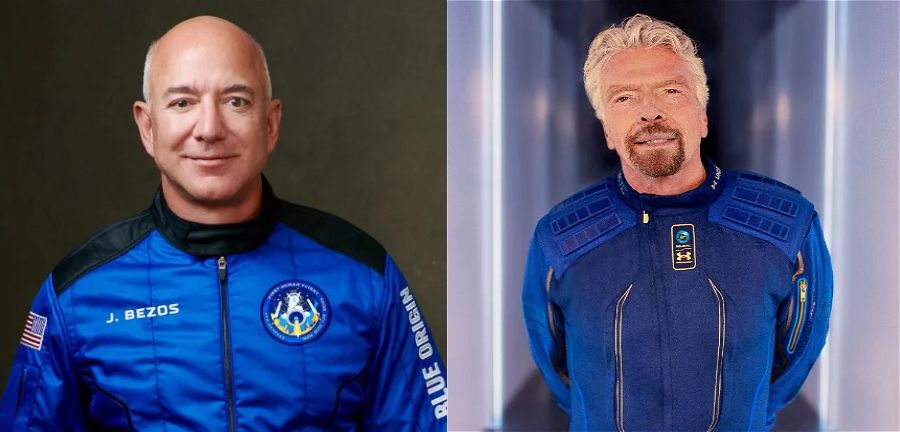
You don't want an astronaut. It's not enough to take a little trip to space to be an astronaut, no offense to Richard Branson and Jeff Bezos. While the two billionaires left the Earth's atmosphere on Sunday July 11 and Tuesday July 20 respectively, the Federal Aviation Administration (FAA) saw fit, on the very day of the Amazon boss's flight, to clarify the definition of the title of "astronaut", notes the BBC, and this by giving a more restrictive definition of the profession. . Also according to the BBC, the regulations in this area had not been amended since 2004, when the category of commercial astronauts was created.
In a press release, the organization certainly recalls the conditions for obtaining the "wings" of an astronaut, in particular in terms of altitude reached and training. But the FAA adds that an astronaut is a "member of the crew", who participated in the piloting and "contributed to safety during space flight". It is therefore also necessary to have been responsible, during the flight, for activities "essential to public safety", or which "have contributed to the safety of manned space flights". The American administration therefore seems to want to recognize the difference between a Neil Armstrong and a Jeff Bezos: sitting in your seat enjoying the trip therefore does not count. As passengers on "tourist" flights, the two billionaires are excluded from the profession of "astronaut".
A possible honorary distinction
As mere passengers on their respective flights, it therefore seems that Richard Branson and Jeff Bezos cannot claim the title of astronaut. The FAA press release nonetheless mentions “honorary awards given on the basis of merit”. not denying the contribution of billionaires to the development of the space sector. However, the FAA recalls that it has full discretionary power over the attribution of these honorary “wings”. It will not be up to whoever financed a flight to declare himself an “astronaut”. Only the FAA gives their “wings” to passengers on American space flights, whether commercial or not.
All hope is therefore perhaps not lost for the two billionaires in space.
|
|
|
|
| Paul Emison for DayNewsWorld |
|
THE RECORDS OF ASTRONAUT
THOMAS PESQUET IN SPACE
|
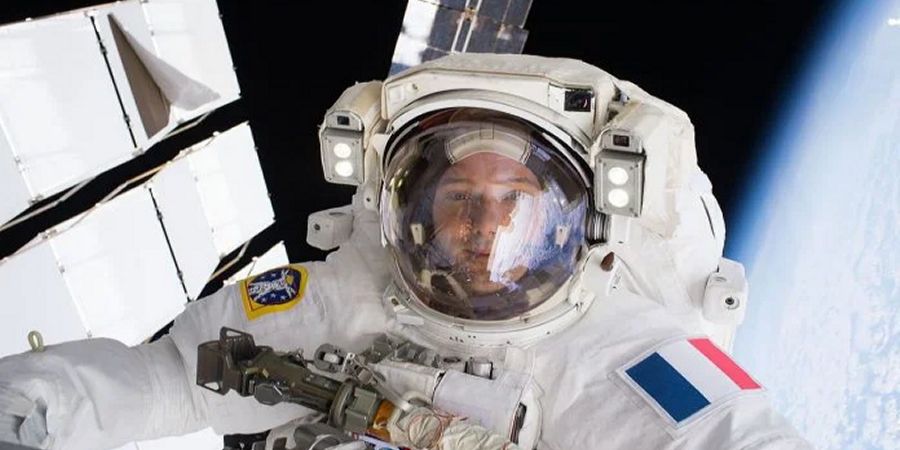
Thomas Pesquet has boarded the International Space Station (ISS) for the second time and at the end of his six-month stay he will become the first French commander of the ISS. During this period, the astronaut will conduct various experiments above the Earth and the scientist very regularly publishes on his social networks splendid pictures of certain parts of the blue planet taken from space. Thomas Pesquet therefore makes his social networks a real logbook of his experience in the space station.
A record spacewalk
Thomas Pesquet returned to the interior of the International Space Station without incident on Sunday, June 20, 2021, after another spacewalk lasting more than six hours. On this occasion, the French astronaut broke a record.
Never has a French astronaut spent so much time in space! Thomas Pesquet is since Sunday the tricolor record holder of duration in terms of spacewalk, with a total of 26 hours and 15 minutes accumulated on the clock.
A 19-year-old record that was until now held by French astronaut Philippe Perrin, during his only mission in 2002 aboard the International Space Station (ISS). He had then donned his spacesuit three times for a cumulative duration of 19 hours and 31 minutes, in the company of the American astronaut Franklin Chang-Diaz.
Thomas Pesquet carried out this Sunday the fourth extra-vehicular outing (EVA) of his career, the second after that of Wednesday which could only be partially accomplished due to a series of technical incidents.
Installation of a solar panel
For 6 hours and 28 minutes, the tricolor astronaut and his American teammate Shane Kimbrough completed the installation of a first latest generation solar panel, attached by two cables to the Space Station running 400 kilometers above the Earth....
The two "mechanics" then began to install a second. Six in total, these solar panels, called iROSA, are supposed to increase the power generation capacities of the ISS.
Soon another record on his hunting board ?
Philippe Perrin nevertheless retains two other records. Starting with that of the longest spacewalk for a Frenchman, which is still 7 hours and 17 minutes. During his Wednesday, Thomas Pesquet however almost dethroned him ... within two minutes. Following a problem in the transmission of data to check the condition of the suit, his teammate Shane Kimbrough had to return to the Station's airlock and perform a reset, before exiting. Meanwhile, the Frenchman was waiting for him, hanging by his feet on a robotic arm. The mission finally resumed, but a precious hour was lost. It only lasted "only" 7 hours and 15 minutes.
The first to take command of the ISS
Another record is still held by Philippe Perrin: that of the number of spacewalks during a single mission, three in total. NASA is however planning a new spacewalk on June 25 for the duo to complete the installation of the second solar panel. Thomas Pesquet should therefore at least equal him.
To end this new odyssey on a high note, the Normand will also become the first Frenchman to take control of the space laboratory for about a month, towards the end of his six-month mission. “I am incredibly honored ! (...) I am fortunate to be the first Frenchman at the controls of a space vehicle ", rejoiced the former airline pilot of 43 years at the time of the announcement." It is a very special honor ”, also underlined a spokesperson for the European Space Agency (ESA).
New posts on Instagram
The companion of Anne Mottetl posted on Instagram, impressive photos of his exit off the International Space Station and was able to testify of his unique experience.
"It was a real fight"
“It was both a magical experience and a real struggle; I'm not ready to forget this little trick at the end of the robotic arm, holding equipment that is 3 times my weight, the slightest movement causing it to gain inertia ”, he first wrote before to add:
“Visually it was a bit like holding a fridge, hanging up by the feet, head upside down on a steep wall a few kilometers away. A lot of things didn't go as planned, but I'm really proud of the team who fought for solutions ”.
A unique experience
A few moments later, Thomas Pesquet thanked the entire team which was present and which made this operation successful. “Shane equal to himself in composure and professionalism, the team at the control center at the top, the colleagues with the robotic arm or who put us in the spacesuits (and we got out of them).
I might still be on the adrenaline rush, but I don't think we can find better (or we'll have to prove it to me). We will try to take a little rest while waiting for the rest of the operations, ”he wrote. |
|
|
|
| Paul Emison for DayNewsWorld |
|
CHINA LETS THE ZHURONG ROBOT ON MARS
|
Mars has proven to be an elusive goal, with most missions since 1960 from Russia, Europe, Japan and India failing. And yet China has just achieved it again.
The remote-controlled robot "Zhurong" has indeed landed successfully on the red planet, according to a Chinese state media. A flawless: China succeeded on Saturday in landing a small remote-controlled robot on the surface of Mars, a first for the Asian country during a particularly delicate mission.
"The Tianwen-1 lander successfully landed in the predefined area" on Mars with the robot "Zhurong" on board, state television CCTV reported, which broadcast a special edition titled "Nihao Huoxing" (Hello Mars ), and specified that a "signal" had been received on Earth. The landing took place in an area of the red planet called "Utopia Planitia", a vast plain located in the northern hemisphere of Mars.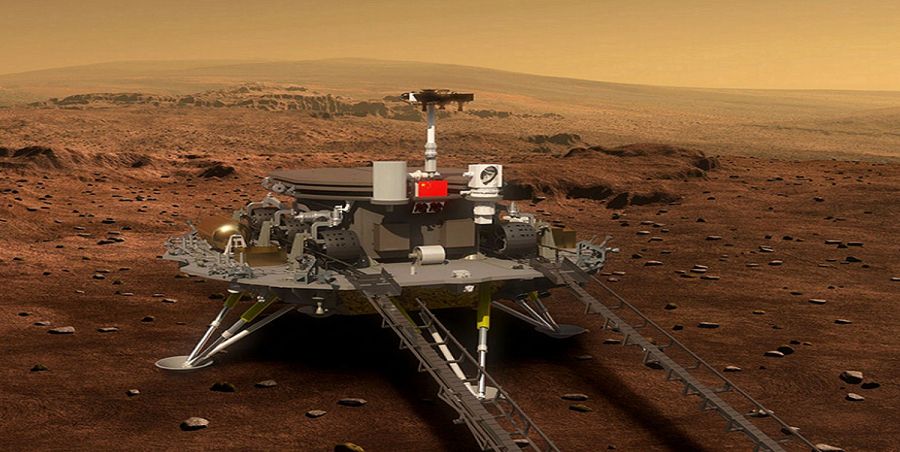
Landing on the Red Planet is far from easy: in the past, many European, Soviet and American missions have failed. In 2011, China did try to send a probe to Mars, during a joint mission with Russia. But the attempt had collapsed and Beijing has since resolved to continue the adventure alone.
The Chinese thus launched in July 2020 from Earth their uninhabited mission "Tianwen-1", named after the probe sent into space. This is made up of three elements: an orbiter (which revolves around Mars), a lander (which has landed on the red planet) and on board a remote-controlled robot, "Zhurong".
In February, "Tianwen-1" had moved into Martian orbit and managed to take pictures of the red planet. Early Saturday, China managed to land the lander, which should allow the robot "Zhurong" to come out. Carrying out these three operations during an inaugural mission to Mars is a world first.
Radar, lasers and solar panels
For this first attempt alone, the ambitious Chinese wanted to do everything the Americans have achieved in several Martian missions since the 1960s.
Weighing around 240 kg, "Zhurong" is to conduct soil and atmosphere analyzes, take photos and map the red planet. China already has experience in this area: it rolled two small robots on the Moon, the “Jade Rabbits” 1 and 2 - deposited in 2013 and 2019 respectively.
The mission to Mars must also look for possible signs of past life. "Zhurong" is equipped with solar panels for its power supply and is supposed to be operational for three months. The robot is also equipped with cameras, radar and lasers which will allow it in particular to study its environment and analyze the composition of Martian rocks.
He arrived on the Red Planet a few months after Perseverance, the rover from NASA, the US space agency, which landed on Mars on February 18 with the mission of looking for proof of past life.
The name "Zhurong" was chosen after an online survey and refers to the god of fire in Chinese mythology. A symbolism justified by the name in Chinese of Mars: "huoxing", literally "the planet of fire".
All-round space ambitions
China is investing billions of euros in its space program, in order to catch up with Europe, Russia and the United States. It sent its first astronaut into space in 2003. China is also launching satellites for itself or on behalf of other countries. And in 2019, she landed a device on the far side of the Moon - a world first. Last year, samples of the Moon were brought back to Earth.
The Asian giant also plans to assemble a large space station by 2022. And he hopes to send men to the Moon within ten years.
|
|
|
|
| Paul Emison for DayNewsWorld |
|
THE SCIENTIFIC EXPERIENCES CONDUCTED
BY THOMAS PESQUET ON BOARD THE ISS |
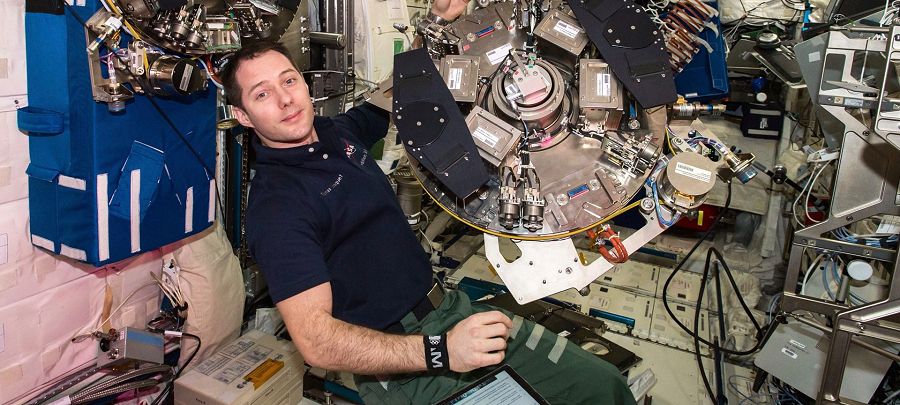
Improvement of surgical methods, fight against microorganisms, recycling of packaging, study of sleep, sport in the ISS ...
Thomas Pesquet will carry out a hundred experiments in space
As part of his “Alpha” mission, the French astronaut Thomas Pesquet will conduct a multitude of scientific experiments. In a six-month mission aboard the International Space Station (ISS). In all, the French astronaut will carry out around a hundred experiments, including 12 designed in Toulouse by the Center d'Aide au Développement des Activities in Microgravity and Space Operations (CADMOS). These experiments carried out in the European Colombus module of the station make it possible in particular to prepare longer space missions.
He will conduct a hundred experiments.
Thomas Pesquet's schedule will be loaded during his six months aboard the ISS. The French must carry out a hundred experiments. Twelve of them were designed by the Center for the Development of Microgravity Activities and Space Operations (Cadmos), which is located in Toulouse. These experiments will be carried out in the European Colombus module and aim, among other things, to prepare for long-term space missions.
In the viewfinder: the red planet. “The ultimate goal, at least within our reach for the next hundred years, is Mars, because it is the twin sister of the Earth, because it has a very similar history, because it has had liquid water , " Thomas Pesquet told" Special Envoy
Mini-brains
Asked about an experience that is particularly close to his heart, Thomas Pesquet mentioned that involving "mini-brains, brain stem cells (...) in a Petri dish". The aim is to study the aging of these stem cells to better understand pathologies such as Alzheimer's disease.
Dreams Study
Thomas Pesquet will also work for a study, called "Dreams", which focuses on the sleep of space travelers. Rachel Debs, neurologist at the Toulouse University Hospital, explains that we will "be able to monitor the sleep which we know is disturbed in space because it will not have the day-night alternation over 24 hours". Indeed, on board the ISS, humans "see the sun rise and set 16 times a day, this is not at all the normal rhythm for the organism and therefore sleep is disturbed for the astronauts. ", Continues the specialist." We have a sleep of a shorter duration, more fragmented, and the paradoxical sleep is also in proportion less important than on earth. "
A blob
Thomas Pesquet will also be accompanied by a blob, an organism neither animal, nor plant, nor fungus. This blob will be cultured aboard the International Space Station, under the watchful eye of the French astronaut.
Composed of a single cell, the "physarum polycephalum" is a living species apart. She has neither a mouth nor a brain, but moves, eats and has amazing learning abilities. Several specimens will be hosted on board the ISS. The goal is to see "if the blob behaves differently in space", and to study "the effects of microgravity and radiation on its evolution", specified the CNES.
Edible packaging
Scientific material is now packaged in bulky petroleum-based foams to send it into space. But for this mission, it will be transported in biodegradable and recyclable transport kits. Another particularity: part of the partitions will be edible! “It was a request from Thomas who told us: 'All these foams that we throw away, it's very nice but if we could do something with them and possibly eat them, it would not be worse. And we took him at his word, rejoices Alain Mayer, responsible for the “Eco pack” experience.
In this container, we have three cookies, two gingerbread, natural taste and ginger taste, we have Genoa bread and madeleine.
|
|
|
| | Paul Emison for DayNewsWorld |
|
|
|
SPACEX NASA THOMAS PESQUET FLIGHT TO THE ISS
|
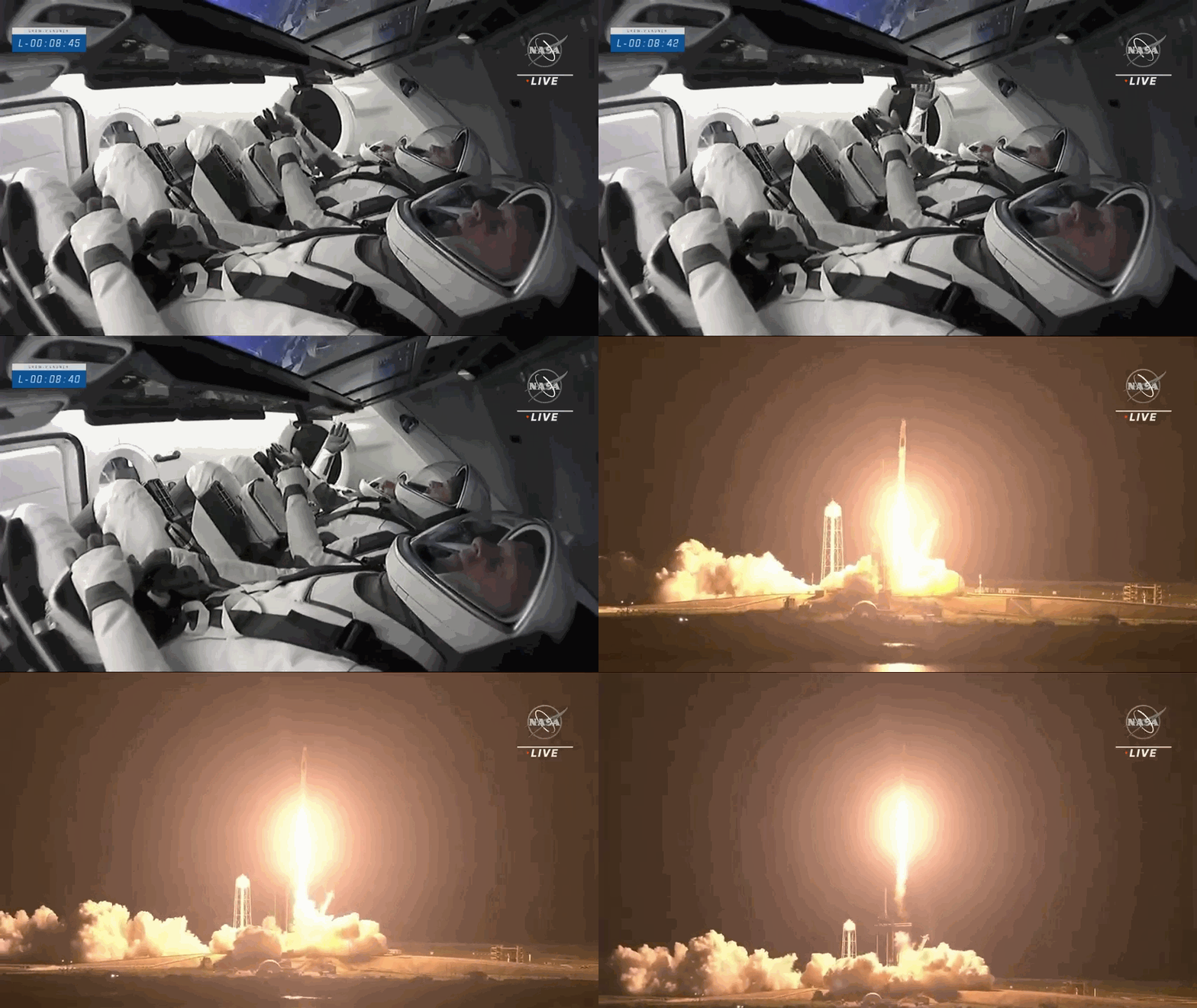
|
|
| Friday, April 23, 2021, Thomas Pesquet left Earth aboard the vessel Crew SpaceX Dragon towards the ISS.
The Falcon 9 rocket liftoff from Cape Canaveral in Florida took place as scheduled at 11:49 a.m. The flight of Thomas Pesquet was to take place the day before, Thursday, April 22, but the weather forced NASA to postpone the departure.
The French astronaut and his companions on the Alpha mission (Shane Kimbrough, Megan McArthur and Akihiko Hoshide will now sail in orbit for about twenty hours before docking with the International Space Station (ISS).
Falcon 9's first stage landed safely
SpaceX has confirmed that the first stage of the launcher managed to land on its platform. Falcon 9's first stage landed safely
Arrival on the ISS scheduled for 11:10 on Saturday
That's it, Thomas Pesquet is in orbit, the launch of the SpaceX rocket went perfectly.
But the road to the ISS is still long, around 18 hours, according to the ESA, despite an average speed of 26,000 km / h, because the trajectory is obviously not in a straight line, but spirals away from the Earth to approach the International Space Station, via very precise trajectories calculated in advance. |
|
|
|
| Paul Emison for DayNewsWorld |
|
THE MANUFACTURE OF OXYGEN ON MARS
NEW JOB FROM NASA |
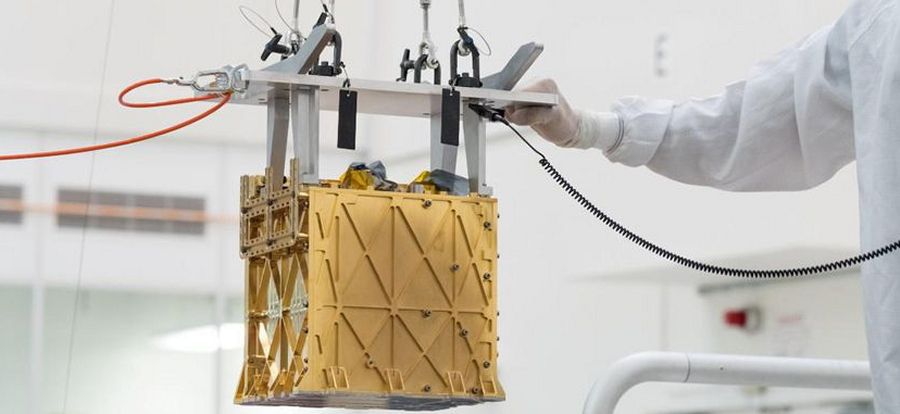
New prowess to the active persistence. The NASA rover transformed carbon dioxide from Mars' atmosphere into oxygen, a first on another planet, the US space agency announced on Wednesday April 21. “This is a crucial first attempt to convert the carbon dioxide to oxygen on Mars, ”said Jim Reuter, an associate administrator at NASA.
The demonstration took place on Tuesday, April 20, 2021, and NASA hopes that future versions of the experimental tool used can pave the way for exploration by humans.
Five grams of oxygen produced for ten minutes
Produced at the Massachusetts Institute of Technology (MIT), the Mars Oxygen In-Situ Resource Utilization Experiment (Moxie) is a golden box the size of a car battery, located on the right front of the rover. Moxie has been manufactured with heat resistant materials to tolerate the scorching temperatures of 800 ° C required for its operation.
He uses electricity and chemistry to split CO2 molecules, producing oxygen on one side and carbon monoxide on the other.For his first experiment, Moxie produced five grams of oxygen, enough to breathe. for 10 minutes for an astronaut with normal activity. The engineers in charge of Moxie will now conduct more tests and try to increase this result. The tool has been developed to be able to generate up to 10 grams of oxygen per hour.
An efficient and practical method
According to MIT engineer Michael Hecht, a one-ton Moxie - this one weighs 17 kg - could produce the roughly 25 tons of oxygen needed for a rocket to take off from Mars. Mars' atmosphere, made up of 96% carbon dioxide, may prove to be easier than extracting ice from below its surface to make oxygen by electrolysis.
Not only could the process produce oxygen for future astronauts to breathe, it could also prevent the large amounts of oxygen needed to propel the rocket on the return trip from Earth.
One more step forward in the colonization of the red planet ?
|
|
|
|
| Paul Emison for DayNewsWorld |
|
HISTORIC FLIGHT OF INGENUITY
THE FIRST HELIPCOPTER TO FLY OVER MARS |
Three meters. This is the altitude at which Ingenuity, the first helicopter in history to be sent to Mars, made its first flight on Monday. His feat was filmed by the Perserverance rover from Martian soil.
After rising to three meters of altitude, having spent 30 seconds in suspension, the small NASA helicopter rested safely on Martian soil.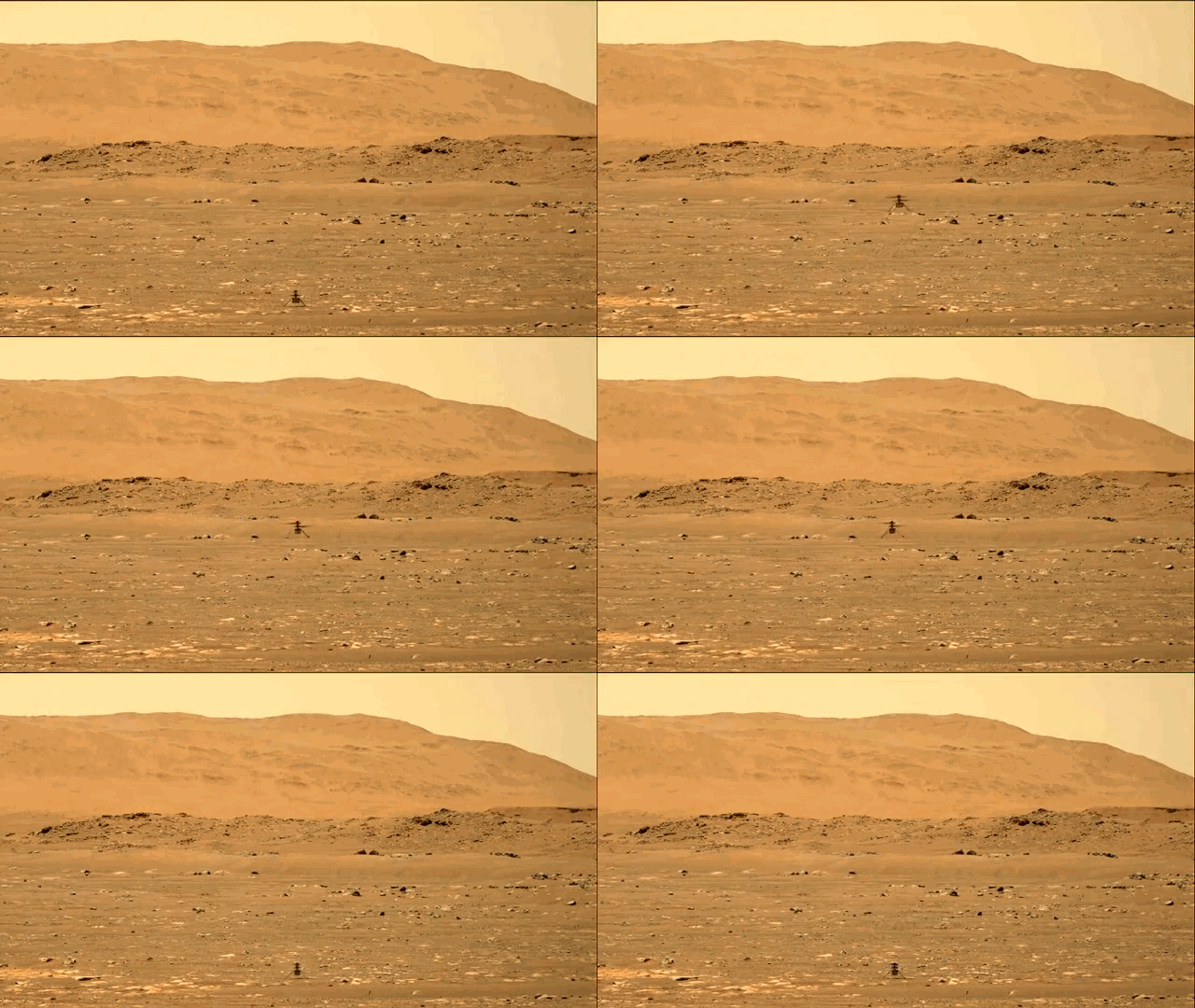
NASA's Ingenuity helicopter became the first motorized craft to fly to another planet on Monday, April 19.
"We can now say that humans flew a motorized device to another planet!" Enthusiastically Ms. MiMi Aung, helicopter project manager at NASA's Jet Propulsion Laboratory.
An unprecedented technical feat which brings the small twin-blade drone into the pantheon of aerospace history. This flight was filmed by the Perseverance rover, which arrived in February on the Red Planet. A few images have already been released, and the helicopter itself has sent a black and white photo, showing its shadow on the red planet.
Tuesday, the day after the flight, once its batteries are recharged, the helicopter must transmit a color photo of the horizon taken by its other camera. The full video taken by Perseverance is due to be transmitted in "the following days," said Elsa Jensen, head of the rover's cameras.
A real challenge
The operation was a real challenge, as the Martian air is of a density equivalent to only 1% of that of the Earth's atmosphere. However, it is by pushing the air while turning that the propellers can lift weight. On Mars, "there are simply fewer molecules to push," MiMi Aung explained before the flight.
To achieve this feat, even if the gravity is three times weaker there than on Earth, the NASA teams therefore had to develop an ultralight machine (1.8 kg), the blades of which turn much faster than a standard helicopter. . With its four feet and two superimposed blades (1.2m in length), it looks more like a large drone.
A second flight scheduled for Thursday
After this first success, NASA intends to embolden itself while time is running out, the lifespan of Ingenuity on Mars being one month. The second flight could take place as early as April 22. Other flights are planned, of increasing difficulty.
For its second flight, the helicopter is expected to climb to a height of five meters and move horizontally a few meters. If all goes well, Ingenuity will make a round trip of about fifty meters for his third attempt.
Two additional flights could take place, which will test the machine in more daring flight configurations and in particular at one hour of the Martian day when the winds are felt. |
|
|
|
| Paul Emison for DayNewsWorld |
|
AMAZING IMAGE ICE DUNES ON MARS |
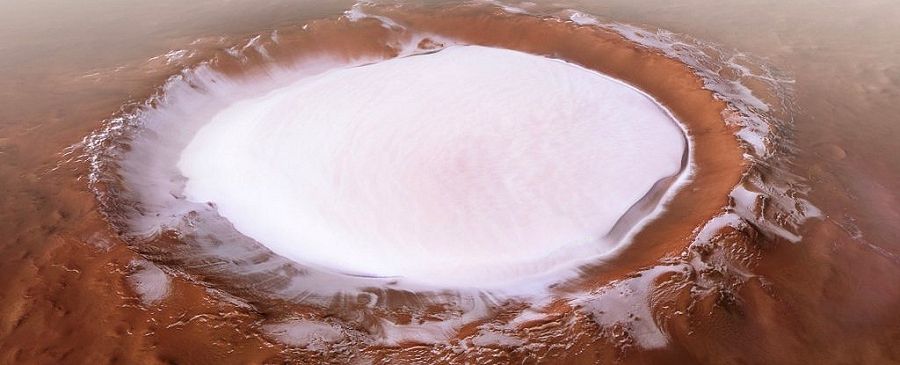 NASA's Mars Reconnaissance Orbiter, commonly known as MRO, has been deployed since 2005. The goal of its space mission is to map the surface of Mars. NASA's Mars Reconnaissance Orbiter, commonly known as MRO, has been deployed since 2005. The goal of its space mission is to map the surface of Mars.
This photo was captured by the spacecraft and shared by NASA on its website. According to the US space agency, “a field of sand dunes occupies this frosted crater 5 kilometers in diameter in the high latitudes of the plains north of Mars.
Some dunes have separated from the main field and seem to climb the slope of the crater along a kind of ravine ”. Indeed, a study published last year revealed that the planet Mars would have been covered with glaciers and not rivers.
Breathtaking Martian icy dunes
The image of the Orbiter probe is totally captivating. Thanks to its high definition, it allows us to see the different textures at the bottom of the crater. NASA effectively explained that the striped and lobed patterns "indicate seasonal thaw caused by sublimation of ice."
The Mars Reconnaissance Orbiter took this image in February 2021. It used its camera called “High Resolution Imaging Experiment” or HiRiSE. It was then about 315 kilometers above sea level from the red planet.
The Orbiter probe also managed to capture an image of the Perseverance rover landing on Mars on February 18. |
|
|
|
| Alyson Braxton for DayNewsWorld |
|
There are no translations available.
L'ASTRONAUTE FRANCAIS THOMAS PESQUET COMMANDANT DE BORD DE L'ISS
|
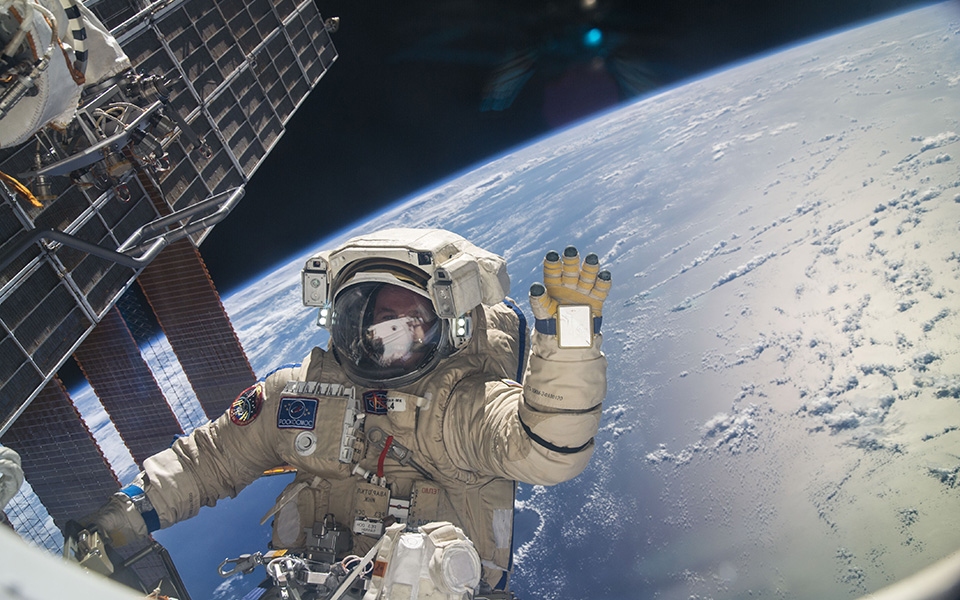 Thomas Pesquet, qui doit s'envoler le 22 avril pour sa deuxième mission sur la station spatiale internationale (ISS), sera commandant de bord durant une partie de son séjour en orbite, a annoncé mardi l'Agence spatiale européenne. Thomas Pesquet, qui doit s'envoler le 22 avril pour sa deuxième mission sur la station spatiale internationale (ISS), sera commandant de bord durant une partie de son séjour en orbite, a annoncé mardi l'Agence spatiale européenne.
C'est la première fois qu'un astronaute français se voit désigner commandant de bord de l'ISS. Il sera assigné à cette tâche pendant environ un mois, vers la fin de sa mission dans l'espace, qui doit durer six mois. « Je suis incroyablement honoré ! », s'est réjoui Thomas Pesquet lors d'une conférence de presse virtuelle de l'ESA.
« Ça fait trois commandements européens à la suite pour trois missions sur l'ISS. Ça montre la place centrale que prend l'Europe de plus en plus dans la station spatiale, et pour les futures explorations lunaires », a-t-il ajouté.
La fonction de commandant est exercée tour à tour par les membres désignés de l'équipage de l'ISS. «C'est comme un bateau, il y a un seul maître à bord après Dieu», a commenté Thomas Pesquet. «Évidemment, il y a beaucoup de choses qui se décident au centre de contrôle au sol», a-t-il expliqué, mais «quand ça va mal et qu'il faut réagir vite, c'est le commandant qui décide, qui assigne un peu les tâches, par exemple si on doit faire face à un départ de feu ou une dépressurisation».
Thomas Pesquet, qui a été pilote de ligne, sera le premier Européen à rejoindre l'ISS à bord d'un vaisseau privé américain, la capsule Crew-2 Dragon de Space X, qui doit décoller depuis la Floride le 22 avril avec trois autres astronautes à bord.(les Américains Megan Mc Arthur et Shane Kimbrough, et le Japonais Akihiko Hoshide).
A la fin de son séjour dans l'espace, Thomas Pesquet devrait être rejoint par un autre astronaute de l'ESA, l'Allemand Matthias Maurer.
« Ça arrive très rarement que deux Européens travaillent ensemble sur l'ISS, ce serait un beau symbole qu'on puisse travailler ensemble », espère Thomas Pesquet.
|
|
|
|
| Paul Emison pour DayNewsWorld |
|
A JOURNEY AROUND THE MOON A BILLIONAIRE OF JAPANESE OFFERS EIGHT SEATS TO ACCOMPANY HIM ON BOARD THE STARSHIP ROCKET
|
If it has long been an old dream of science fiction writers, space tourism today represents a concrete field for which many companies have launched projects. This is particularly the case with SpaceX, whose commercial reusable rocket Starship is currently being tested.
Elon Musk's company has teamed up with Japanese billionaire Yusaku Maezawa for the dearMoon project, which involves traveling around the moon in 2023. And the billionaire, online fashion mogul, art collector contemporary and patron, offers eight tickets to people around the world to accompany him on a space tourism trip around the Moon, scheduled for 2023 with SpaceX.
Yusaku Maezawa was the first private customer to book a flight aboard Starship, a future habitable rocket developed by US aerospace company Elon Musk, for an undisclosed fee. Initially, he planned to find a girlfriend for his flight around the Moon, by launching a strange contest with "single women aged 20 and over". He then changed his plans, not without having attracted nearly 30,000 applications, saying he wanted to invite six to eight artists instead.
On Wednesday March 3, 2021, in a video posted on his Twitter account, the 45-year-old billionaire finally opted for a broader recruitment policy, saying he is now convinced that "everyone who does something creative can be called an artist". “I invite you to join me on this mission. Eight of you from around the world, he said. I bought all the seats so it will be a private trip. Candidates will only need to meet two criteria, he said: be willing to "push the limits" of creativity and be willing to help other crew members do the same.
Pre-registration until March 14
In all, 10 to 12 people are expected to participate in the expedition supposed to circle the moon before returning to Earth, said Yusaku Maezawa. The schedule calls for aspiring astronauts to pre-register by March 14, and an initial screening is due a week later. An "initial screening" process begins on March 21, with a "final interview and medical examination. At the end of May.
The dearMoon mission will take three days to reach the Moon and loop around it, then another three days for the return trip.
Yusaku Maezawa and his companions will become the first lunar travelers since the last American Apollo mission in 1972, at least if SpaceX is able to complete this project on time. Indeed, two prototypes of its Starship rocket crashed on landing in recent months. "I am very confident that we will reach the orbital level with Starship before 2023 and that the safety will be sufficient for human flight in 2023. It is very promising," said Elon Musk in the video of Yusaku Maezawa released. this Wednesday.
SpaceX plans to launch its first space tourism mission for the fourth quarter of 2021, targeting low Earth orbit. This mission, called Inspiration4, will be carried out using the reusable Falcon 9 space launcher and SpaceX's Crew Dragon space vehicle, already used by NASA. It will host the American billionaire Jared Isaacman, who also offered three seats at his side. Her first elected, announced at the end of February, is a 29-year-old American survivor of pediatric cancer.
SpaceX has not disclosed its spending on the Starship program as of yet, but Musk previously estimated that he expected it to cost the company around $ 5 billion.
SpaceX's valuation has skyrocketed since Maezawa's initial announcement, from around $ 25 billion at the time to around $ 74 billion last month..
|
|
|
|
| Paul Emison for DayNewsWorld |
|
There are no translations available.
UNE IMPRESSIONNANTE PHOTO DE MARS
PUBLIEE PAR LA NASA
|
|
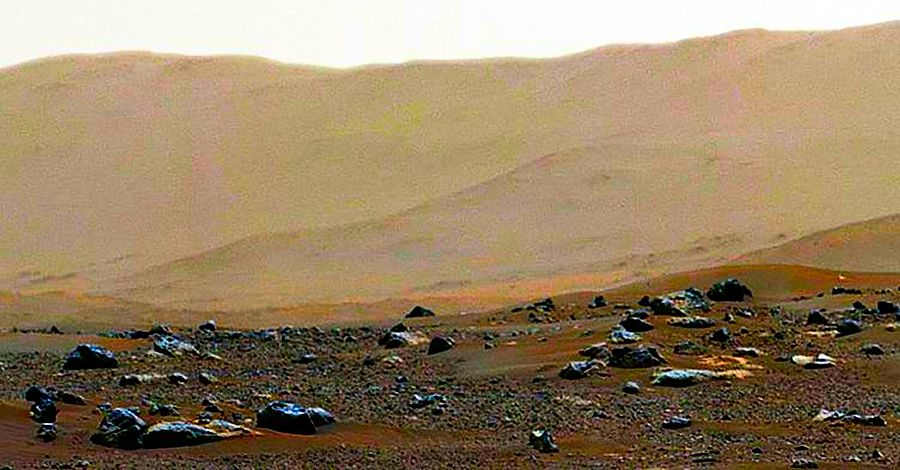 La Nasa a publié, mercredi 24 février, une spectaculaire photo panoramique de Mars prise par Perseverance dans la zone où le rover a atterri la semaine dernière : on se croirait dans une zone désertique ..La photo, reconstituée à partir de plusieurs clichés pris par le véhicule, montre la crête du cratère de Jezero, qui a contenu selon les scientifiques un profond lac dans lequel se jetait une rivière il y a environ 3,5 milliards d'années . La Nasa a publié, mercredi 24 février, une spectaculaire photo panoramique de Mars prise par Perseverance dans la zone où le rover a atterri la semaine dernière : on se croirait dans une zone désertique ..La photo, reconstituée à partir de plusieurs clichés pris par le véhicule, montre la crête du cratère de Jezero, qui a contenu selon les scientifiques un profond lac dans lequel se jetait une rivière il y a environ 3,5 milliards d'années .
Le rover a réalisé 142 clichés à 360 degrés avec les appareils haute définition installés sur son mât.
« Nous sommes installés sur un très bon site, d’où on peut voir des caractéristiques très similaires à celles trouvées par Spirit, Opportunity et Curiosity [trois rovers ayant précédé Perseverance sur la Planète rouge] sur leur zone d’atterrissage », s’est réjoui Jim Bell, de l’université de l’Arizona.
L’agence spatiale américaine a comme but explicite de trouver des traces de vie ancienne sur la Planète rouge, en collectant pendant au moins deux ans jusqu’à une trentaine d’échantillons de roche.Les caméras de Perseverance aideront les scientifiques à déterminer l’histoire géologique et les conditions atmosphériques du cratère, et identifier les rochers et les sédiments qui seront prélevés avant d’être transportés sur Terre lors d’une future mission, prévue dans les années 2030.
La NASA avait déjà diffusé, lundi, deux documents exceptionnels capturés par son rover, une spectaculaire vidéo de son atterrissage enregistré sous tous les angles, et le son d’une bourrasque de vent martien, premier audio enregistré sur la Planète rouge par un micro.
|
|
|
|
| Paul Emison pour DayNewsWorld |
|
There are no translations available.
LE ROVER PERSEVERANCE A ATTERI SUR MARS
|
«Atterrissage confirmé ! », s'est exclamée Swati Mohan, en charge du contrôle des opérations d'atterrissage de Perseverance. Le robot de la Nasa s'est posé sur Mars, jeudi 18 février 2020 . Perseverance a posé ses six roues sur un site d’atterrissage « spectaculaire », le cratère de Jezero, au terme de « sept minutes de terreur », dixit la NASA, de la séparation du rover et de la capsule qui le transporte, au « touchdown », en passant par l’entrée atmosphérique. Des cris de joie ont retenti dans la salle de contrôle de Pasadena, en Californie.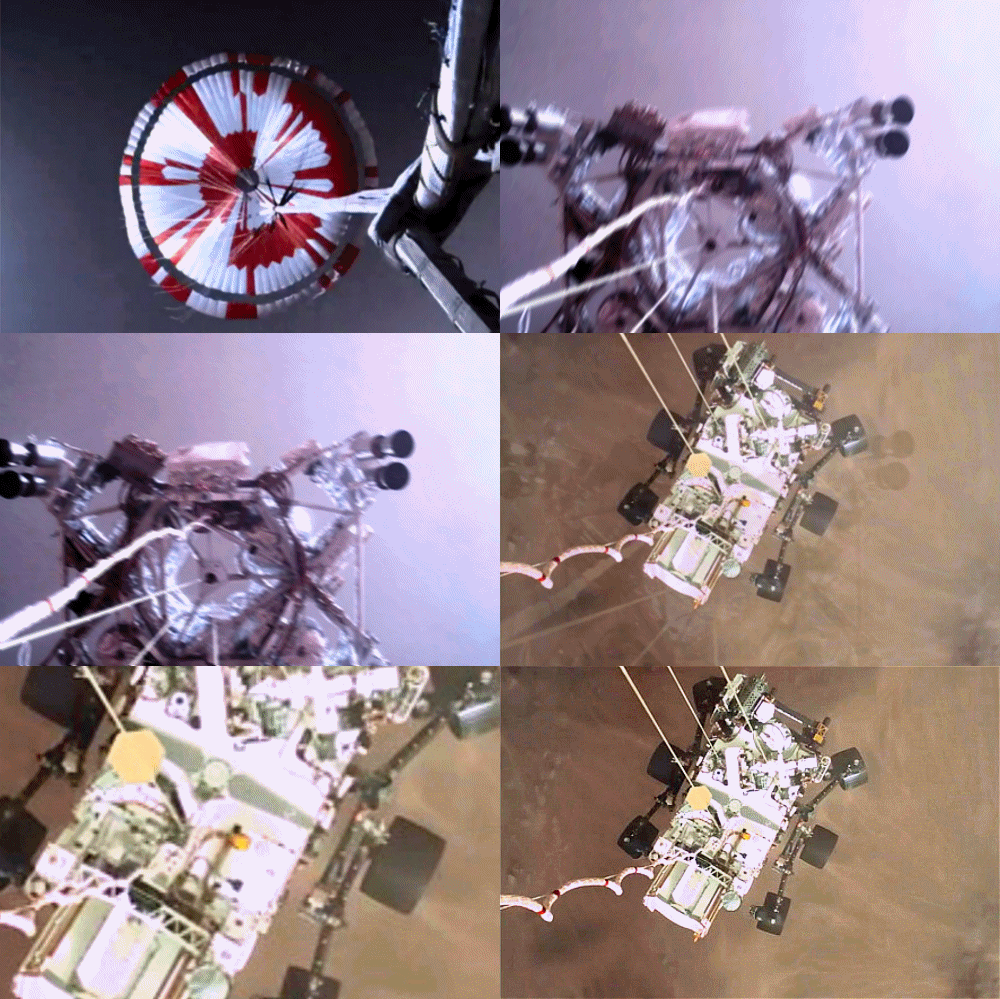
Après être entré dans l'atmosphère martienne avec une vitesse de 20 000 km/h, les frictions avec l'air ont fait monter la température du vaisseau jusqu'à 1300°C.
Le rover était protégé par un bouclier thermique, qui n'a été largué qu'après l'ouverture d'un immense parachute supersonique. Huit rétrofusées ont fini de le
La mission Mars 2020, qui a décollé fin juillet, a transporté Perseverance, le véhicule le plus gros et le plus avancé jamais envoyé sur la Planète rouge.
Construit par la NASA, il pèse une tonne, est équipé d’un bras robotique de plus de deux mètres, de pas moins de 19 caméras et, pour la première fois, de deux micros. Arrivé à bon port, jeudi 18 février, c’est le cinquième rover à réussir le voyage depuis 1997.
Mars 2020 est la première mission ayant explicitement pour but de prouver qu’il y a eu de la vie sur la Planète rouge. Les chercheurs pensent que le cratère de Jezero abritait, il y a plus de trois milliards et demi d’années, un profond lac d’environ 50 km de large. A l’époque, « Mars était très similaire à la Terre sous de nombreux aspects. Elle avait une atmosphère conséquente, des lacs et des rivières », selon les scientifiques.
Perseverance devrait prélever des échantillons qui devront être analysés par les laboratoires les plus performants sur Terre pour y distinguer, peut-être, les traces microscopiques d’anciens organismes. Les tubes contenant les échantillons seront précieusement conservés sur Mars jusqu’à ce qu’une mission ultérieure soit capable de revenir les chercher, dans les années 2030.
La Nasa a rapidement communiqué une photo prise par le rover sur place. « Bonjour le monde. Ma première vue sur la maison qui sera la mienne pour toujours », a tweeté le compte officiel du rover pour accompagner l'extraordinaire image en noir et blanc.
|
|
|
|
| Paul Emison pour DayNewsWorld |
|
There are no translations available.
MYSTERE DES MONOLITHES SUR TERRE ET DANS L'ESPACE
LE MYSTERE S'EPAISSIT !!
|
|
 Au Pays-Bas un cinquième monolithe est apparu. Au Pays-Bas un cinquième monolithe est apparu.
Après des apparitions de manière éphémère aux États-Unis (en Utah et en Californie), en Roumanie et au Royaume-Uni, des randonneurs sont tombés nez à nez avec un nouvel objet couleur métal dans la réserve naturelle du Kiekenberg.
«Je me suis approché mais il n'y avait rien à remarquer autour du monolithe.
C'était comme s'il avait été déposé depuis le ciel», a confié un des randonneurs qui a découvert cette installation. Un mystérieux «monolithe de métal» est apparu dans une lande du nord des Pays-Bas, ont confirmé lundi les autorités, après la découverte d'objets similaires aux États-Unis, en Roumanie et au Royaume-Uni.
Des randonneurs ont découvert l'objet dimanche sur un terrain privé proche de la réserve naturelle du Kiekenberg dans la province de la Frise, selon Imke Boerma, porte-parole de Staatsbosbeheer, l'organisation néerlandaise des gardes-forestiers.
«Nous savons qu'il a probablement été installé ce week-end car des randonneurs qui marchaient là l'ont trouvé (...). Mais nous ne savons pas comment il est arrivé à cet endroit», a confié Imke Boerma à
Des gardes-forestiers sont allés l'inspecter ce lundi matin et étaient encore à la recherche d'indices sur sa provenance. 
Monolithe sur Phobos Lune de Mars ! Un collectif appelé The Most Famous Artist et basé au Nouveau-Mexique a revendiqué la paternité du monolithe de l'Utah, mais pas celles des objets découverts en Roumanie, au Royaume-Uni et aux Pays-Bas.
Il continue de « pleuvoir » des monolithes mystérieux sur la planète. Un nouvel objet de ce type est apparu dans une lande du nord des Pays-Bas, ont confirmé lundi les autorités, après des découvertes similaires aux Etats-Unis, en Roumanie et au Royaume-Uni ces derniers jours.
 Des randonneurs ont découvert l'objet dimanche sur un terrain privé proche de la réserve naturelle du Kiekenberg, dans la province de la Frise, selon Imke Boerma, porte-parole de Staatsbosbeheer, l'organisation néerlandaise des gardes forestiers. Des randonneurs ont découvert l'objet dimanche sur un terrain privé proche de la réserve naturelle du Kiekenberg, dans la province de la Frise, selon Imke Boerma, porte-parole de Staatsbosbeheer, l'organisation néerlandaise des gardes forestiers.
« Nous savons qu'il a probablement été installé ce week-end car des randonneurs qui marchaient là l'ont trouvé […]. Mais nous ne savons pas comment il est arrivé à cet endroit », a confié Imke Boerma. Des gardes forestiers sont allés inspecter l'objet lundi matin et étaient encore à la recherche d'indices sur sa provenance.
Monolithe sur la Lune !! Un collectif appelé The Most Famous Artist et basé au Nouveau-Mexique a revendiqué la paternité du monolithe de l'Utah. Mardi dernier, des images ont été diffusées sur Internet montrant quatre hommes s'affairant de nuit pour démanteler l'étrange sculpture, qui a donné lieu à des nombreuses. |
|
|
|
| Paul Emison pour DayNewsWorld |
|
A BAG OF TEA TO HELP
THE INTERNATIONAL SPACE STATION
|
In September 2019, an air leak was spotted on board the International Space Station. At this time, no reason to worry, the station atmosphere can be maintained at a comfortable pressure, so the problem does not endanger the life of the crew.
A year later, however, the leak grew, forcing NASA to intervene. But before you could plug it, you had to know where it came from. For this, the astronauts had an ingenious idea involving a tea bag, says Numerama.
A small crack spotted
The investigations quickly led the astronauts to the Russian module of the ISS, the most dilapidated. Then, to precisely locate the leak, the crew members extracted tea leaves from a sachet and released them into the module. The latter, then suspended in microgravity, were observed using a device.
"We took several photos and videos of the direction of flight of the tea bag (...) and it shows precisely the direction in which the air is sucked in by the air leak", explains to the Russian space agency the cosmonaut Anatoly Ivanishin. The crew was thus able to see the tea leaves approaching a small crack in the hull of the module.
The leak repaired temporarily
The leak has been sealed with duct tape but this will not be enough in the long run. "The air pressure continues to drop, even if the rates of this drop have reduced," says Anatoly Ivanishin, which can be explained by the insufficiency of the adhesive tape, or by the existence of another leak. Additional equipment will be delivered during the next manned mission.
The International Space Station, some modules of which date from 1998, is experiencing several dilapidated problems, Numerama recalls. During the night of October 20-21, the Elektron-VM oxygen support system broke down in the Russian module. At the same time, the ISS was experiencing a malfunction in the food and toilet heating system. But this time too, the astronauts managed to fix everything. .
The ISS is one of the rare examples of cooperation between Moscow and Washington. Sixteen countries are participating in the 1998 orbiting station, outpost and orbital laboratory that cost a total of $ 100 billion, largely funded by Russia and the United States.
It is expected to be dismantled within the next decade, due to structural wear and tear..
|
|
|
|
| Boby Dean for DayNewsWorld |
|
MARCH CLOSEST TO EARTH
THIS TUESDAY OCTOBER 13, 2020 |
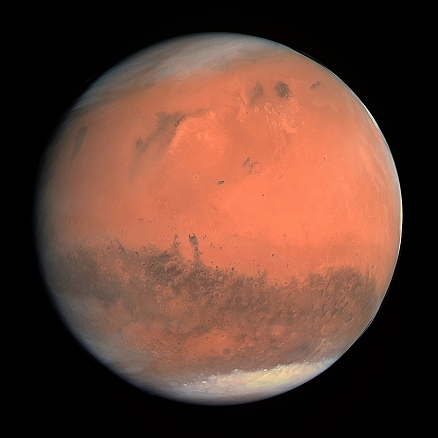
Go ! go ! go ! to your telescopes !
The time is ideal this Tuesday, October 13, 2020 to observe Mars in the sky, if the climatic conditions allow it. The planet is in a perfect position, closest to us until 2035.
“In opposition” is the current alignment of the red planet with respect to Earth. Mars will be directly opposite the Sun on the celestial vault.
The Earth will therefore be located between Mars and the Sun, offering a configuration that will show Mars larger in telescopes.
This "opposition" between Mars and the Sun gives the fourth planet a particularly bright appearance, brighter than Jupiter itself.
It will be observable without a telescope, provided you have good eyes ! Especially since last Tuesday, October 6, 2020, the planet Mars was already closest to Earth, at a distance of 68 million kilometers.
These conditions combined should offer us an impregnable spectacle this Tuesday.
Concretely, Mars aligns itself with the Earth on the same side of the Sun, approaching, before diverging again in their separate orbits around our star. But perfect alignment does not appear as often.
Mars and Earth do not have perfect circle shaped orbits and are not even on the same planes. For these reasons, these elliptical planets generally shy away from each other.
Earth only takes 365 days to complete an orbit around the sun while Mars takes 687 days. When the Earth gets closer to the sun, Mars moves away from it.
These elements explain why this phenomenon of opposition does not occur every earth year.. |
|
|
|
| Jenny Chase for DayNewsWorld |
|
DISASTER AVOIDED FOR THE INTERNATIONAL SPACE STATION (ISS)
UNDER THE THREAT OF SPACE DEBRIS |
This is the third time this year that the ISS has to maneuver to avoid space debris, not to mention the threatening potential conjunctions on a daily basis. The density of fragments and debris from ancient rockets or satellites launched over six decades is such that space objects number in the thousands.
The International Space Station (ISS) had to maneuver Tuesday, September 22 to avoid a possible collision with a debris of an old Japanese rocket, the third avoidance maneuver this year, announced NASA, which calls for more means to monitor the increasing number of objects in Earth orbit.
Remember that the ISS is 110 m wide, 74 m long and 30 m high for a mass of some 400 tonnes. Despite the small size of the debris of about 10 centimeters and, coming from a stage of a Japanese rocket launched in 2018 that had disintegrated into 77 pieces in February 2019, a collision with this most imposing orbital complex, can generate a risk of rapid depressurization .
Third avoidance maneuver this year
The debris would have passed just 1.39 kilometers from the ISS, according to NASA, but it was decided to raise the orbit of the station as a precaution. It was a Russian cargo capsule (Progress), moored at the station, which pushed the ISS a little higher by igniting its thrusters, for 2 and a half minutes, the operation being controlled in cooperation between the Russian control rooms and American.
The crew members, two Russians and an American, had to be temporarily placed in the Russian part of the ISS, in order to be able to evacuate urgently with the Soyuz capsule in case of danger, which was ultimately not necessary. . In June 2011, as in 2009, when it was no longer possible to perform an evasive maneuver, the occupants of the ISS had to take refuge in the Soyuz capsules after the detection of a potentially dangerous object.
According to the European Space Agency website, the ISS was about 421 km above the oceans before the operation, and 435 km after. It spins at around 27,500 km / h: at this speed, even a small object can seriously damage or even destroy a solar panel or other element.
Celestial pollution: thousands of space debris have been fluttering for 60 years
If space debris does not pollute space, strictly speaking, (it does not deteriorate it) as oil spills do for example, we still speak of pollution because there are so many of them that they become a nuisance. for human activities in orbit.
This type of maneuver is regularly necessary, and is expected to become more frequent with the increasing pollution of the Earth's surroundings by debris from old rockets or satellites launched for six decades, and by the thousands of fragments created by accidental or deliberate collisions. , for example with the shipments of anti-satellite missiles by India in 2019 and China in 2007.
The station had to avoid 25 times between 1999 and 2018, according to NASA. “The Space Station maneuvered three times in 2020 to avoid debris. In the past two weeks, there have been three potential high-risk conjunctions. Debris is getting worse! Tweeted Jim Bridenstine, administrator of NASA, who is demanding $ 15 million from Congress for the Office of Space Trade, a civilian service, to take over the monitoring of space objects and coordinate warnings to private satellite operators in the event risk of collision.
In addition to financial resources adapted to the context, NASA wishes to transfer this space surveillance to a civilian service
To date, a military unit is responsible for space surveillance.
|
|
|
|
| Paul Emison for DayNewsWorld |
|
THE PERSEIDES OF THE SHOOTING STARS
DO NOT MISS |
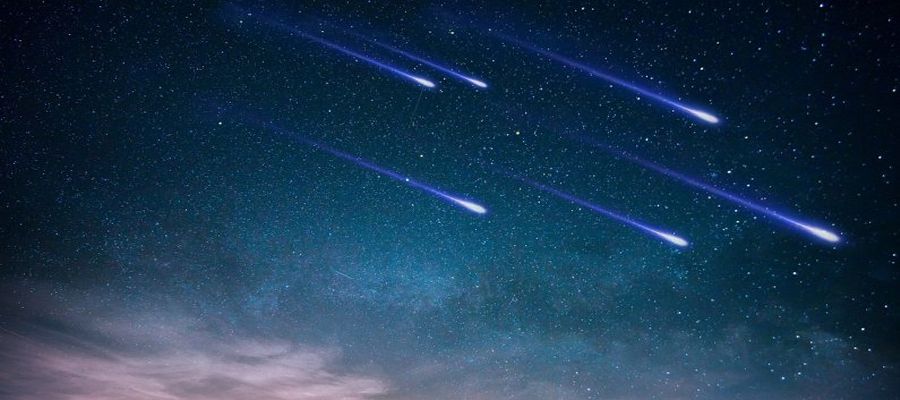 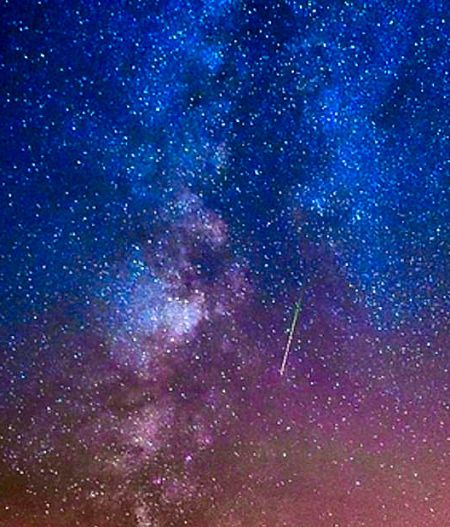
Like all years, having enjoyed the South Delta Aquarids, astronomy lovers can admire the Perseids in the sky.
The peak of this meteor shower is scheduled for the night of August 12 to 13.
The Perseid Peak is the peak of the meteor shower.
It occurs every year between mid-July and mid-August.
It is one of the three most beautiful events of this kind, along with the Quadrantids, in January, and the Geminids, in December.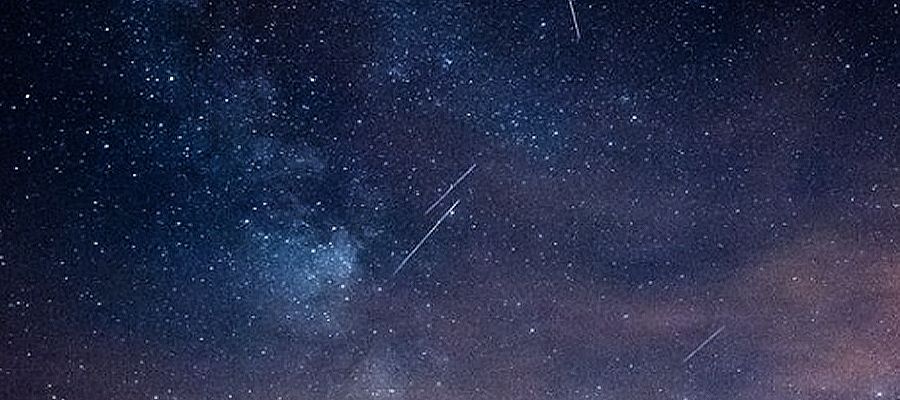
On its website, the French astronomical association explains that “the Earth is going through a cloud of dust left by comet Swift-Tuttle; on entering our atmosphere, these small dusts are consumed, leaving magnificent light trails. "
The Perseids originate from the debris of comet Swift-Tuttle. Under optimal weather conditions, it is possible to see more than a hundred shooting stars per hour.
It is still advisable to wait until the Moon is down to observe this phenomenon.
As with the Delta Aquarids, no equipment is required, it is possible to see the Perseids with the naked eye.
If you can't see the Perseids on the night of August 12-13, that's okay: the swarm is still active until the 24th, according to NASA..
|
|
|
|
| Paul Emison for DayNewsWorld |
|
There are no translations available.
LA RUEE VERS MARS
|
Direction Mars. Après les Émirats Arabes Unis lundi, la Chine a lancé jeudi 23 juillet 2020 avec succès une sonde spatiale depuis la base de Wenchang, sur l'île de Hainan. Embarquée à bord d'une fusée Longue Marche 5, la sonde spatiale Tianwen-1 (« Questions au ciel » en mandarin) est désormais en route vers la planète rouge. Un voyage qui durera sept mois. Le départ d'une sonde américaine est également prévu pour la fin du mois.
Il faut dire que les conditions de lancement sont particulièrement idéales en ce mois de juillet. La planète rouge, la Terre et le Soleil se retrouveront dans le même alignement à la fin de l'année, permettant aux missions de suivre la trajectoire la courte. « L'idée est de profiter de ce qu'on appelle l'opposition, moment où le Soleil, la Terre et Mars sont alignés exactement dans cet ordre-là , explique Olivier Sanguy, de la Cité de l'Espace . Le cycle de la mécanique céleste n'offre qu'une fenêtre de tir tous les 26 mois, pendant laquelle la distance entre Mars et la Terre est la plus courte. »
Les Emirats arabes unis ont été les premiers à se lancer durant le mois de juillet. Après deux reports de lancement, en raison du mauvais temps, la sonde émiratie Al-Amal (« Espoir » ), première mission spatiale arabe vers Mars, a décollé lundi depuis le centre spatial de Tanegashima (Japon). La sonde Al-Amal devrait amorcer son orbite autour de Mars d'ici à février 2021, marquant le 50e anniversaire de l'unification des sept principautés qui forment les Emirats arabes unis.Une fois sur place, elle doit faire le tour de la planète rouge pendant toute une année martienne, soit 687 jours terrestres. L'objectif est de fournir une image complète et inédite de la dynamique du temps dans l'atmosphère de Mars.
La mission chinoise, nommée Tianwen-1 (« Questions au ciel-1 »), est partie du centre de lancement de Wenchang, dans le sud de la Chine, ce jeudi 23 juillet 2020. Ambitieuse, la Chine espère faire, lors de cette première tentative indépendante, presque tout ce que les Etats-Unis ont réalisé en plusieurs missions martiennes depuis les années 1960 : placer une sonde en orbite, poser un module sur Mars, puis en faire sortir un petit robot téléguidé afin qu'il mène des analyses à la surface.
Après Curiosity lancé en 2012 ,qui continue de parcourir activement sa surface accidentée, les Etats-Unis enverront le rover américain Perseverance à la fin de ce mois. Il se posera le 18 février 2021 dans le cratère de Jezero, où une rivière se déversait il y a 3 à 4 milliards d'années, déposant boues, sables et sédiments dans l'un des deltas les mieux préservés de la surface de Mars. L'engin mesure trois mètres de long, pèse une tonne, a des yeux (19 caméras), des oreilles (deux micros), un bras robotique de deux mètres et est doté d'un drone. Objectif de la Nasa : collecter des échantillons de son sol rocailleux, dans la perspective historique de les ramener sur Terre lors de missions ultérieures.
Pourquoi une telle course vers la Planète rouge ?
Si certes Mars est la planète la plus proche de la nôtre , les raisons principales sont d'abord scientifiques. « La sonde Mars Express nous a appris qu'elle était habitable. Il faut savoir si elle a été habitée », explique Jean-Yves le Gall, président du Cnes.
De plus la course vers Mars est aussi une affaire de puissance. Pendant la Guerre froide, Etats-Unis et URSS se livraient un duel sans merci pour aller sur la Lune. Des décennies plus tard, la Chine a pris la place du régime soviétique. « Ses objectifs ne sont pas différents de ceux d'autres pays, déclare Chen Lan, analyste pour un site spécialisé dans le programme spatial chinois. Il s'agit d'améliorer ses capacités, d'explorer l'univers, d'investir dans les ressources futures et in fine d'augmenter son influence politique et son prestige. »
Le saint Graal de l'espace, ce sont aussi les extractions minières. Dans la transition numérique et environnementale en cours, ce sont les métaux rares indispensables à tous les nouveaux produits technologiques -batteries, panneaux solaires, serveurs, calculateurs...- Or, l'espace regorge de tels métaux rares. Il y en a sur la Lune, sur Mars, et sur de nombreuses astéroïdes.
Selon un traité international de 1967, tous les corps célestes sont des biens communs : personne ne peut se les approprier.
Mais le droit est en voie d'évoluer très vite. En 2015, Barack Obama a signé le Commercial Space Act, qui reconnaît le droit de posséder et de vendre des « ressources » spatiales...
|
|
|
|
| Paul Emison pour DayNewsWorld |
|
There are no translations available.
L'ARMEE FRANCAISE OFFICIALISE L'ESPACE COMME TERRAIN STRATEGIQUE
|
 Et maintenant, l’espace. L’armée française a ajouté vendredi 24 juillet à ses attributions fondamentales un nouveau terrain d’opération, plus vaste que tous les autres réunis, et objet de fortes convoitises internationales. Et maintenant, l’espace. L’armée française a ajouté vendredi 24 juillet à ses attributions fondamentales un nouveau terrain d’opération, plus vaste que tous les autres réunis, et objet de fortes convoitises internationales.
L’état-major de l’armée de l’air est devenu état-major de l’armée de l’Air et de l’Espace, un vocable qui ne désigne rien moins qu’une nouvelle frontière.
« Au cœur des rêves mais aussi des convoitises, l’espace ne doit pas devenir le théâtre de luttes sauvages », a déclaré la ministre des Armées Florence Parly lors d’un discours sur la base de Salon-de-Provence (Bouches-du-Rhône). « Espionnage, sabotage, pollution : les menaces sont tangibles. Face à ce nouvel ordre des choses, nous devons être prêts »
Dans un entretien avec le quotidien La Provence, la ministre avait auparavant évoqué le « passage d’une vision d’un espace 'bien commun', au service de la science, à un espace dans lequel les puissances continuent de se disputer la suprématie mondiale ».
Les développements des derniers jours le confirment : la Chine a lancé jeudi une sonde pour Mars, les Émirats Arabes Unis ont propulsé lundi la leur baptisée Espoir, pour la première mission spatiale arabe, et les États-Unis en lanceront une aussi, nommée Mars 2020, le 30 juillet.
Mais les ambitions ne se limitent pas à l’exploration. En mars 2019, L’Inde a rejoint le club très fermé des nations capables d’abattre par un tir de missile un satellite dans l’espace.
Jeudi, le Commandement spatial américain a affirmé avoir « des preuves » que la Russie avait « conduit un test non-destructeur d’une arme antisatellite depuis l’espace » le 15 juillet. « Propagande », a rétorqué Moscou, qui affirme que les tests n’étaient pas menaçants et « n’avaient pas violé » le droit international.
L’incident en rappelle pourtant un autre, survenu en 2017, au cours duquel le « satellite espion » russe Louch-Olympe avait tenté de s’approcher du satellite militaire franco-italien Athena-Fidus.
Depuis, Paris a réagi. « Nous ne sommes en aucun cas engagés dans une course aux armements », affirme Mme Parly dans son interview. Mais tout en réaffirmant l’attachement de la France à un « usage pacifique de l’espace », elle juge indispensable d’identifier parfaitement « les menaces auxquelles notre pays est potentiellement confronté ».
La France va donc s’équiper en satellites patrouilleurs capables de « détecter, caractériser et attribuer à leurs auteurs ce type de manœuvres inamicales ». Elle se dotera de caméras à 360 degrés et de « lasers de puissance » pour tenir à distance ou éblouir « ceux qui tenteraient de s’approcher trop près ». L’an passé, une source gouvernementale avait aussi fait état de « mitrailleuses à même de casser les panneaux solaires d’un satellite à l’approche ».
De la compétition à l’affrontement
« On est en train de changer de monde en matière spatiale », dit-on au cabinet de Mme Parly. « L’espace est, de plus en plus, un domaine de compétition, un domaine contesté et potentiellement un domaine d’affrontements ».
Une loi, que le ministère espère faire adopter d’ici début 2021, intégrera juridiquement la nouvelle appellation. Mais il n’était plus question d’attendre.
Basé à Toulouse, le grand commandement de l’espace comprendra un effectif de 200 personnes au départ, 500 en 2025. Le sujet va monter en puissance dans les écoles militaires. Et les investissements du secteur passeront de 3,6 milliards d’euros, prévus initialement dans la loi de programmation militaire (2019-2025) à 4,3 milliards.
Avec ses deux milliards d’euros d’investissements annuels dans le spatial militaire et civil, l’Hexagone reste cependant loin du trio de tête : 50 milliards pour les États-Unis, 10 pour la Chine et 4 pour la Russie, selon des chiffres du gouvernement français.
Mais si pour l’heure, Paris s’interdit d’attaquer dans l’espace et de frapper sur terre depuis le cosmos, Mme Parly revendique le droit d’y « développer des moyens d’autodéfense ».
La suite reste à inventer. Les hautes instances militaires anticipent un avenir troublé. « L’espace étant à la fois un enjeu économique majeur et un milieu essentiel à la supériorité militaire, la compétition devient confrontation », constatait début 2019 le général Michel Friedling, à la tête du commandement interarmées de l’Espace.
« Tout conflit de haute intensité, impliquant une puissance dotée de capacités spatiales de premier rang, s’étendra inéluctablement à l’espace ». |
|
|
|
| Alize Marion pour DayNewsWorld |
|
FIRST HABIT FLIGHT OF SPACE X
|
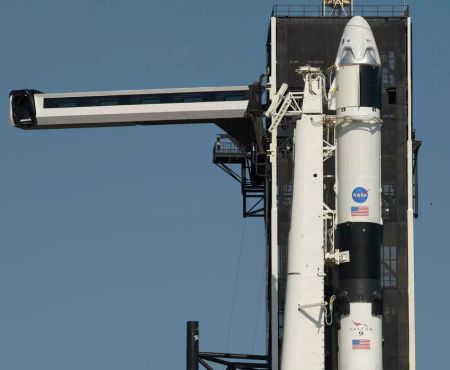
The two American astronauts Robert Behnken, 49, and Douglas Hurley, 53, who have both flown twice, took off on Saturday May 30, 2020 aboard the Crew Dragon capsule, launched by a Falcon-9 rocket from SpaceX from Florida.
It is the first time that a manned mission has been operated by a private company. The spacecraft was designed by billionaire Elon Musk's company.
Initially scheduled for Wednesday at 4.33 p.m. (10.33 p.m. Paris time), the launch could not take place.
The countdown was interrupted seventeen minutes before takeoff due to poor weather conditions in the Kennedy Space Center.
Taking advantage of a clearing, the rocket of the company founded by Elon Musk took off on Saturday at 3:22 p.m. (9:22 p.m. Paris time) and placed the Crew Dragon capsule in orbit unhindered ten minutes later.
A successful takeoff
Once the astronauts were on board, the rocket was full of fuel and the Falcon-9 was able to leave Florida soil.
After two and a half minutes, the first floor stopped pushing and came off; the second stage engine started soon after.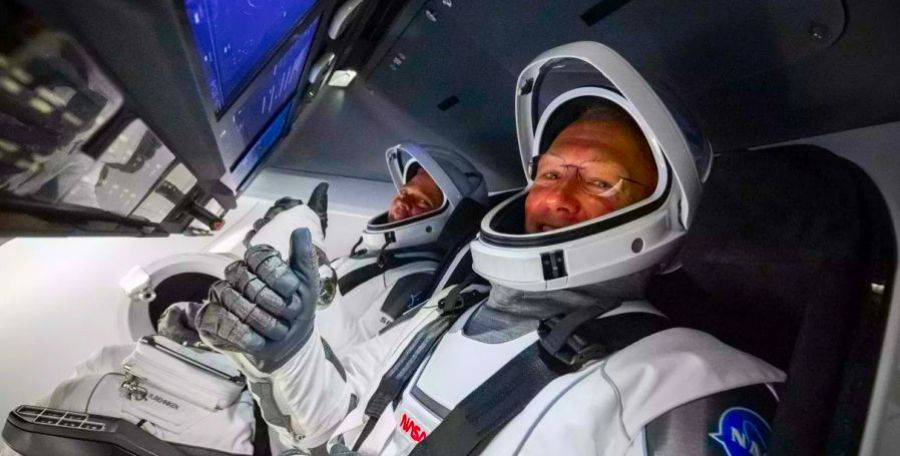
The body of the first stage began its controlled descent with retro-fuses to land on the barge in the Atlantic nine minutes and twenty-two seconds after takeoff.
Less than three minutes later, the second stage of the rocket in turn detached from the capsule.
As for the flight plan, astronauts Hurley and Behnken must automatically dock at the International Space Station (ISS) approximately nineteen hours after takeoff from the old lunar mission launch pad.
They will support the three members of the Russian-American crew there in their scientific experiments - the primary mission of the ISS -, before leaving for Earth in their Crew Dragon capsule, which will land in the Atlantic Ocean before the end of summer. And if all the lights are green, after this test mission, another mission, the first known as “routine”, will be launched before the end of the year towards the station.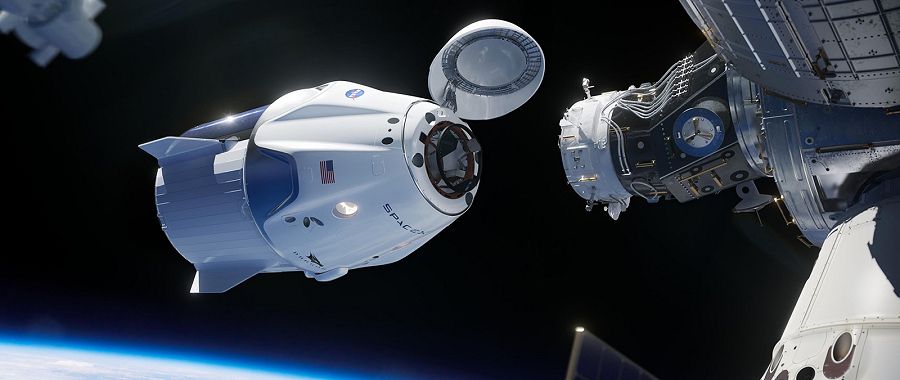
The Crew Dragon capsule should then be in orbit and dock with the International Space Station (ISS) on Sunday.
Reducing the American coat of arms
With this inaugural flight, the Americans intend to restore their coat of arms and regain their independence by ending the monopoly of the Russians for the transportation of astronauts to the International Space Station (ISS), after ten years of hitchhiking on board Soyuz vessels . The last space mission "100% Made in USA" dates back almost a decade
Savings for NASA
For NASA, the Crew Dragon capsule is also a good way to save money. Because to continue sending astronauts into orbit, the United States has relied so far on the Russian Soyuz spacecraft, launched from the historic Baikonur Cosmodrome in present-day Kazakhstan.
A costly collaboration: the price of a Soyuz seat cost the American taxpayer $ 86 million this year. By comparison, a seat on the Crew Dragon is estimated at $ 55 million. A considerable gain, when the American space shuttle, it returned to 450 million dollars per mission.
The manned flight of the SpaceX capsule to the International Station opens a new era in space exploration.
SpaceX also intends to make private passengers travel in orbit, or even in the ISS, perhaps next year.
|
|
|
|
| Paul Emison for DayNewsWorld |
|
SECRET-DEFENSE VIDEOS OF UFOs
BROADCASTED BY THE PENTAGON |
The Pentagon has officially released three videos taken by U.S. Navy pilots showing in-flight encounters with what appear to be unidentified flying objects, which were previously leaked on the internet and published by To The Stars Academy of Arts & Sciences, a private company, in 2017 and 2018.
"After an in-depth examination, the Defense Department determined that the publication of these videos did not reveal sensitive information", explains the Pentagon, which wants to "clarify any public misconception about the reality or not of these images" by making them public.
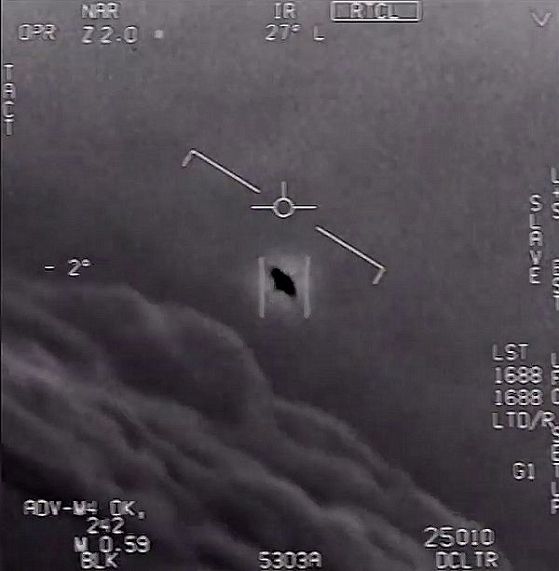 The videos, which the Navy confirmed to be true last September, "do not intrude on any further investigation into incursions into military airspace by unidentified aerial phenomena," spokeswoman Sue Gough said in this release. of the Pentagon, to justify their declassification. The videos, which the Navy confirmed to be true last September, "do not intrude on any further investigation into incursions into military airspace by unidentified aerial phenomena," spokeswoman Sue Gough said in this release. of the Pentagon, to justify their declassification.
The videos, which are all in black and white, bear the names of "FLI R", "GOFAST" and "GIMBAL", and are now available on the Naval Air Systems Command website
One of these videos dates from November 2004, the other two from January 2015. Captured by F18 Hornet on-board fighters, these videos first show an object shooting at a very high speed above the waves.
"The observed aerial phenomenon remains qualified as" unidentified ", assures the Pentagon.
On another video, above the clouds, this time appears a much larger UFO. The pilots of the two US Navy planes that have it in their sights are wondering if it is a drone.
"Look at that: there is a whole swarm of it
[...] The cow, they are all going against the wind !"
A west wind of 120 knots ! " Look at this thing !" ", Continues his interlocutor when the object begins to rotate." Like a ping pong ball "
Now retired navy pilot David Fravor, who encountered one of these "UFOs" in 2004, told American television station CNN in 2017 that the object was moving erratically. "As I approached him [...] he quickly accelerated south and disappeared in less than two seconds."
It was "like a ping pong ball bouncing off a wall," he said. In a statement, the United States Department of Defense explained that it had decided to broadcast these images "in such a way as to dissipate all public misconception about the veracity or not of the videos already taken up in the media ”. After this official development, everyone is now free to imagine everything.
Harry Reid, a former Nevada senator, home of the US Air Force's ultra-secret Zone 51 facilities, welcomed the declassification, while deploring that "it only scratches the surface of research and documentation available ”.
"The United States must take a serious and scientific look at this and all the potential national security implications. The American people deserve to be informed, " he continued. In December 2017, the Defense Department admitted that it had financed until 2012, the official date of its completion, a secret program costing several million dollars intended to investigate UFO sightings.
These videos are much more original than other military documents since they are supposed to reveal the object of all our fantasies, or rather objects ... unidentified flying objects. |
|
|
|
| Paul Emison for DayNewsWorld |
|
THE LYRIDES WILL SPIN THE SKY TONIGHT |
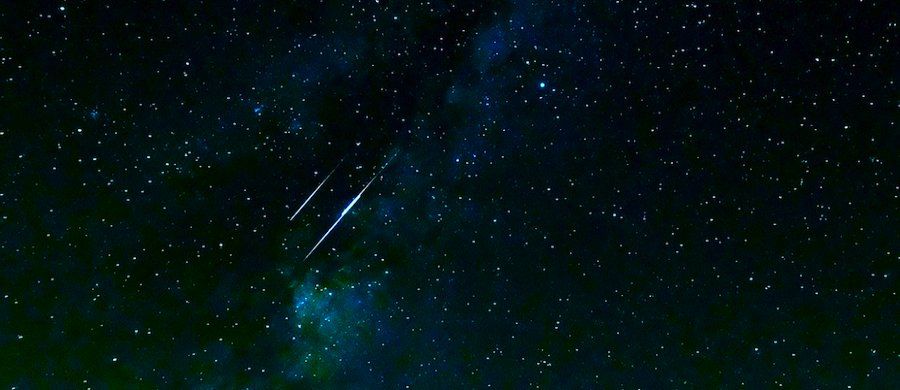
This night look up to the sky to contemplate the immense wealth of the Universe that we offer 21 to 22 April a beautiful meteor shower, the Lyrids.
Comet dust
Like every year in April, our planet crosses the path of comet C / 1861 G1 Thatcher in its stellar journey. From this meeting, shooting stars are born which will streak our sky with a very particular intensity.
This year, the culmination of this phenomenon called the Lyrids will take place on the night of Tuesday, April 21. It will thus be possible to observe up to 20 shooting stars per hour.
Originally, the Lyrids are dust left by this comet in its wake.
These small meteors then “ignite” when they enter our atmosphere at more than 49 km / s according to NASA.
Peak activity around 6:40 am
The rain of shooting stars from the Lyrides can be watched all night from 0:40 am Paris time.
However, the International Meteor Organization (IMO) specifies that the peak of activity could actually take place around 6:40 am on April 22. Better to get up early to enjoy it!
In addition, unlike the rain of 2019, we will not be bothered by the brightness of the Moon which is close to its new phase and therefore invisible for the moment.
|
|
|
|
| Paul Emison for DayNewsWorld |
|
PARTNERSHIP BETWEEN SPACE X AND AXIOM SPACE
FOR 10 DAYS ON BOARD THE ISS | | For ten years, no tourist has been able to approach the International Space Station (ISS). This was without counting on SpaceX, the aeronautical company of the whimsical Elon Musk, launched at full speed in the conquest of space.
After announcing in February a partnership to send four private customers into orbit by 2022, SpaceX is now attacking the International Space Station (ISS). Musk's company announced Thursday that it has signed an agreement with Axiom Space to give it seats on board its Crew Dragon capsule. 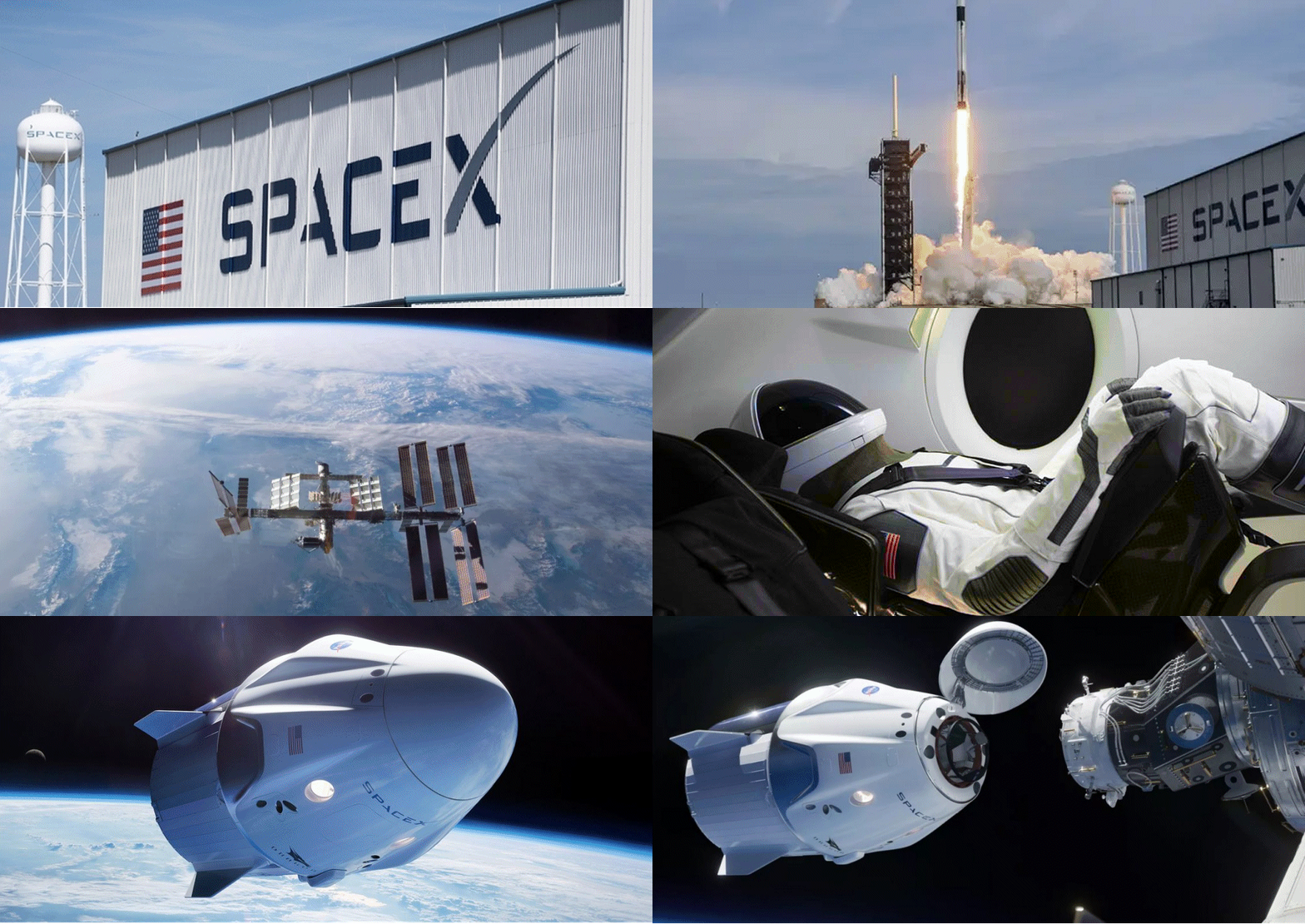
The launch of the operation is planned for the second half of 2021. This trip "will mark a turning point in the universalization of access to space", welcomed the boss of Axiom Space, Michael Suffredini. On this occasion, three people should be able to spend 10 days on board the ISS for $ 55 million.
But SpaceX is not the only company that wants to touch the stars. Virgin Galactic (Richard Branson) and Blue Origin (Jeff Bezos) are also involved in space tourism.
They are currently developing vessels capable of sending private passengers, for a few minutes, just over the border of space (80 or 100 km depending on the definitions chosen by each company), for 250,000 dollars or more in the case of Virgin.
Boeing is also developing a vehicle for NASA, Starliner, to join the ISS. The company wants to make private passengers travel there in the future
Those traveling to the ISS will be supported on the SpaceX Falcon 9 reusable rocket. Musk's company has already signed another partnership with a company called Space Advnetures with the aim of offering a five-day trip, for four passengers, aboard the Crew Dragon capsule.
Eight space tourists have already made a trip to the international station in the Russian Soyuz rockets. Latest: Cirque du Soleil founder Guy Laliberté in 2009. |
|
|
|
| Paul Emison for DayNewsWorld |
|
There are no translations available.
UNE NOUVELLE PLANETE DE LA TAILLE DE LA TERRE DECOUVERTE PAR LA NASA DANS UNE ZONE HABITABLE
|
|
L’agence spatiale américaine a annoncé, lundi 6 janvier 2020, que son télescope avait permis de découvrir une nouvelle planète de la taille de la Terre et à une distance ni trop proche, ni trop éloignée de son étoile pour que de l’eau liquide y soit – peut-être – présente.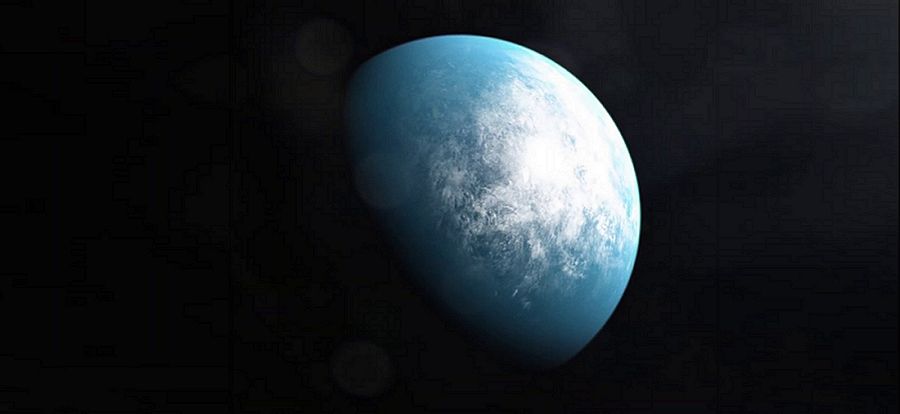
Baptisée « TOI 700 d », cette planète se trouve à cent années-lumière de la Terre. Elle a été découverte par le satellite TESS, grâce à l’œil vigilant de plusieurs astronomes amateurs.
Le satellite TESS (Transiting Exoplanet Survey Satellite) commence à atteindre ses objectifs, soit « trouver des planètes de la taille de la Terre et en orbite autour d’étoiles proches », a déclaré Paul Hertz, directeur de la division d’astrophysique de la NASA.
Une étoile pour trois planètes
Baptisée « TOI 700 d », cette planète est relativement proche de nous : à cent années-lumière. Quelques autres planètes de type similaire ont été découvertes auparavant, notamment par l’ancien télescope spatial Kepler, mais c’est la première par TESS, lancé en 2018. Ce satellite fixe une partie du ciel pour détecter si des objets – des planètes – passent devant des étoiles, ce qui cause une baisse temporaire de luminosité de l’étoile. Cela permet à TESS d’inférer la présence d’une planète, sa taille et son orbite.
L’étoile TOI 700 est petite, environ 40 % de la taille et de la masse de notre Soleil, avec une température de surface inférieure de moitié. TESS a découvert trois planètes autour de cette étoile, nommées TOI 700 b, c et d. Seule la « d » est dans la zone dite « habitable ». Elle fait presque la taille de la Terre (20 % de plus) et fait le tour de son étoile en 37 jours. Elle reçoit 86 % de l’énergie fournie par le Soleil à la Terre.
Mais reste à savoir de quoi elle est composée. Les chercheurs ont utilisé des modèles climatiques prédictifs. Sur les 20 versions générées, une au moins est proche de la Terre, sans les océans, avec des vents soufflant de la face cachée vers la face éclairée, quand une autre ressemble plutôt à la planète Mars quand elle était jeune.
De multiples astronomes vont désormais observer la planète avec d’autres instruments, obtenant de nouvelles données qui correspondront peut-être à l’un des modèles prédits par la NASA.
|
|
|
|
|
|
|
|
| Paul Newton pour DayNewsWorld |
|
There are no translations available.
PREMIER DELIT SPATIAL D' UNE JUSTICE EXTRATERRESTRE
|
|
L’astronaute Anne McClain est accusée d’usurpation d’identité et d’accès irrégulier aux dossiers financiers de son ex-épouse alors qu'elle séjournait dans la Station spatiale internationale (ISS).
Ce pourrait bien être le premier délit commis dans l’espace.
C'est le New York Times qui a révélé samedi ce scoop:
La Nasa enquête actuellement sur les agissements de l’astronaute Anne McClain, accusée d’usurpation d’identité et d’accès irrégulier aux dossiers financiers de son ex-épouse depuis la Station spatiale internationale (ISS). L’Américaine a séjourné dans l’espace pendant six mois, entre décembre 2018 et juin 2019.
Le quotidien américain raconte ainsi que l’ex-femme de McClain, Summer Worden, une agente de renseignement de l’Air Force américaine, s’interrogeait l’année passée sur les informations dont semblait avoir connaissance son ancienne conjointe.
Après avoir sollicité sa banque pour connaître la localisation des dernières connexions à son compte, Worden s’est vue informer que certaines d’entre elles provenaient d’ordinateurs de la Nasa. Or McClain, qui devait faire partie de la toute première sortie 100% féminine dans l’espace, a reconnu avoir accédé à ce compte bancaire à bord de l’ISS.
Son avocat a affirmé que sa cliente n’avait rien fait de mal, cherchant simplement à surveiller le compte joint du couple, ce qu’elle faisait au cours de leur relation, pour s’assurer que son ex-femme avait assez d’argent pour élever leur enfant. Anne McClain indique avoir continué à utiliser le même mot de passe qu’auparavant, lorsqu’elles étaient encore en couple, sans savoir qu’elle n’en avait plus le droit.
Selon le New York Times, Summer Worden a donc déposé plainte auprès de la Commission fédérale du commerce (FTC), une agence indépendante, ainsi qu’auprès de l’inspection générale de la Nasa.
Sur Twitter, Anne McClain a déclaré qu’il n’y avait «absolument rien de vrai dans ces informations». «Nous avons vécu une séparation douloureuse et personnelle qui se retrouve hélas désormais dans les médias. J’apprécie le soutien que l’on m’a apporté et je réserve mes commentaires pour la fin de l’enquête. J’ai une confiance totale dans le processus de l'inspection générale.
Il pourrait donc bien s’agir du premier délit spatial.
Ce n'est pas la première fois que des actions en justice ont été intentées mais elle n’avaient jamais impliqué une personne en mission.
Ainsi en 2011, selon le New York Times, la Nasa avait organisé une opération d’infiltration avec pour cible la veuve d’un ingénieur spatial voulant vendre une roche lunaire.
En 2017, un homme d’affaires autrichien a poursuivi en justice une entreprise de tourisme spatial : il voulait récupérer une caution déposée pour un voyage dans l’espace qui ne semblait pas près de se produire.
Des délits commis dans l’espace appelés à se reproduire avec le développement du tourisme spatial.
|
|
|
|
|
|
|
|
| Paul Emison pour DayNewsWorld |
|
RUSSIA LAUNCHES FIRST HUMANOID ROBOT ON ISS
|
|
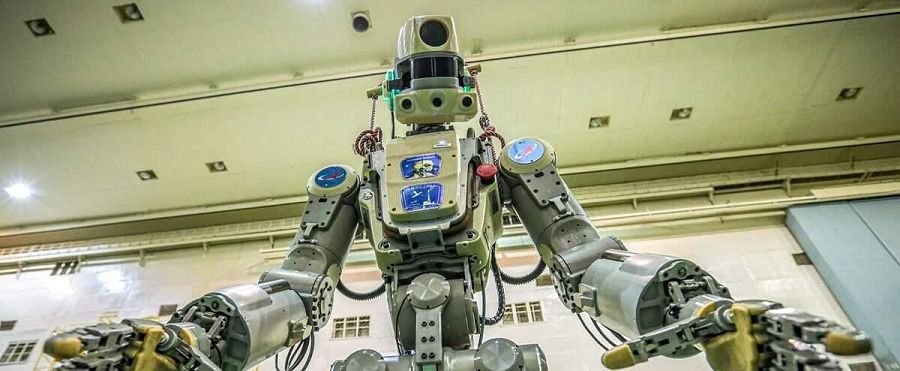
A robot departing for the ISS
Russia launched on Thursday, August 22, a rocket for the International Space Station (ISS) with on board a humanoid robot named Fedor .
According to Navias, a NASA representative, Fedor "looked good, sitting in the shuttle commander's seat."
Fedor carrying the Skybot F850 identification number took off at 6:38 am (Moscow time) aboard a Soyuz rocket from the Russian Baikonur Cosmodrome in Kazakhstan to join the ISS.
After his arrival scheduled for Saturday, August 24, the anthropomorphic robot, which measures 1.80 m and weighs 160 kg, will begin a stay of ten days.
Fedor shares its travel capsule with 660 kilograms of goods, including food supplies, and supplies for the ISS crew.
Purpose of this mission
Once arrived at destination, no rest for the robot: it is expected by the Russian cosmonaut Alexander Skvortsov who will be responsible for supervising during his stay on the ISS. Fedor will have to carry out different tasks. Able to imitate human movements, it has been designed to assist astronauts in their daily lives.
"His operations will lead him to use a screwdriver or keys," said Alexander Blochenko, director of promising programs at the Russian Space Agency (Roskosmos), in an interview with Rossiyskaya Gazeta newspaper.
The robot will also have to test its capabilities in very low gravity conditions.
A Fedor to perform all these tests successfully to conquer the deep space.
Communication operation
It is also a big communication operation for Russia that did not fail to retransmit the take-off on television and during which the robot pronounced
"Let's go, let's go! ".
Words that obviously refer to those uttered by Yuri Gagarin in 1961, when he made the first flight of a man in space.
Like any good modern self-respecting humanoid, Fedor has its own Instagram and Twitter social network accounts on which he shares his daily life:
"I am going to fulfill the mission entrusted to me. What is the space still hiding ? " Released the robot before leaving.
In the meantime, Fedor has certainly not finished making the buzz.
He will be back on Earth on September 6th, still aboard Soyuz.
|
|
|
|
| Paul Emison for DayNewsWorld |
|
THE EXPLOIT OF FRANKY ZAPATA ON HIS FLYBOARD FOR A CROSSING OF THE HANDLE
|
|
Franky Zapata, "the flying man", made the crossing of the Channel Sunday morning, August 4, standing on his flying board.
The Frenchman has traveled 35 kilometers of strait on his "Flyboard" with five mini-turbojet allowing him to fly up to 190 kilometers per hour, with a range of about ten minutes.
The jet ski champion took off at 8:15 am near the beach of Sangatte (Pas-de-Calais) to reach St Margaret's Bay English side in the space of about twenty minutes.
He flew over the sea about 15 meters high and made a halt halfway on a boat, to refuel in kerosene.
During the 14th of July military parade on the Champs-Elysées Franky Zapata had already given a demonstration, in front of Emmanuel Macron:
he had stolen a rifle in his hands, several tens of meters above the ground, on his flyboard.
The French army invested in this device 1.3 million euros of subsidy.
"It can be used to evacuate a casualty, what is called a medical evacuation, it can serve as a logistics platform to carry ammunition," says the director of the Defense Innovation Agency, Emmanuel Chiva.
The French special forces see in this flying platform the "potential for employment in special operations in urban areas".
In the United Kingdom, a former reservist, Richard Browning, also invented his own flying machine equipped with five integrated reactors. A battle of the airs which is only beginning.
|
|
|
|
|
|
|
|
| Alize Marion for DayNewsWorld |
|
DREAMS OR MEGALOMANIA THE FRANCE
WANTS TO PREPARE FOR THE WAR OF THE STARS
|
| In the framework of the "Active Defense of Satellites, Unified Command", new investments have been presented by the Minister of Armies, Florence Parly, for a new defense space strategy that places the army at the center of the extra-ordinary game. atmospheric.
As a historical reminder in 1967, the entire international community agreed that all humankind would benefit from the conquest of space.
A great treaty signed that year that is still in force!
The latter spoke emphatically of "the use for the good of all peoples and for peaceful purposes of space".
But a radical change half a century later, space now seems to the eyes of politicians and military the fourth medium, in the military sense, after the land, sea and air.
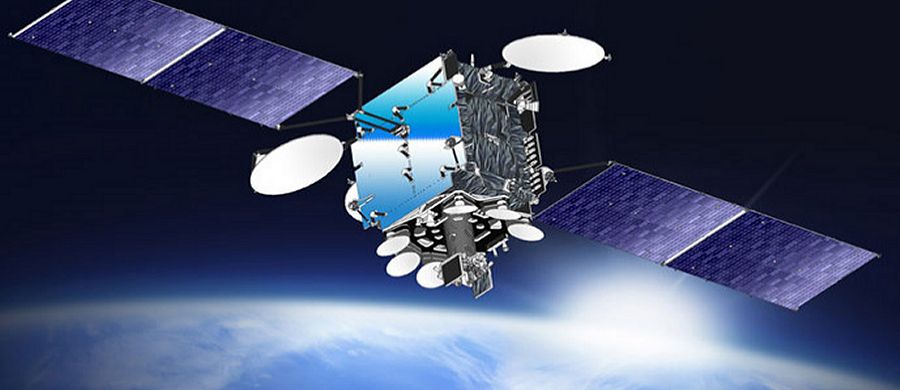 In an objective of guiding or detecting missiles, to communicate, to make intelligence and espionage of others, armies depend largely on outer space, In an objective of guiding or detecting missiles, to communicate, to make intelligence and espionage of others, armies depend largely on outer space,
Like Americans and Russians, France now intends to invest space militarily.
Current Minister of the Armed Forces, Florence Parly, presented in Lyon the new "defense space strategy", wanted by Emmanuel Macron, who had already put forward the idea about a year ago.
France will not launch into the destruction of satellites, as did China, the United States or more recently India, but will launch into a surveillance and very military objectives however.
France will not put into orbit weapons of mass destruction, blinding lasers or offensive nanosatellites, prohibited by the Treaty of 1967 and ratified by the French State,
 France, however, intends to continue militarization and embark on the weaponization of space. France, however, intends to continue militarization and embark on the weaponization of space.
First objective the protection of the French satellites, ensures the ministry of the Armies.
Indeed Florence Parly had revealed that "in January the Russian spy satellite Louch-Olympe had discreetly approached the Athena-Fidus, used for telecommunications, including military, France and Italy.
In a framework of "active defense", Emmanuel Macron, wants by surveillance cameras soon embarked on Syracuse (central device for the communications of the French army) to protect and monitor the space, in order to detect approaches.
From 2023, France plans to no longer respect the 1967 treaty using blinding lasers, machine guns to break the solar panels feeding intruders, "clouds of nanosatellites watchers" deployed around the most strategic devices.
Hello the pollution of the space which is already well encumbered by so much waste in low and medium orbit and here is a beautiful example of ecology which Emmanuel Macron knows so well to speak !!
Florence Parly acknowledged that "France had fallen behind in terms of power lasers", but that it would "make up for France's gap by 2025, which will cost 700 million euros"
This expense is in addition to the 3.6 billion euros already planned for space in the military programming law for a global envelope of armies.
In comparison with the investments of the great powers: each year, the United States devotes 50 billion dollars, China 10 billion and Russia 4 billion.
Florence Parly wants more autonomy, and therefore become a "space operator", within the meaning of the 2008 law that regulates so far the extra-atmospheric activities.
The government does not exclude a legislative amendment.
The role of the National Center for Space Studies (CNES), a civil administration, will be reduced when it comes to military activities.
A large space command also needs to be created on September 1, with 220 people at the beginning, to streamline governance, and eventually the air force will become "the air force and the air force." space".
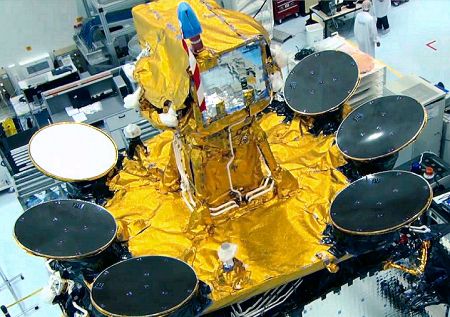 The Minister of the Armies Florence Parly wants to regulate the space activity beyond its strict perimeter, even going to give an assent for any outside activity, even private! The Minister of the Armies Florence Parly wants to regulate the space activity beyond its strict perimeter, even going to give an assent for any outside activity, even private!
Florence Parly finally wants to benefit from the progress of commercial satellite imagery by buying terrestrial observation services, in addition to the means available to them (the CSO satellites of the Musis program), but also to "limit the use, so that these high-definition images that are very cheap, sometimes even free, do not end up in all hands! "
Florence Parly wants to "forbid the States purchasing French equipment to photograph certain areas, particularly the deployments of the French forces in operation"!
France forgets that space does not belong to it and NASA, companies such as "SpaceX", " Virgin Galactic", "Blue Origin", "Boeing" and many others do not care about the opinion of France , that's another reason for Donald Trump to get angry, France should be aware of it!
Evidence that is no longer in doubt, after the Gafa Tax, and now the space. If France and its leaders do not radically change their behavior, the retaliatory measures will take another dimension, yet from 1668 the famous French author Jean de la Fontaine wrote the fable "The Frog who wants to be as big as the ox" the latter should nevertheless inspire France
Space does not belong to France, it is not the master of the place either, it does not have any force or legitimate laws on the space, it does not have more right on the space than the other states of the planet, it is necessary to think that if other forms of life in the universe exist, they make fun of the rules that France would like to impose on them, the organs of other states like NASA, JAXA ..., as well that private companies like SpaceX, Virgin Galactic, Blue Origin, Boeing do not have to submit to France !!!
Donald Trump is patient but patience has its limits. Let's hope that he does not manage to say like "Rambo": "it's going to be silly" because we know that it will hurt a lot for those who want to attack America !!!!
|
|
|
|
| Simon Freeman Washington for DayNewsWorld |
|
THE AMERICAN SPACE AMBITION
FROM THE MOON TO MARS
|
| The opportunity was given to Donald Trump to express his space ambition for America. On the fiftieth anniversary this weekend, the first American steps on the moon, the President of the United States received at the White House former astronauts Buzz Aldrin and Michael Collins of the Apollo 11 mission (Neil Armstrong died in 2012). "We do not know what we will find on Mars, but it will certainly be a very interesting trip," Donald Trump then said.
"The Moon is our test bed for our future mission to Mars. That's why we're going to the moon, "said NASA boss Jim Bridenstine.
Indeed, the expeditions mounted by NASA on the Moon serve both to advance technological and scientific advances that prepare an expedition to Mars. 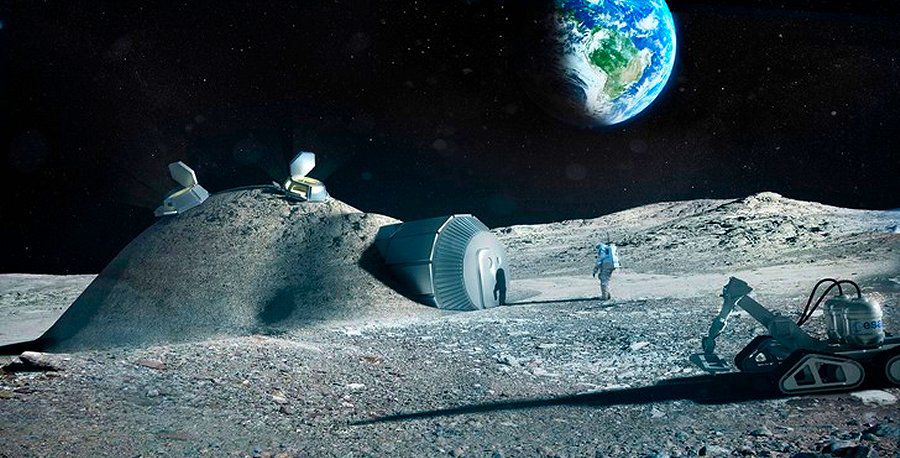
Scientific progress ... still today
The chip and embedded system are an example. The rocket thus participates as much as it benefits from a development of computer science, which will have to answer ever more technical software, but also a huge dose of sensors to record everything and study during the test phases. The Apollo computer is the world's first integrated circuit (an electronic chip) and the first to have an embedded system.
Beyond the direct effects, the lunar conquest has had indirect benefits for the world of businesses and sciences: project management, crisis, planning, interdisciplinary cohabitation ... Methods still used fifty years later.
But scientific progress does not stop at this step on the Moon. A myriad of lunar rocks were reported or 382 kilos in all for all the Apollo missions that helped understand the Earth-Moon system.
"Today, the most popular theory is that our satellite was formed by an impact with a planet the size of Mars that would have hit the prototerre. This idea began with the return of the lunar samples, when we saw that the materials extracted there looked surprisingly like terrestrial materials. "Develops Athena Coustenis.
Rich in technological teachings as scientists, the Moon also serves as a springboard for walking on Mars.
The moon a stepping stone for Mars
Although no program has been officially approved, NASA's boss recalls that the agency "is working on developing a detailed plan on how to conduct a mission to Mars using the technologies that [she is going to ] to prove on the Moon ". Regarding the report of the Science and Technology Policy Institute, Bridenstine wants to believe that there are "assumptions in this relationship that everyone may not agree with" and that there are "alternatives that allow a mission to Mars in 2033, "he said.
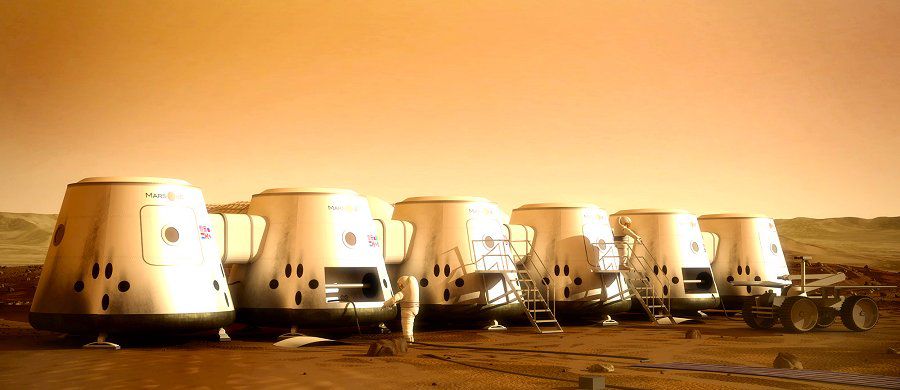 With its program Artemis, NASA discount the return of astronauts on the Moon in 2024. An ambitious goal within five years and a lunar experience that should also serve to target Mars. For the administrator of the US space agency, it is thus necessary to use the Moon as a "test bed" in the perspective of Mars. With its program Artemis, NASA discount the return of astronauts on the Moon in 2024. An ambitious goal within five years and a lunar experience that should also serve to target Mars. For the administrator of the US space agency, it is thus necessary to use the Moon as a "test bed" in the perspective of Mars.
A first mission inhabited towards the red planet could be carried out in 2033.
A direct mission to Mars can not take place as many problems are still unresolved. The NASA boss also pointed out that a Gateway space station in lunar orbit allowed access to more parts of the solar system.
Jim Bridenstine is optimistic, setting a new goal for 2033 to send a mission to the Red Planet.
Although some experts doubt that NASA will be able to guarantee a landing of astronauts on the Moon in five years as President Trump wants, the Artemis mission aiming for a return to the Moon in 2024 is on track. And 2033 is the goal of NASA to send men to Mars.
"The destiny of humanity is to walk on another planet and we can do it ..." said Buzz Aldrin, pleading for manned missions to Mars.
"The colonization of the solar system is a way to establish another place of survival for the human race", which will become necessary one day according to him.
|
|
|
|
|
|
|
|
| Paul Emison for DayNewsWorld |
|
AN AMERICAN RECONQUEST OF THE AMBITIOUS MOON
|
|
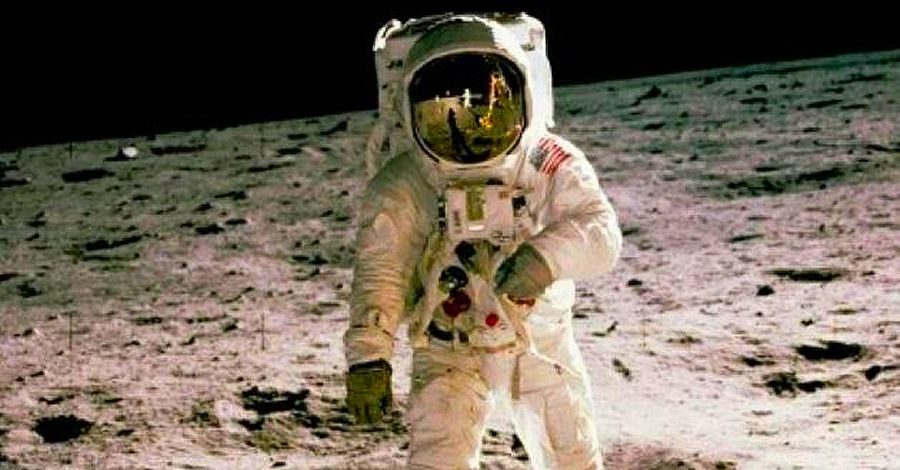
Fifty years after the first step of a human on the Moon, the conquest of the Moon is experiencing renewed interest. The NASA aims to send a man back and send the first woman to the moon by 2024. This is the Artemis program. But before we can pronounce the words "It's a big step for the woman ...", NASA has planned a whole range of projects to the number of 12.
With its program Artemis, NASA hopes to reconquer the Moon. Three major phases are planned: an unmanned flight in 2020; astronauts on lunar soil in 2024; then a permanent and autonomous base around 2028.
For the second phase of 2024, the US space agency announced no less than 12 research projects. Their common goal: to advance our understanding of the moon while testing scientific hypotheses and technological innovations. The results will best prepare the arrival of astronauts and their installation.
NASA also states that these projects will be able to find even wider applications for Mars exploration and beyond. The equipment will be transported using Commercial Lunar Payload Services, a series of contracts with private companies to which NASA will subcontract the lunar cargo ships.
Scientists will test hypotheses and test new equipment. Side assumptions, we find for example the LuSEE experiment (for "Lunar Surface Electromagnetics Experiment").
It must measure the electromagnetic phenomena on the surface of the Moon. Let us also mention the RAC Payload, a study seeking to study the adhesion of the regolith (the material found on the surface of the Moon) to other materials of the star.
Hardware and technological experimentation, they are more numerous.
The LISTER probe will measure the heat levels inside the Moon. This instrument can drill 2 to 3 meters in the regolith (the material that makes up the lunar soil), an essential ability to capture all the thermal variations depending on the depth.
Among the many projects, there is also a rover:
MoonRanger. Small, fast, autonomous, the mission of this newcomer will be to map in 3D and in high quality all the lands on which it passes. He will be able to explore the places up to 1 km from his control center.
PlanetVac and SAMPLR are two methods of sampling regoliths.
Lunar Demonstration of a Reconfigurable, Radiation Tolerant Computer System: computer equipment capable of withstanding the radiation of the sun (very strong on the Moon due to the absence of atmosphere), Heimdall is a system of cameras capable of making shots in very high resolution before, during and after the moon landing.
It could map the surface of the moon.
Donald Trump has granted a $ 1.6 billion extension for this return to the moon.
In its statement, NASA said: "The agency will use everything we have learned on the moon to prepare for a new giant leap: send astronauts to Mars".
|
|
|
|
|
|
|
|
| Paul Emison for DayNewsWorld |
|
There are no translations available.
LA PREMIERE IMAGE DU TROU NOIR
|
| Des astronomes révèlent la première image d'un trou noir ce mercredi10 avril. Pour la première fois dans l’histoire de l'humanité, des astronomes ont réussi à photographier un trou noir. L’image de ce monstre 6,4 milliards de fois plus lourd que notre soleil, situé au centre d’une autre galaxie, a été révélée ce mercredi 10 avril. Cet exploit a été possible grâce à la coopération de scientifiques du monde entier . L’humanité a fait la connaissance de M87*: un disque orange entourant un cercle sombre, le tout un peu flou.
Situé à 53 millions d’années-lumière de nous, ce trou noir pèse 6,4 milliards de fois la masse de notre Soleil. Il mesure 40 milliards de kilomètres de diamètre. Plus grand que notre système solaire aussi lourd qu’une petite galaxie.
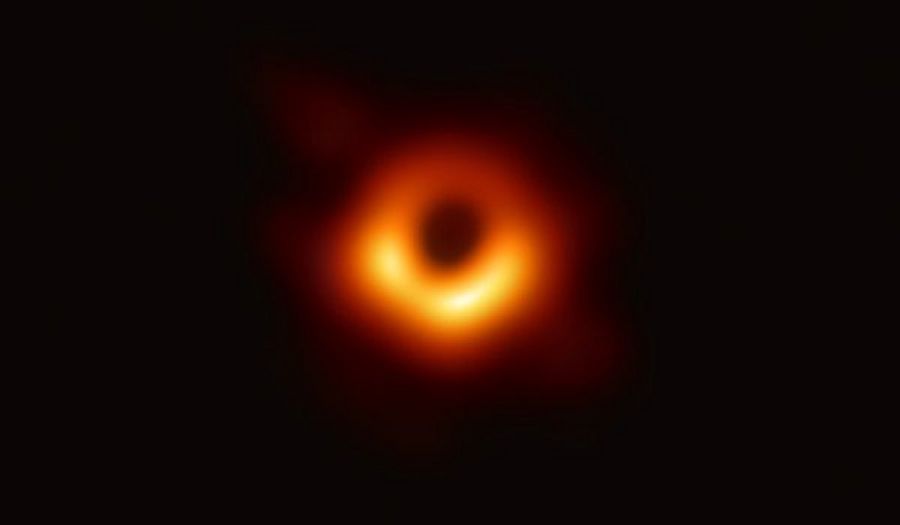 Mais malgré sa taille , saisir cette image constitue un réel défi tellement ce trou noir se situe loin de la Terre. C'est grâce à l’interférométrie c.a.d l'utilisation de plusieurs télescopes situés un peu partout sur Terre qu'une antenne virtuelle s'est crée : 7 télescopes du pôle sud aux États-Unis et une distance de 9 000 kilomètres ont été ainsi crée. Sur tous les sites il fallait en plus des conditions climatiques idéales. Ce fut le cas 4 jours en avril 2017. Mais malgré sa taille , saisir cette image constitue un réel défi tellement ce trou noir se situe loin de la Terre. C'est grâce à l’interférométrie c.a.d l'utilisation de plusieurs télescopes situés un peu partout sur Terre qu'une antenne virtuelle s'est crée : 7 télescopes du pôle sud aux États-Unis et une distance de 9 000 kilomètres ont été ainsi crée. Sur tous les sites il fallait en plus des conditions climatiques idéales. Ce fut le cas 4 jours en avril 2017.
Mais que nous apprend cette image, au-delà de la prouesse ?
Il faut avoir en mémoire Albert Einstein et la théorie de la relativité générale. Cette dernière est la proposition faite par l'illustre physicien pour expliquer la gravitation.La présence d'une masse modifie la géométrie de l'espace-temps.
Si longtemps les trous noirs n’ont donc existé que par théorie, les équations permettaient d'en connaître leur existence. La première confirmation de leur existence fut la première détection des ondes gravitationnelles le 14 septembre 2015. C’est la fusion de deux trous noirs qui a été détectée.
« Ce qui nous intéresse, ce n’est pas tellement le trou noir mais ce qui se passe autour du trou noir, explique Jean-Pierre Lasota, chercheur émérite CNRS à l'Institut d'astrophysique de Paris. Et puis le trou noir contient des informations sur l’histoire et l’évolution de notre galaxie, et peut-être même sur la formation de cette galaxie. »
Nous attendons avec impatience la prochaine étape : l'obtention d'une image similaire d’un autre trou noir, mais pas n’importe lequel : le nôtre, Sagittarius A* qui se trouve au centre de notre galaxie, la Voie lactée !!!
|
|
|
|
|
|
|
|
| Paul Emison pour DayNewsWorld |
|
A WORLD FIRST
HAYABUSA 2 ATTACKS AN ASTEROID
|
| Japan bombed an asteroid on Friday, April 5th. The Hayabusa 2 spacecraft successfully catapulted a small car on the asteroid Ryugu, one of the most promising vestiges of the formation of the solar system.
A world first successful to more than 300 million kilometers of the Earth. This is indeed the first collision experience in the world with an asteroid, say the researchers.
After several months spent in orbit about twenty kilometers from the star, the probe approached tonight 500 meters from its surface to drop a machine loaded explosive 2 kilos at a speed of 7,200 km / hour.
The impact made it possible to create 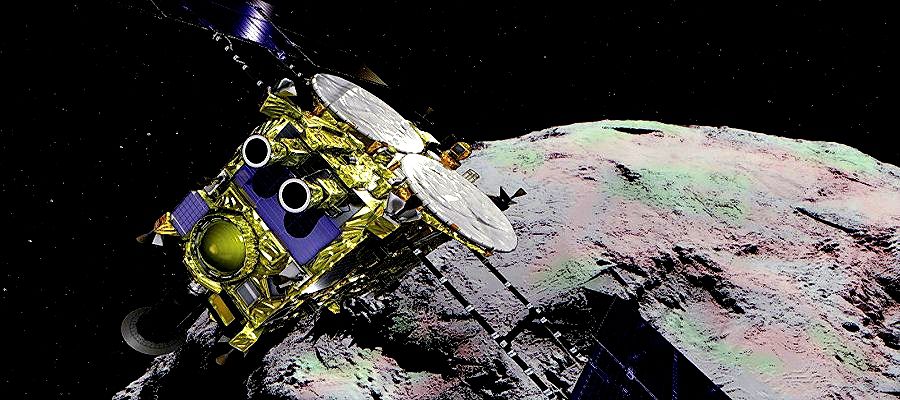 an artificial crater in which Hayabusa will collect dust samples from the subsoil of the asteroid. an artificial crater in which Hayabusa will collect dust samples from the subsoil of the asteroid.
The objective of this operation is to have access to material under the surface of the asteroid to analyze the composition of the solar system at its creation.
The probe had to come close enough to Ryugu to fire his projectile without being hit by the debris of the explosion. It holds indeed valuable samples of the soil of the asteroid collected February 21 during a furtive contact with him.
Hayabusa 2 (literally "Peregrine Falcon 2") is a space mission of JAXA, the Japanese space agency, launched on December 3, 2014, to study the Asteroid Ryugu and bring a sample to Earth in December 2020.
The probe should land on the asteroid next May to collect soil samples.
|
|
|
|
|
|
|
|
| Paul Emison for DayNewsWorld |
|
INDIA SHOOT DOWN SATELLITE IN SPACE
|
| India becomes the fourth nation to successfully bring down a satellite in low Earth orbit. For Prime Minister Narendra Modi, "it's a moment of pride for India". "India has achieved an unprecedented feat today," Narendra Modi said. India on Wednesday slammed a satellite into space with an ASAT anti-satellite missile during an exercise, Indian Prime Minister Narendra Modi said in a speech to the nation.
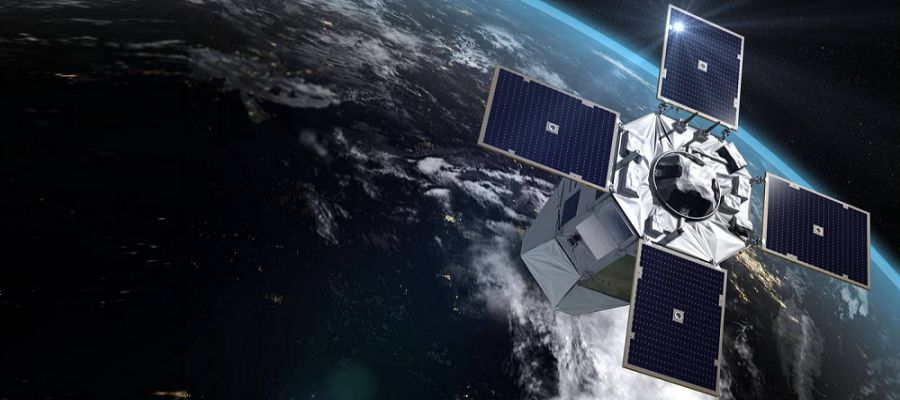 It has achieved this technological feat after the United States, China and Russia. It has achieved this technological feat after the United States, China and Russia.
"Our scientists shot down a satellite in low Earth orbit at an altitude of 300 kilometers," the Hindu nationalist leader said in a televised address to the nation. "Our goal is to establish peace and not create an atmosphere of war. This is not directed against any country, "he said.
The operation, titled "Mission Shakti" ("force", in Hindi), lasted three minutes. "The satellite was a predefined target and was shot down by an anti-satellite missile," said the Hindu nationalist leader. An anti-satellite missile developed by the DRDO, the Indian agency responsible for the development of military technologies.
But according to experts this antisatellite technology has a major disadvantage in that the explosion in space projects into the Earth's orbit thousands of debris spinning at high speed that endanger other space objects. The use of a laser on the other hand would have made it possible to put out the instruments of a satellite by "glare", without touching its physical integrity.
According to India Defense Update, India began researching its space military capabilities after a Chinese test in 2007. Beijing had indeed demonstrated its ability to remove one of its satellites using a specialized missile .
The space competition between great powers is sharpening.
It should also be remembered that Narendra Modi is seeking a second five-year term in the legislative elections which will begin on April 11.
|
|
|
|
|
|
|
|
| Paul Emison for DayNewsWorld |
|
THE RETURN OF CREW DRAGON SPACEX ON EARTH
|
After having achieved its maiden flight, the Crew Dragon capsule developed by SpaceX returned to Earth this Friday, March 8th. Launched March 2 by a Falcon 9 rocket from the Kennedy Space Center in Florida, the Crew Dragon docked successfully at the International Space Station (ISS) the next day. 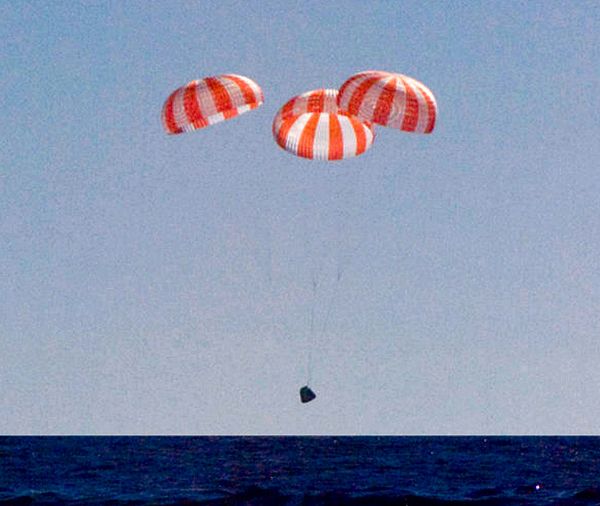
A first for a private vehicle for human space transport.
For this demonstration flight, the capsule was only passenger Ripley the model, a reference to the heroine of the movie Alien (1979) interpreted by Sigourney Weaver.
SpaceX's new Crew Dragon capsule on Friday (March 8th) left the comfort of its Earth orbit to dive into the atmosphere and land in the Atlantic, the ultimate and most dangerous phase of this Nasa demonstration mission.
Dragon returned unhindered and in one piece to Earth. SpaceX passed the exam:
demonstrate that the first US space shuttle vehicle since shuttles (1981-2011) is reliable and safe for astronauts.
It is the first private livable vehicle to have docked at the ISS.
It was also the first launch of a human ship from the United States in eight years.
A test for the thermal shield of the capsule
So far, the mission has been a success. The capsule was launched last Saturday by a SpaceX rocket from the Kennedy Space Center in Florida. She docked automatically at the International Space Station (ISS) on Sunday. Early Friday morning, briefly igniting its thrusters over the Sudan, 410 km above sea level, it broke off smoothly.
At 12:53 GMT, Dragon turned on his thrusters for a quarter of an hour, in order to "desorb":
to slow down and start the atmospheric reentry, which will test for the first time in real conditions its thermal shield. The landing a few hundred kilometers from the coast of Florida is scheduled to 08:45 (13:45 GMT). Four large parachutes, tested multiple times on Earth, will slow the fall.
Only a stoic dummy is on board (named Ripley in tribute to the heroine of the stoic series is on board (named Ripley in tribute to the heroine of the Alien film series).
"I would say that the hypersonic comeback is probably my biggest concern," said Elon Musk, the founder and boss of SpaceX, last Saturday.
SpaceX's Dragon capsule landed in the Atlantic Ocean, marking the success of the space mission
|
|
|
|
|
|
|
|
| Paul Emison for DayNewsWorld |
|
SPACEX TO SUCCESS THE LAUNCH
FROM CREW DRAGON TO THE ISS
|
|
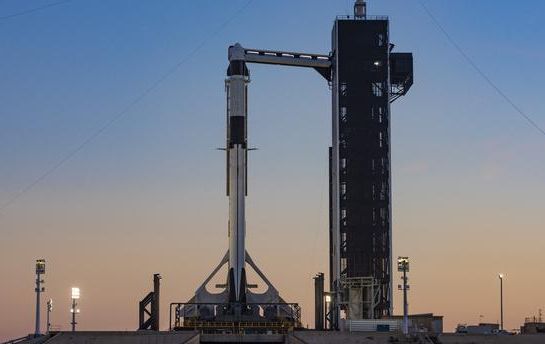
A faultless one for SpaceX's Falcon 9 rocket, which successfully took off from the Kennedy Space Center in Florida, USA, and launched the new Crew Dragon capsule, designed to carry NASA astronauts in the near future.
The capsule should join International Space Station (ISS) in the day of Sunday.
She will stay there for five days before stalling and return to Earth next Friday.
For now, only a mannequin on board
Only a model named Ripley (a beautiful reference to the film Alien), equipped with a series of sensors, has been placed in the device that should eventually allow to transport real scientists.
It has been almost 8 years since the shutdown of the Space Shuttle Space Shuttle program that no spacecraft took off from the United States to join the ISS, so NASA had to buy its seats on board. of the Russian vessel Soyuz.
NASA is now focusing on SpaceX and its Crew Dragon capsule for astronaut transport to the ISS.
With this mission Elon Musk intends to prove the reliability of its system as well as its ability to safely transport NASA's future crews to join the ISS from US soil.
For the next launch will be astronauts Robert Behnken and Douglas Hurley on board.
Jim Bridenstine, NASA Administrator confirmed that the first manned test flight will take place before the end of the year.
|
|
|
|
|
|
|
|
| Paul Emison for DayNewsWorld |
|
MISSION ACCOMPLISHED FOR THE JAPANESE SPATIAL PROBE HAYABUSA2 ON ASTEROID RYUGU
|
| Vaste success for the Japanese space agency Jaxa: on the night of Thursday 21 to Friday 22 February, the probe Hayabusa 2 landed on the asteroid Ryugu to collect samples before leaving. "The analysis of Hayabusa 2 data confirms that the sequence of the operation went well, including firing a projectile into the asteroid to collect its sample. The Hayabusa 2 spacecraft is in nominal condition. This marks the success of the landing of Hayabusa 2 on Ryugu, "comments the agency.
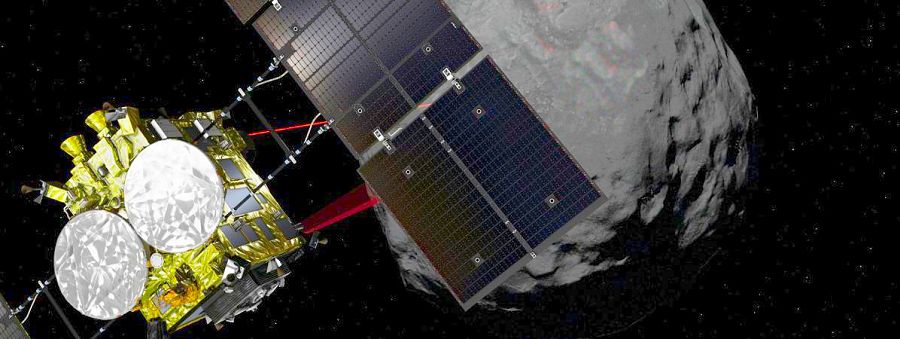 The Hayabusa 2 adventure began on December 3, 2014. The probe then left for a 3.2 billion kilometer long journey to reach Ryugu, which is 340 million kilometers from the Earth. It took him exactly three years and ten months to reach his destination. The return to Earth of Hayabusa 2 is expected in 2020 over Australia, in a desert area. The Hayabusa 2 adventure began on December 3, 2014. The probe then left for a 3.2 billion kilometer long journey to reach Ryugu, which is 340 million kilometers from the Earth. It took him exactly three years and ten months to reach his destination. The return to Earth of Hayabusa 2 is expected in 2020 over Australia, in a desert area.
An incredible technical feat.
As expected, the Japanese spacecraft Hayabusa 2 only landed for a few seconds, the time to launch a projectile to clear dust and take a sample.
For this, the machine had to do what is called a "touchdown", that is to say, a touch-and-go at the surface.
Thus Hayabusa 2 (which means peregrine falcon) remained hovering a few tens of centimeters above the surface of Ryugu, for about five seconds. The only physical contact between the probe and the asteroid was a cone that was to collect surface grains projected into the air after firing a metal projectile made at a very high speed of 300 meters per second. After landing, the probe then took off.
Photos of Ryugu's surface, a very old diamond-shaped asteroid that dates from the formation of the solar system, taken by the probe show traces of the brief contact between the two.
The descent from Hayabusa 2 to the asteroid Ryugu began Thursday at 1:15 pm (4:15 GMT) late. But the probe finally came into contact with the asteroid nearly an hour earlier than announced, early in the morning in Japan, announced the Japanese Space Exploration Agency (Jaxa) who handled this delicate mission with extreme caution. The Japanese team was not in fact on its first try. A previous mission, Hayabusa 1, to the asteroid Itokawa, had collected dust from this small body, but at the cost of an incredible number of adventures.
Back on Earth at the end of 2020, these samples will inform scientists about the origins of the universe and the solar system.
In addition, the US Osiris-Rex probe, currently in the bosch of the asteroid Bennu, should return to Earth in 2023 with on board, hope NASA, the largest collection of space samples since the astronauts returned from the moon half a century ago.
|
|
|
|
|
|
|
|
| Paul Emison for DayNewsWorld |
|
SUCCESSFUL FIRST TEST OF THE NEW VERSION OF THE SPACEX SPACEX ROCKER ENGINE
|
|

SpaceX and his boss and founder Elon Musk are proud to announce the success of his new SpaceX rocket engine shown in action.
 The SpaceX company, led by Elon Musk , has just tested its new rocket engine, the Raptor , which is intended for future rocket generations of the firm. The SpaceX company, led by Elon Musk , has just tested its new rocket engine, the Raptor , which is intended for future rocket generations of the firm.
The project began in 2009 and the first experimental tests in 2016, SpaceX's ambitious Raptor has changed dramatically since its inception.
The test was successfully held on February 3 in Texas, on the facilities of the American company.
The Raptor will initially be used on the Big Falcon Rocket .
The craft will have 31 rocket engines for the first stage, and 7 for the second, enough to provide enough power to the rocket to fly to the moon, and even beyond.
The Raptor CRS-15 rocket engines have a bright future for SpaceX and the space launch market.
These should be used in all space operations of the company, including its upcoming space tourism activities to the Moon and Mars which represents a very promising market.
One thing is on SpaceX is preparing the future for a better control of space and travel in the universe.
|
|
|
|
|
|
|
|
| Paul Emison for DayNewsWorld |
|
THOMAS PESQUET SOON
BACK IN SPACE
|
|
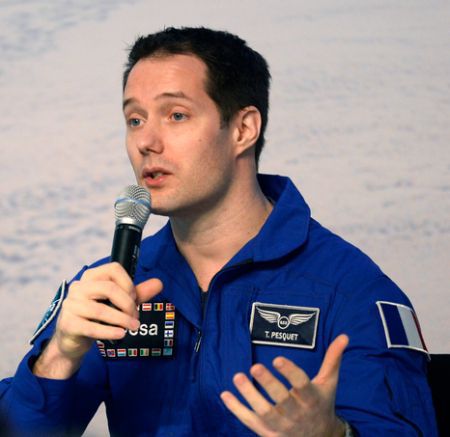
"In my dream, ideally, by 2024 I will return to the ISS for a second mission," Thomas Pesquet said in an interview.
This dream is coming sooner than expected.
The Director General of the European Space Agency (ESA) Jan Wörner "has proposed to Thomas Pesquet to return very soon in space, for a flight whose date should soon be fixed with our international partners," said Tuesday the Minister of Higher Education, Research and Innovation Frédérique Vidal in her vows.
Thomas Pesquet is likely to leave at the end of 2020 or the beginning of 2021, subject to the agreement of NASA and the progress of the mission planning of the ISS. The youngest of the European astronaut corps, Thomas Pesquet, who will be 41 at the end of February, will have to resume intensive training very quickly.
He who flew for the first time in the International Space Station, for nearly 200 days, was able to share his experience through social networks.
"Beyond the tremendous scientific work he did during his flight, he managed to make every French player in this flight when before people were spectators," said Jean-Yves Le Gall, President of the Center National Space Studies.
And the ambitions of the French astronaut do not stop there. "I would like to be among the first to go to the future station around the moon," Thomas Pesquet said enthusiastically.
|
|
|
|
|
|
|
|
| Paul Emison for DayNewsWorld |
|
A CHINESE FARM OR ALLOY
ON THE HIDDEN FACE OF THE MOON
|
|
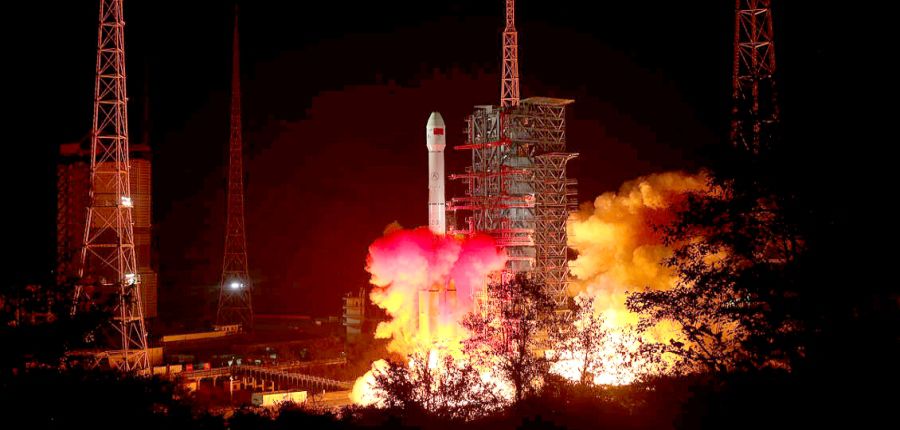 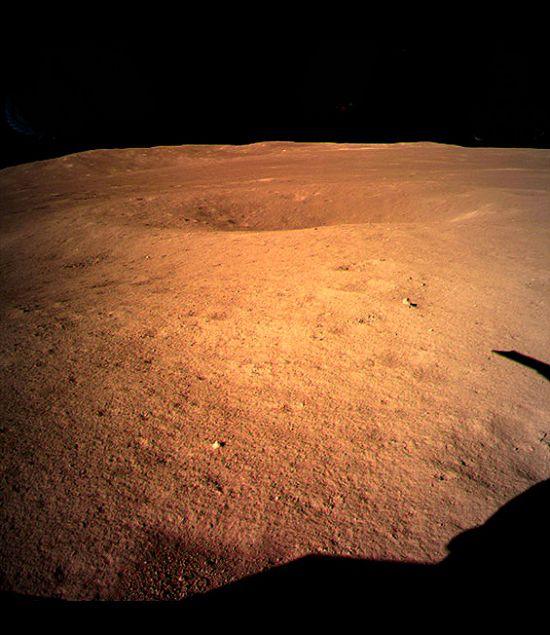
China has just completed the first moon landing on the dark side of the Moon.
The rover of the Chang'e 4 mission, which left the Earth on December 8, landed safely at 10:26 am Beijing time, the Chinese National Space Administration said in a press release.
It landed in the Von Kármán crater at 177.6 degrees east longitude and 45.5 degrees south latitude. 186 kilometers wide, this crater is located in the Aitken Basin, an old impact crater with a width of 2,500 kilometers and a depth of 12 kilometers.
A technological feat
It is a technological feat for China, the first country to make a moon landing on the hidden side.
The hidden face is mountainous and rugged, dotted with craters, while the visible face offers many flat surfaces to land. Chang'e 4 - named after the goddess of the moon in Chinese mythology - was sent to a region of the south pole of the lunar body, the Aitken Basin, whose terrain is complex and steep.
Neither the United States, nor Russia, let alone Europe, have explored this unknown part of the moon from the ground, even though probes in orbit around the moon have overflown it and mapped its entire surface.
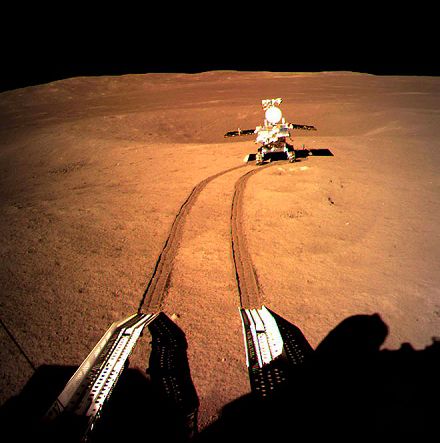 Another challenge is to be able to communicate with the lunar robot: the hidden face is always oriented in the opposite direction to the Earth, there is no direct "line of sight" to transmit the signals, except to install a relay . Another challenge is to be able to communicate with the lunar robot: the hidden face is always oriented in the opposite direction to the Earth, there is no direct "line of sight" to transmit the signals, except to install a relay .
To this end, Chinese engineers had launched in May a satellite called Queqiao ("The Bridge of the magpie"), positioned in lunar orbit, to relay orders and data exchanged between the Earth and the module.
China will therefore use the Queqiao relay satellite in orbit around the second Lagrange point (L2) of the Earth-Moon system located approximately 455,000 kilometers from our planet.
Like Chang'e 3, the Chang'e 4 rover has a panoramic camera and a radar to probe the basement. It also carries an imaging spectrometer in the visible and near infrared.
A great scientific interest
This unknown region of the Moon is of great scientific interest: it could contain exposed materials from the upper mantle of the Moon.
Thus the rover will study the impact of solar winds on the lunar surface for at least three months.
An experiment in the biological field, which 28 Chinese universities have developed, will also be conducted.
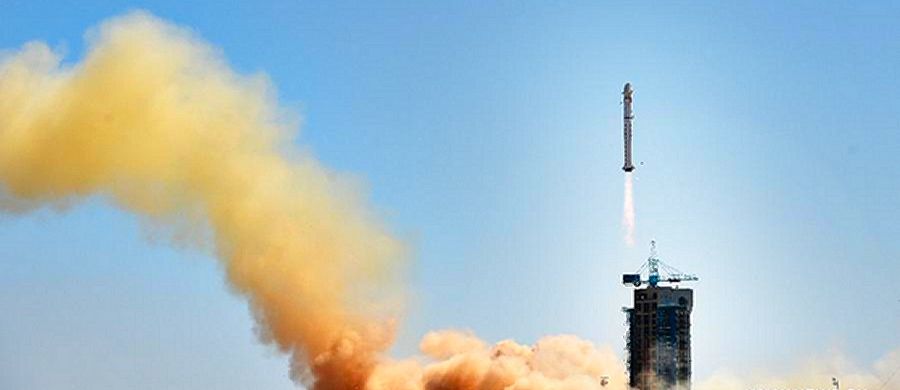 D D 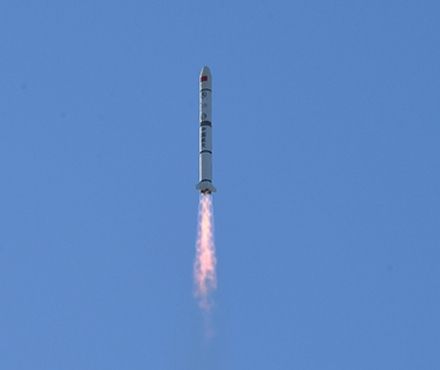 seeds of Arabidopsis, potatoes, tomatoes will be planted to see if they emit oxygen through photosynthesis. seeds of Arabidopsis, potatoes, tomatoes will be planted to see if they emit oxygen through photosynthesis.
The rover also sent his first images that are historical.
Unpublished clichés because the first taken from the surface of the hidden side of the Moon.
The stated ambitions of China
With this achievement, Beijing asserts itself as a great space power but the Chinese space agency, at the forefront of robotic exploration of the Moon, does not intend to stop there.
After Chang'e 4, China plans another mission on the hidden side but to bring back lunar samples, which has not been done since NASA's inhabited Apollo mission.
Three other robotic missions are also planned for the lunar poles.
Beyond these robotic missions, the Asian giant, which also unveiled in November 2018 a replica of its first major space station ("Heaven Palace"), plans to make it operational around 2022. It would become the only station to evolve in space after the planned 2024 retreat of the International Space Station (ISS) - which combines the United States, Russia, Europe, Japan and Canada.
Moon, advanced post for space
Any country that begins space exploration begins with the Moon, an accessible destination, while Mars is far away and expensive. The moon now appears as the first step for space habitats
NASA, too, is studying the idea of a "lunar orbit portal" (the former "Deep Space Gateway"), which would turn the Moon into an outpost of conquest of other planets. A lunar outpost that could serve as a "relay point" leading to Mars..
|
|
|
|
|
|
|
|
| Jenny Chase for DayNewsWorld |
|
LAUNCH OF THE SP-FRENCH SATELLITE COS-1
|
"We are witnessing a democratization of space, with the arrival on the market of small and cheap satellites and launchers and more and more countries are equipping themselves. We are in a competition for access to space ", explains General Michel Friedling
|
|
|
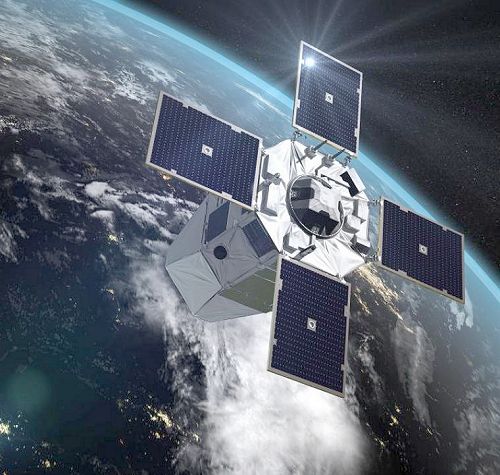
On Wednesday 19 December 2018, at precisely 17h37mn14s, CSO-1, a military optical observation satellite, was placed in orbit at 800 km altitude. It is the first of a constellation of three identical 3.5-ton satellites, intended to replace the Helios 1 and 2 series of systems, which have been monitoring space since 1995 on behalf of the DGA (Directorate General armaments) and the Ministry of the Armed Forces.
Since October 2011, Soyuz launchers have been fired from the Soyuz Launch Pack (ELS) located in the commune of Sinnamary, 27 km from Kourou, and about 13 km from Ariane installations. Every year, at least four Soyuz shots are fired from the Guyanese site. Eight have already taken place this year and the last one has just been realized this Wednesday afternoon with the French observation satellite CSO-1 (Optical Space Component).
This satellite, which will provide very high resolution images, will be joined by two others, in 2020 and 2021, to form a constellation to replace the current French military observation satellites Helios 2A and 2B. Expected to last 10 years, the constellation will cost 920 million euros, and 1.4 billion euros with the ground segment.
This latest Arianespace launch of 2018 is of major importance for the French defense. It is part of the space projects of the French Military Planning Act (LPM) 2019-2025 which provides for a significant budget of 3.6 billion euros for the defense space.
These shooting satellites ensure the operational needs of the various armies in terms of intelligence, whether it is the surveillance of risk sites, compliance with international treaties or the global strategic intelligence function.
The information collected by these observation satellites on the geographical environment makes it possible to prepare the missions as closely as possible. Thus these satellites made it possible to locate the caches of Daech in the Levant.
"Space intelligence also allows for political autonomy," said General Michel Friedling, commander of the Joint Space Command. "In 2003, when the war entered Iraq, we had our own images. Which allowed to question the American speech, and from there, our authorities decided not to intervene "
In a competition for access to space, a new field of confrontation, innovations in military defense are indispensable.
|
|
|
|
|
|
| Paul Emison for DayNewsWorld |
|
SUCCESSFUL LANDING FOR THE SOYOUZ FUSEE
|
The Soyuz MS 11 rocket, currently the only means of transporting crews to the International Space Station (ISS), was successfully launched on Monday, 3 December, from the Baikonur Space Center in Kazakhstan.
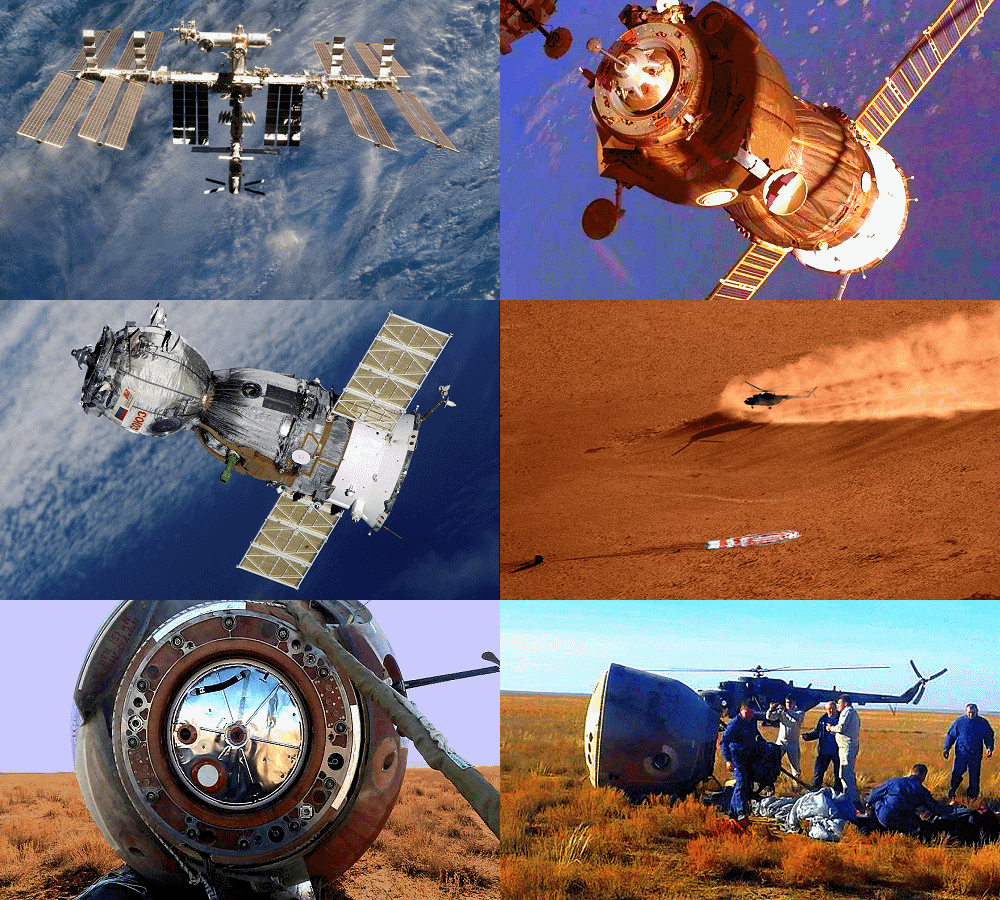 It landed at 18:40 (Paris time) after taking off unhindered at 12:30, or 6:30 after the launch as planned. On board the crew of Expedition 58, composed of three astronauts: It landed at 18:40 (Paris time) after taking off unhindered at 12:30, or 6:30 after the launch as planned. On board the crew of Expedition 58, composed of three astronauts:
David Saint-Jacques of the Canadian Space Agency, Ana McClain of NASA, and Russian cosmonaut Oleg Kononenko of Roscosmos. The three scientists took off for a six-and-a-half-month mission in orbit 400 kilometers above the Earth. The current crew of Sergei Prokopyev, Alexander Gerst and Serena Auñon-Chancellor are due back on December 20th.
This flight was a test for the Russian space industry, half a century after the beginning of the space conquest marked by the historic flight of Yuri Gagarin,
Indeed, on October 11, the rocket carrying the American Nick Hague and the Russian Alexey Ovitchinin had suffered a failure two minutes after takeoff. Added to this failure was another incident, namely the discovery of a leak in August on one of the Soyuz vessels stationed aboard the ISS.
Although Soyuz remains one of the safest space programs in history, doubts have been expressed about the Russian space industry, which has been plagued by failures in recent years. In the United States, which has invested $ 100 billion in 28 years in the Space Station, NASA leaders and politicians are worried about their reliance on a single space transportation system.
Vladimir Vladimir Putin asked his agency in July "to drastically improve the quality and reliability of Russian spacecraft and launchers". Roscosmos is facing rising cost problems, insufficient technology and lack of skilled labor.
The Russian space industry is struggling to replace an aging workforce with young engineers and technicians with unattractive salaries. Added to this is corruption and embezzlement. Since 2014, 140 investigations have been opened following embezzlement around the construction of the Vostochny Cosmodrome.
If Russia had until then had the monopoly of these trips since 2011 and the shutdown of the American Space Shuttle, it should face in 2019 the competition of "space taxis" SpaceX and Boeing.
|
|
|
|
|
|
|
|
| Paul Emison for DayNewsWorld |
|
THE INSIGHT PROBE AT LAND ON MARCH
|
After almost six months of travel in space and 484,773,006 kilometers traveled between Earth and Mars, NASA's InSight probe landed on the Red Planet on November 26, 2018.
Launched by NASA on May 5, 2018 as part of the Discovery program, the probe will study the internal structure of the red planet, including evaluating its seismic activity.
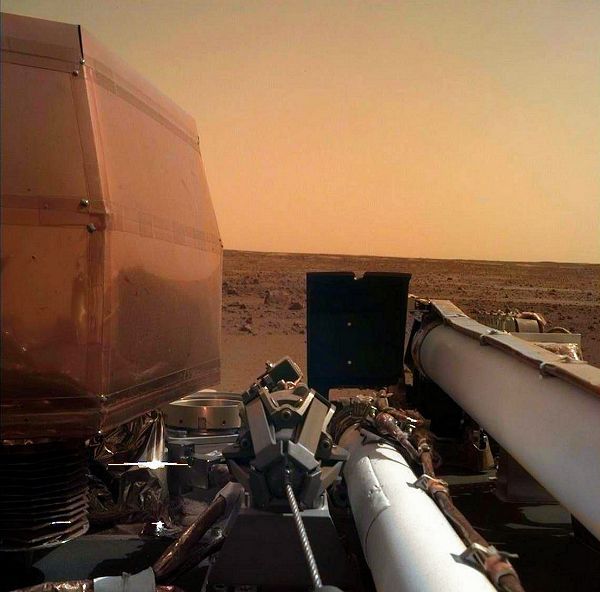 Hardly had the robot InSight begun to send signs of presence to the Earth, probe has sublime pictures of its environment. Hardly had the robot InSight begun to send signs of presence to the Earth, probe has sublime pictures of its environment.
More specifically, InSight will aim to study the internal structure of Mars. Like the other three terrestrial planets - including the Earth - the red planet is formed by the gradual accretion of rock bodies, until its mass and temperature become sufficient for the process of planetary differentiation to take place.
As Mars does not have tectonic plates, its internal structure has not undergone any major changes since the formation of the planet and must have retained geophysical signatures of this process of differentiation.
By analyzing the different parts of its structure - crust, mantle and core - InSight should be able to collect important information on how the planets were formed 4 billion years ago.
Scientific operations will not begin right away.
Seis seismometer and HP3 heat flow sensor must be installed on the ground using a robotic arm. The maneuver is not planned for two to three months.
Two European instruments aboard InSight will allow to analyze the internal structure of Mars
1 ° Seism seismometer (Seismic Experiment for the Interior Structure), developed by the Institute of Earth Physics of Paris under the authority of CNES, which is a three-axis seismometer of about 30 kg, including seismic sensors and temperature. It will study the Martian tectonic activity and make seismic surveys.
2 ° HP3 Heat Flow and Physical Properties Package developed by the German Space Agency. It is a thermal probe that will sink up to 5 meters deep below the Martian surface. Its role is to measure the heat flow released by the Martian nucleus, in order to better understand its evolution.
These tools will be put in place in sixty days while an additional seven weeks will be necessary for the thermal probe to sink into the Martian soil.
Good luck to InSight who deployed its two 2.2 m wide solar panels and will pierce the Martian depths, listening to the heartbeat of Mars. .
|
|
|
|
| Kelly Donaldson for DayNewsWorld |
|
SOON A FOOT ON MARS
|
| Nine month of journey to reach a planet still inaccessible for man. NASA, the US space agency, has just announced its new goal: send men to the planet Mars in 25 years or 2,043.
"With the current budget or a slightly increased budget, it will take 25 years to address these issues," said retired astronaut Tom Jones. But what problem still unresolved!
You must know that Mars is located 225 million kilometers from the Earth, which requires nine months of travel.
 And a move that is not without risk! And a move that is not without risk!
Scientists warn about the dangers that duration might represent this mission. According to them, an extended stay in space could degrade the blood vessels of the retina and thus alter the vision of the cosmonauts. They also warn against a loss of calcium in the bones, also caused by a period spent too long in zero gravity.
"We need to start focusing on some key technologies right now," said Jones. And for this former astronaut, the solution is simple: it is necessary to create nuclear propulsion systems to shorten the travel time.
NASA must find not only a solution to reduce travel time but also to avoid radiation. During the journey, astronauts could suffer as much as during an entire career.
"We do not yet have the solution for the protection of cosmic rays and solar flares," acknowledged Tom Jones. NASA experts have begun to work on technologies to develop to carry out this mission with the minimum of risk for the health of their men.
While waiting to send men to Mars, NASA continues to exploit the data collected by the Curiosity robot that has been on the planet since 2012.
Sent May 5, 2018, the probe InSight, created by the American space agency, must land on November 26 on the red planet.
It will notably study the internal structure of Mars to better understand how the rocky planets of the solar system are formed.
A new rover must be sent to Mars in 2020 to determine this time if the planet is habitable.
|
|
|
|
|
|
|
|
| Paul Emison for DayNewsWorld |
|
THE FUTURE CHINESE SPACE STATION UNVEILED
|
|
|
China has a new symbol of its ambitions in space at the Zhuhai Air Show. It unveiled Tuesday, November 6 a replica of its first major space station (CSS), which should be launched around 2022 with the goal of succeeding the International Space Station (ISS).
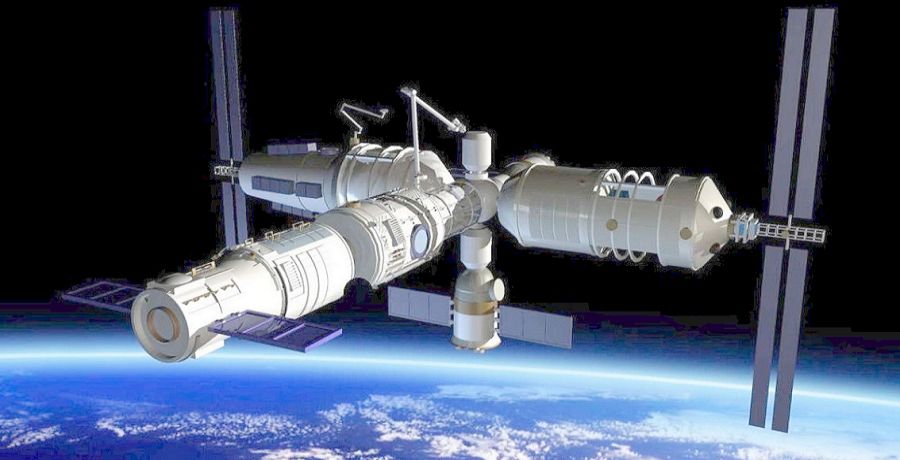
The craft is surmounted by a mannequin in cosmonaut's attire and flanked by the national red and yellow flag constituting one of the main attractions of the show.
The lifetime of the CSS, also called Tiangong ("Heavenly Palace"), is estimated at 10 years. It would then become the only station to evolve in space after the planned retirement in 2024 of the international space station associating United States, Russia, Europe, Japan and Canada.
The Chinese space station will consist of three parts: a main module nearly 17 meters long - for living and working space - and two additional modules for scientific experiments. Three astronauts will be able to live permanently on the machine weighing at least 60 tons and equipped with solar panels. They will be able to carry out research in science, biology or microgravity.
China also announced in May with the UN Office for Space Affairs that its station would be open "to all countries" to conduct scientific experiments. Forty projects from twenty-seven countries and regions Institutes have been submitted by universities and public and private companies.
The European Space Agency (ESA) is already sending astronauts to train in China, with the goal that they will one day fly aboard the Chinese station.
Beijing is investing billions of euros in its space program, led by the army shipping satellites in orbit on its behalf (Earth observation, telecommunications, Beidou geolocation system) or for other countries. She is also planning to send a robot to Mars and humans to the Moon.
The Middle Kingdom, aware of commercial and military issues, will become one of the great powers of space alongside Russia, Japan and India.
|
|
|
|
|
|
|
|
|
| Paul Emison for DayNewsWorld |
|
RUSSIAN SPYING ON A FRENCH SATELLITE
OR THE ISSUES OF SPATIAL STRATEGIC SECURITY
| "Attempting to listen to your neighbors is not just unfriendly. It's called an act of espionage "
The French Minister of the Armed Forces, Florence Parly, Friday accused Russia of having committed in 2017 "an act of espionage" against the French-Italian military satellite Athena-Fidus to try to intercept secure communications.
Has Russia tried to spy on a Franco-Italian military satellite ?
The minister of the Armies asserts it, since the Cnes.
Florence Parly in a speech on the space defense sector indicated that in 2017, "while Athena-Fidus continued its rotation quietly over the Earth, a satellite approached him, up close, a little too close . However, "this satellite with big ears is called Louch-Olymp, Russian satellite well known but a little ... indiscreet," she added.
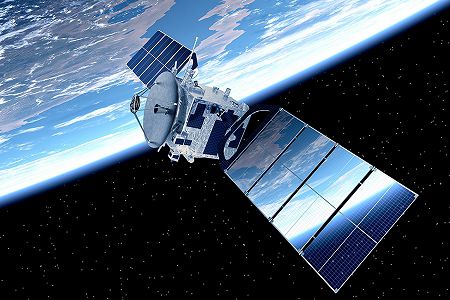 Launched in 2014, Athena-Fidus provides high-speed satellite telecommunications services for the French and Italian military forces, as well as for civil security in the same two countries. Launched in 2014, Athena-Fidus provides high-speed satellite telecommunications services for the French and Italian military forces, as well as for civil security in the same two countries.
Satellite launched in February 2014, Athena-Fidus "consists of two payloads French and Italian," says CNES on its website. It weighs a little more than 3,000 kg and its charges "offer 23 Ka and EHF broadband transponders and 12 different covers: national metropolitan covers, mobile covers, [...] global coverage". It was "built for a lifetime of 15 years in geostationary orbit".
"So much so that we could have thought he was trying to capture our communications," she added. But "trying to listen to your neighbors is not just unfriendly. It's called an act of espionage.
France has fallen behind.
" This big-eared satellite is called Louch-Olymp, it's a well-known but somewhat indiscreet Russian satellite, " she continued. "We had seen it happen, and took the necessary measures. We watch him closely, and we have observed that he continues to actively maneuver the following months with other targets, but tomorrow, who says he will not come back to one of our satellites? She asked herself.
The United States has recently denounced "the very abnormal behavior" of a "space object" deployed by Russia in October 2017. The French Minister regretted for its part that France did not become aware of a militarization of space. " For some time now, as our neighbors have partly changed the nature of space, what have we done? Not much, she said. Not enough in any case. No, we are not protected against these threats. No, espionage and offensive acts, it does not happen only to others. Yes, we are in danger, our communications, our military maneuvers as our dailies are in danger if we do not react , " warned the French Minister of Armies. She also pointed out that " other very large space powers deploy intriguing objects into orbit, experiment with potentially offensive capabilities, conduct maneuvers that leave little doubt about their aggressive vocation".
Critical space defense issues.
It is important to know that space defense issues are becoming crucial. Indeed in the magazine Military Zone are raised the risks. "This is not the first time the risk of a cyberattack targeting satellites is mentioned.
In 2009, the "hacker" Adam Laurie demonstrated that it was possible to intercept a flow of information transmitted by satellite with a computer, a Dreambox type decoder and some software. " Says Pascal Lagneau.
"Then, five years later, a study by IOActive highlighted that the flows of telecommunications satellites could be hacked because of" multiple high-risk vulnerabilities "present in the software integrated into the satellite access terminals. He adds. For example, a group of Chinese hackers named "Thrip" is accused by the United States of spying on geospatial telecommunications and imaging companies and defense organizations in the United States and South Asia. -East. The cyber threat therefore also joins the threat to space activities.
"Space systems are likely to be attacked, like all other systems, and are protected. But, by nature, their protection, in orbit, is materially more difficult than that of other sovereign systems. We have observed specific cases of so-called 'foragers' and sovereign satellites. We have observed specific cases of satellites known as 'browsers', and it protects against possible misdeeds by conventional methods of coding and shielding against laser fire and electromagnetic charges , " explained Jean-Yves Le Gall, president of the National Center for Space Studies [CNES], during a parliamentary hearing.
These threats to the exo-atmospheric space were highlighted by the Strategic Review published in October 2017. "The progress of space rendezvous techniques, robotics and electric propulsion capabilities make it possible to repair, refuel and fuel or even de-orbiting spacecraft. Under the guise of civilian targets, states can therefore openly fund potentially anti-satellite technologies. These would allow the commissioning of tools whose actions would be much more difficult to detect, track, assign and counter than more conventional exo-atmospheric actions (missiles, lasers, jammers ...) " , can we read there.
The Law of Military Programming [LPM] 2019-25 that President Macron promulgated, takes into account this "arsenalisation" of space.
While in the United States, it is now a question of creating a "space force", President Emmanuel Macron has indeed announced his intention to define for France "a defense space strategy" . It makes space a national security issue. The space is "essential for our operations" and "by the incredible potentialities it offers but also by the conflictuality that it arouses" , it "is [...] a real stake of national security" , affirmed Mr. Macron .
A Ministry of the Armed Forces working group is expected to make proposals on the subject by November.
|
|
|
|
| Joanne Courbet for DayNewsWorld |
|
ECLIPSE OF MOON WE ARE
|
|
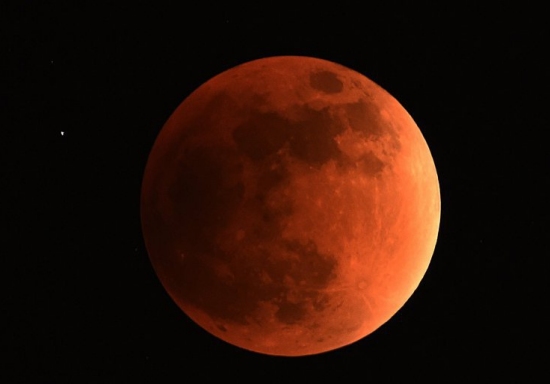
On the evening of Friday, July 27, the moon will be totally eclipsed and the bright Mars will appear visible side by side to the naked eye, southeast of the sky.
The full moon at sunset is partially hidden by the shadow of the Earth, the Moon will plunge completely into the Earth's shadow and present us with a deep coppery hue.
In space, the Sun, the Earth and the Moon have aligned themselves perfectly and the lunar disk is gradually diving into the shadow of the Earth.
At 9:30 pm, Paris time (universal time +2 hours), the full moon is fully immersed in the shadow cone of our planet and its face is a coppery color.
At 22 h 20 min, in a darker sky and when the full moon reaches the deepest part of the Earth's shadow, the bright orange dot of Mars is visible at 6 degrees below it. 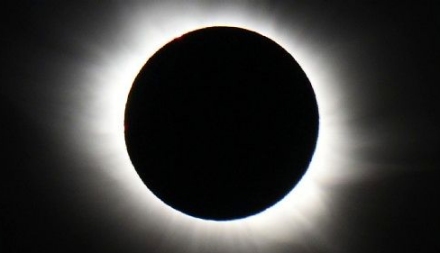
An hour after the departure of the Sun, in a twilight sky already dark, we will observe this extremely brilliant point of the planet Mars, just beautiful next to the Moon totally eclipsed.
This planet is in opposition and it shines as never in the last fifteen years:
superb heavenly show !
It is also aligned with the Sun and the Earth, but it is nearly 58 million kilometers from us, well beyond the end of the shadow of our planet.
From 23 h 13 min the Moon sketches out of the shadows.
At 0 h 19 min, July 28 is the full moon fully out of the shadows to return there on January 21 for an upcoming total eclipse.
At your telescopes !
|
|
|
|
|
| Paul Emison for DayNewsWorld |
|
A POSSIBLE LIFE ON THE RED PLANET
|
Astrobiologist Jennifer Eigenbrode of the US Space Agency's Goddard Center said, "This is a significant step forward as it indicates that organic matter is being preserved in the harshest environments of Mars," adding, "Curiosity has showed that the crater Gale was habitable about 3.5 billion years ago, with conditions comparable to those of the Earth in formation, where life evolved at this time ".
|
|
|
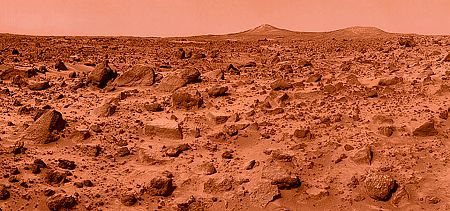
Recall that the Curiosity rover rolls since August 2012 on the sedimentary layers inside a Martian crater called Gale (in honor of a nineteenth century Australian amateur astronomer). And finally here he is who has just delivered a discovery of the most important!
Amazing organic molecules have been discovered by the Curiosity rover in sedimentary rocks dating back about 3.5 billion years. These rocks have been deposited in a lake considered one of the most difficult areas of Mars at a time when life could flourish. The researchers also know a little more about the atmosphere of Mars with the discovery of traces of methane.
Curiosity seems to have also confirmed the presence of seasonal variations of methane in the Martian atmosphere. But this gas, often a sign of the presence of life, comes from the planet itself and could be contained in ice sheets below the surface. 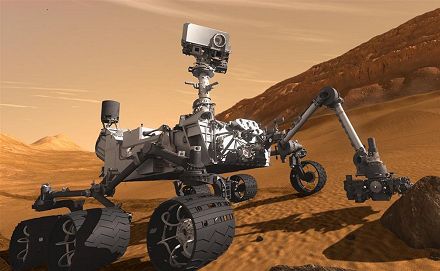
If this is a step forward in the search for life on the red planet, it does not yet suggest the discovery of life on this planet. Indeed samples of organic matter may have an abiotic origin, come from geological formations similar to coal, or a meteorite.
In 2014, organic matter in small quantities had already been found by Curiosity. If that does not mean that life is present, according to Sanjeev Gupta, professor of SVT at Imperial College London (UK) and co-author of the study, "organic compounds are the building blocks of life ".
These two discoveries however evoke the potential life existing or passed on the Red Planet. These types of molecules turn out to be constitutive elements to the appearance of life. And there are two possibilities concerning their origin: either it is an exclusively physical process, or these molecules mean that there has been a life on Mars in the past.
Organic molecules and a potential life on Mars?
Knowing that these organic molecules appeared at the same time as liquid water on Mars and that these two elements together triggered life on Earth, the second possibility is quite probable. Added to this is the presence of methane, another potential indicator of life on Mars.
Indeed, it is the seasonal variability of this methane that intrigues scientists, especially as a peak occurs in the summer. For our Earth, this phenomenon is associated with a biological process. But is it the same for Mars? No one knows for now ...
Methane and organic molecules could be biosignatures of life forms but their origins could also be abiotic.
Let's hope that NASA's Rovers March 2020 and ESA's ExoMars 2020 will land on the red planet to elucidate this intriguing new find.
|
|
|
|
| Paul Emison for DayNewsWorld |
|
RESEARCHERS DISCOVER PLUTO
IS COVERED WITH DUNES
|
|
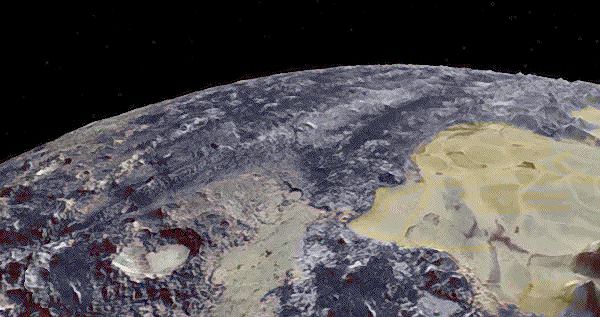
The scientists looked at snapshots taken by NASA's 2006 New Horizons spacecraft, which flew over Pluto in 2015.
It is about -230 degrees and is the farthest dwarf planet in the solar system.
You may have guessed it, it's about Pluto.
And we now know more about the surface of this planet. According to snapshots taken by the New Horizons spacecraft, which flew over Pluto in 2015, it would be covered with dunes of methane ice.
"The probable source of the dune's grains is the methane ice carried by the winds from the mountains," the scientists explain in an article published Thursday in the journal Science. "But we can not exclude that it is nitrogen ice."
Surprising discovery insofar as the atmospheric pressure at the surface of Pluto is 100,000 times lower than that of the Earth. As a result, astronomers thought that it was too weak for winds to form.
"The probable source of the dune's grain is the methane ice carried by the winds from the mountains," scientists say in an article published Thursday (May 31st) in the journal Science. The winds would blow at an approximate speed of 30 to 40 km / h. Weak winds, but so is gravity.
The dunes themselves are spread over an area about 7 km long.
Besides Pluto, it was already known that Mars, Venus or Saturn's great moon, Titan, had dunes, says lead author Matt Telfer, a professor at the University of Plymouth (United Kingdom). "We knew that everything in the solar system with an atmosphere and a solid surface had dunes, but we did not know what we would find on Pluto."
The dunes are probably young, geologically. They would have formed in the last 500,000 years.
"But it turns out that Pluto, while being 30 times farther away from the sun than the Earth, has similar characteristics to Earth's," according to the scientist.
|
|
|
|
| Paul Emison for DayNewsWorld |
|
LAUNCH OF A CHINESE SATELLITE
TO OBSERVE THE HIDDEN FACE OF THE MOON
|
|
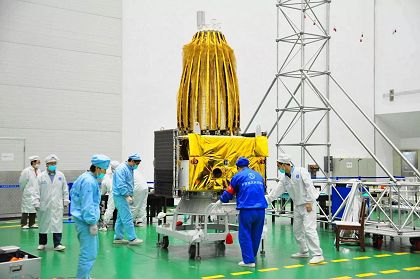
China came to launch on Monday a satellite to observe the hidden face of the moon, photographed since 1959 but never explored. 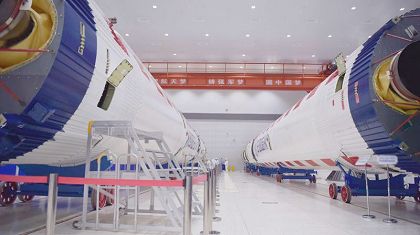
The hidden face of the Moon refers to the hemisphere of the lunar body that is not visible from Earth.
She has been photographed since 1959 but has never been explored.
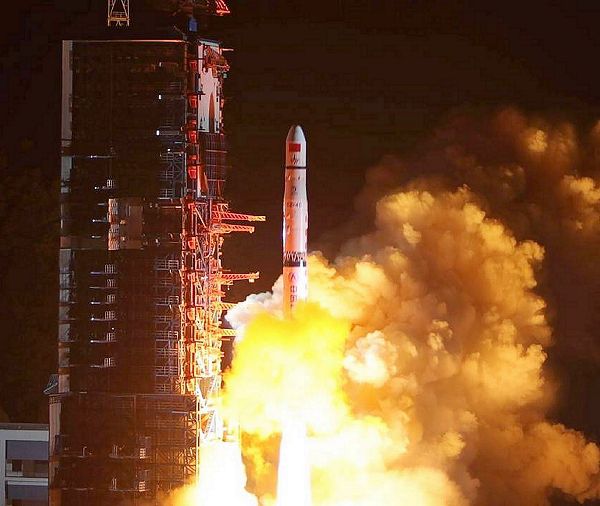 This relay satellite responsible for ensuring communications between the Earth and a small robot should be deployed on the far side of the Moon in 2018, according to the Chinese Space Agency. This relay satellite responsible for ensuring communications between the Earth and a small robot should be deployed on the far side of the Moon in 2018, according to the Chinese Space Agency.
That's why a Long March-4C rocket took off at 5:28 am local time (2128 GMT Sunday) from the Xichang launch pad (south-west) with the Queqiao satellite on board, the National Space Agency said.
Upon the arrival of the remote-controlled robot on the Moon, the satellite will be at a place where it can exchange with the Earth, while having in its line of sight the hidden face of the Moon.
"This launch is a crucial step for China to become the first country to send a probe able to smoothly glide and explore the dark side of the moon," said Zhang Lihua, head of the satellite project.
This is a second Chinese remote-controlled vehicle on the moon after the launch in 2013 of a rover named "Jade Bunny" which has surveyed the lunar surface for 31 months, well beyond its expected life.
It is expected that another robot (Chang'e-5) will be sent to the Moon in 2019 to collect samples and bring them back to Earth.
China invests billions of euros in its space program, coordinated by the army. The country aims to have a space station inhabited by 2022, and eventually send humans on the moon.
|
|
|
|
| Paul Emison for DayNewsWorld |
|
TAKE OFF THE INSIGHT MISSION
|
|
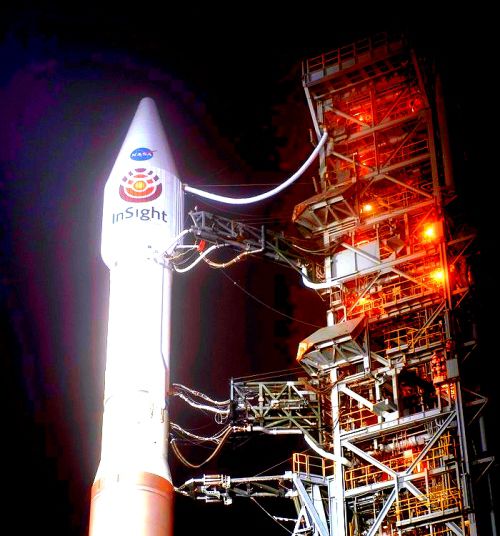
The take off took place at dawn on Saturday. Look at the images.
NASA successfully launched the InSight probe for Mars on Saturday. According to the US space agency, the red planet will be subjected to the first "in-depth verification of its vital functions since its creation 4,500 million years ago".
"Three, two, one, take off!" said a NASA commentator and the unmanned mission moved into the overcast sky. The takeoff took place before dawn, at 4.05 local time (8.05 Buenos Aires) from Vandenberg Air Force Base in California, United States. Aboard an Atlas V rocket - equivalent in height to a 19-storey building
The InSight robot must be placed on Mars on November 26th. The mission will last two years and will cost $ 933 million. It's the first to take off from the west coast of the United States to another planet.
Historical Odyssey: For the first time, NASA will explore the heart of Mars with robots
In fact, the launch was planned for 2016, but it had to be postponed for two years due to a leak in two of the analytical instruments. "It's like playing golf in New York and putting the ball in a hole in California is the level of precision we need," said Jim Green, NASA's chief scientist, during the broadcast. direct.
InSight will allow the analysis of the heat flux of Mars and will measure the tremors that occur during earthquakes. Researchers are convinced that new knowledge about a rocky planet like Mars will directly contribute to future discoveries about the formation of the Earth.
At the same time, he seeks to expand data on the internal conditions of this planet, because, for example, understanding the temperature of Mars is crucial to send people to the red planet in 2030, as expected.
Its name, InSight, comes from inland exploration using seismic surveys, geodesy and heat transport. "March, I'm going, six months and I hope I'll get to the red planet , " reads the InSight Twitter account.
If everything goes as planned, your trip will be 400 million kilometers.
The difference with Curiosity
Unlike the Curiosity mobile, InSight can not travel on the Martian surface. It will remain stationary at a point to study the vital functions of the planet.
To measure temperature, the German Aerospace Center (DLR) has developed a device that will automatically drill up to five meters in Mars soil and record at different depths.
The InSight mission responds to a craving for planetary researchers: "having a geophysical observatory on a planet similar to Earth," said Tilman Spohn of the DLR in a statement.
"Mars is an ideal goal: it can be well achieved and it is an ideal object of comparison with the Earth," he added.
How does InSight work?
Green said the experts already know that Mars presents earthquakes (which could technically be called martemotos), avalanches and meteorite falls. "But how is Mars subject to earthquakes?" This is basic information that we need to know as human beings who are exploring Mars, " he said.
InSight collect data using three instruments: a seismometer, a device to accurately locate the Mars probe oscillates around its axis of rotation and a flow sensor heat is inserted 5 meters below the surface of Mars.
But its key instrument is the seismometer, manufactured by the French Space Agency.
Once the probe is placed on the Martian surface, a robotic arm must be placed directly on the ground. 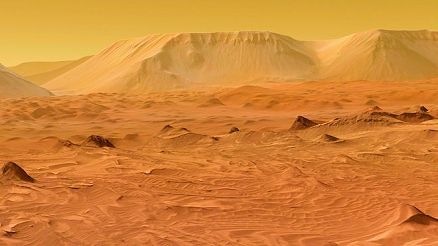
"For us, InSight is perhaps not the best, but a very important mission because we are going to hear the beating of Mars with the seismometer we put on board," Jean-Yves Le Gall, CNES President of France ( says CNES), in a NASA television interview after the launch.
The second important element is the heat detector that will be placed in the basement. Called Heat Flow and Physical Properties Package, it was produced by the German Space Agency with the participation of its Polish counterpart.
The instrument will be introduced between three and five meters below the surface of Mars, at a depth fifteen times greater than that reached in any previous mission.
The temperature at the landing point is freezing and should be between -100 and -20 degrees Celsius. During the summer day at the equator of Mars, the temperature reaches about 20 degrees Celsius, but then drops to -73 degrees at night.
"We must be able to survive in these conditions as human beings living and working on Mars," Green said.
The battery powered, solar powered sensor is designed to operate for 26 months from Earth - or a year 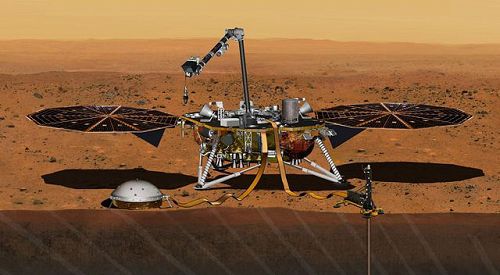 on Mars - a period during which it is expected to detect about 100 earthquakes. on Mars - a period during which it is expected to detect about 100 earthquakes.
"I wish it would be longer than expected," said Tom Hoffman, InSight Project Manager at NASA's Propulsion Laboratory.
"There is nothing usual about going to Mars, especially landing on Mars," said Stu Spath, Lockheed Martin Space InSight Program Manager.
Favorable launch windows for Mars occur only every two years.
The "Marcos", other satellites
Aboard the Atlas V rocket, two small cube-shaped satellites accompanied the InSight: the CubeSats. They are part of the Mars Cube One mission (MarCo) and are prototypes of miniaturized technology, more economical than the one usually used in major space missions.
The MarCo A and MarCo B satellites, the first CubeSats orbiting a planet other than Earth, will follow the path to Mars separated from InSight. But if they manage to reach the Red Planet in time, they will participate in the retransmission to Earth of the ship's signals after landing.
The engineers responsible for the mission nicknamed them precisely Wall-E and Eva, as they explained in the live broadcast of the InSight version.
|
|
|
|
| Larry Ricky for DayNewsWorld |
|
TAKING THE PROBE FROM NASA
MARCH SATURDAY
|
|
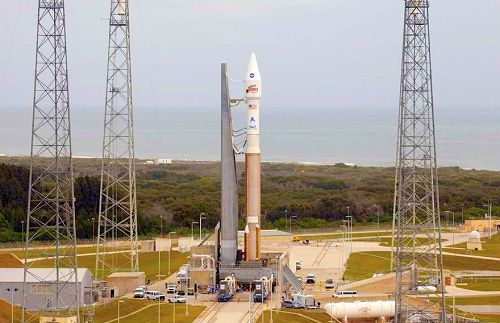
On Saturday, May 5, 2018, the probe will be propelled towards the red planet aboard an Altas V rocket.
The NASA probe is due to take off on Saturday to Mars to reach its final destination in November.
The Mission InSight mission is to study the tectonic activity of the star to better understand how the rocky planets are formed.
On board, a seismometer developed by CNES.
As scheduled at 13:05 (Paris time) the craft was launched from the Vandenberg base of the US Air Force, near Santa Barbara, California.
 Once there, the NASA spacecraft will listen to "beating" the heart of Mars by measuring its seismic activity to better understand the history and structure of this planet. Once there, the NASA spacecraft will listen to "beating" the heart of Mars by measuring its seismic activity to better understand the history and structure of this planet.
"We know that March has been liveable ," said Jean-Yves Le Gall, director of CNES.
It was Mars Express, which was launched in 2003, which showed it. There was water, the atmosphere, the oceans and then all that disappeared. Today Mars is a frozen desert, probably toxic on the surface.
We want to understand why. "
These changes could be due to the modification of the magnetism of Mars.
As part of the Discovery program's geophysics mission, the spacecraft will study two years of tectonic activity on the Red Planet using three instruments:
a seismometer (SEIS), developed by the French National Center for Space Studies (Cnes), a device to accurately locate the probe while Mars oscillates on its axis of rotation (RISE) and a heat flow sensor inserted at 5 meters in the Martian basement (HP3) .B
"If InSight is a success, we will know in 2 or 3 years why the oceans have disappeared, why magnetism has evolved.
From there, we will have one more clue that will help move forward. "
Good Mission !
|
|
|
|
| Paul Emison for DayNewsWorld |
|
DEATH OF THE ASTROPHYSICIAN FAMOUS
STEPHEN HAWKING
|
| British astrophysicist Stephen Hawking, the most famous contemporary scientist - compared to Albert Einstein or Isaac Newton - died Wednesday at the age of 76 at his home in Cambridge, North London, announced his children. "We are deeply saddened by the death of our beloved father today , " said his children, Lucy, Robert and Tim, in a statement. " His courage and tenacity, his genius and his humor, have inspired people around the world," said his children.
 He has been suffering from paralytic degenerative disease, amyotrophic lateral sclerosis (ALS) or Charcot's disease since the age of 21, and has challenged the idea that he only had a few years to live. Paralyzed all the same it only communicated thanks to a computer and a synthesizer of voices. He has been suffering from paralytic degenerative disease, amyotrophic lateral sclerosis (ALS) or Charcot's disease since the age of 21, and has challenged the idea that he only had a few years to live. Paralyzed all the same it only communicated thanks to a computer and a synthesizer of voices.
In his autobiography, The Brief History of My Life , we learn that the announcement of his illness at 21 years had triggered in his passion for mathematics and physics at age 17 at Oxford University his desire to make scientific discoveries "When you face the possibility of dying young, you understand that life deserves to be lived and that there are many things to do," he says in his autobiography.
He then concentrated his life exploring the secrets of the universe. His work focused on bringing the theory of relativity and quantum theory closer together in an attempt to explain the creation of the Universe and how it works. His ideas on black hole physics, the Big Bang and astrophysical singularities that have resulted in more than 130 research papers have revolutionized the understanding of these enigmatic bodies.
In 1974, at the age of 32, he became one of the youngest members of the Royal Society, the most prestigious scientific institution in Britain. In 1979, Hawking was named professor of mathematics at the University of Cambridge.
"My goal is simple," he said one day. "It's the total understanding of the Universe", "to understand why he is as he is and why he exists" . And this understanding, he wanted to share with the Boeotians that we are by the publication of a global bestseller, A brief history of time , published in 1988 and sold several million copies.
In cinema, a biopic directed by James Marsh had been devoted to him in 2015, "A marvelous history of time".
The tributes of the scientific community multiplied on the announcement of his death. "Professor Hawking was a unique being who will be fondly remembered not only in Cambridge but around the world," said Stephen Toope, vice-president of Cambridge University, where Stephen Hawking had studied and worked. . "His outstanding contribution to scientific knowledge, mathematics and extension leaves an indelible contribution." On Twitter, NASA praised "a renowned physicist and a science ambassador". "His discoveries have opened up a world of possibilities that we and the world continue to explore," said the US Space Agency.
British Secretary of State for Veterans Tobias Ellwood said Stephen Hawking was "an inspiration to all of us, no matter what our situation, to reach the stars".
|
|
|
|
| Britney Delsey for DayNewsWorld |
|
There are no translations available.
LANCEMENT REUSSI DE LA FUSEE SPACE X
|
|
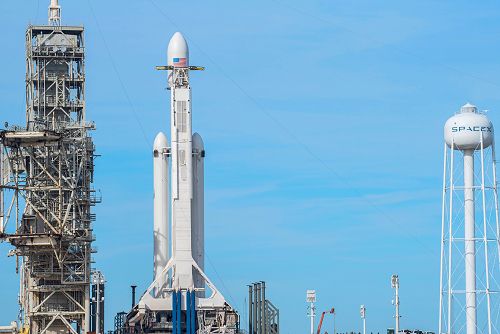 Hier, mardi 6 février 2018, la fusée la plus puissante du monde, la Falcon Heavy, de Space X, a effectué son premier vol historique. Le lancement avait cependant été reporté par deux fois dans l’après midi. Hier, mardi 6 février 2018, la fusée la plus puissante du monde, la Falcon Heavy, de Space X, a effectué son premier vol historique. Le lancement avait cependant été reporté par deux fois dans l’après midi.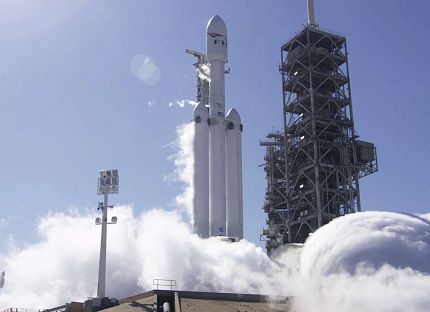
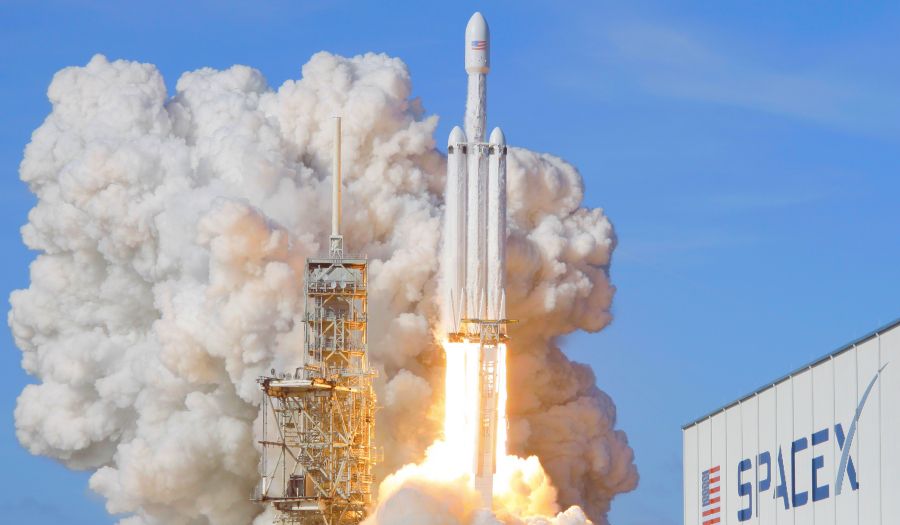 Elon Musk a tweeté à 20 h 46 GMT (19h30 heure française) un message accompagné d’une vidéo de Falcon Heavy. Elon Musk a tweeté à 20 h 46 GMT (19h30 heure française) un message accompagné d’une vidéo de Falcon Heavy.
Selon lui, « la mission s’est déroulée aussi bien que l’on pouvait l’espérer, et le tir a été réussi ».
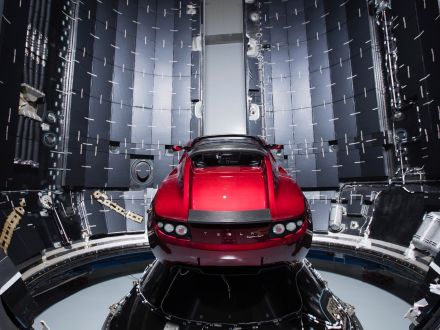  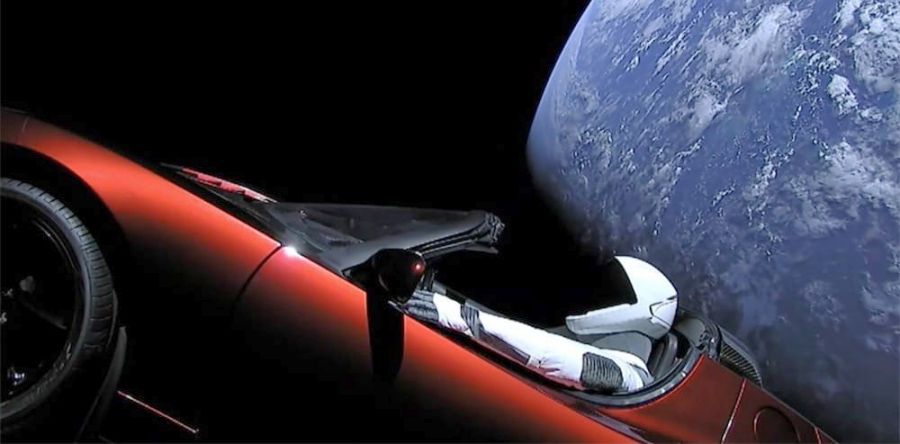 La conquête de l‘Espace va désormais entrer dans une nouvelle ère. La conquête de l‘Espace va désormais entrer dans une nouvelle ère.
La Falcon Heavy va en effet ouvrir une nouvelle voie qui devrait permettre de transporter des humains vers la Lune ou Mars.
Les 27 moteurs de cette super fusée se sont allumés tous en même temps pour générer une poussée de 2500 tonnes, soit l’équivalent de 18 Boeings 747, à la verticale.
Une explosion géante a été vue sur le pas de tir de la base spatiale de la Nasa en Floride.
Elon Musk , le milliardaire sud africain avait au préalable décidé de remplacer la charge utile (60 tonnes) de la fusée par son Roadster Tesla Rouge Cerise, lequel a été propulsé vers l’espace puis mis sur orbite.
La Tesla Rouge Cerise était cachée dans le capuchon de la fusée.
Un mannequin, qui avait été équipé d’une combinaison rouge elle aussi et baptisé Starman et qui avait été installé au volant de la Tesla diffusait la chanson de David Bowie, Space Oddity. De son coté, le tableau de bord de la Tesla Rouge affichait « D’ont Panic », la référence très galactique de Douglas Adams (extrait de son Guide du Voyageur).
Le clou du spectacle : l’atterrissage en retour et en douceur, de deux des propulseurs qui se sont posés comme des plumes sur le sol. Le troisième, en revanche, a sombré dans l’Atlantique, plongeant à une centaine de mètres de la barge ou il devait se poser ; Selon Elon Musk, l’engin aurait apparemment pénétré à 480 km/h dans l’eau.
|
|
|
|
| Clara Mitchell pour DayNewsWorld |
|
There are no translations available.
DEUX SATELLITES MIS EN ORBITRE
PAR ARIANE 5 EN GUYANNE
|
|
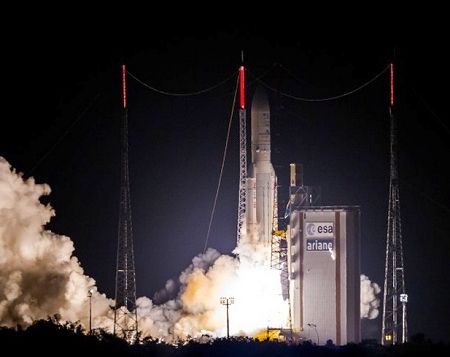
Ariane 5 confirme sa fiabilité après son tir avorté début septembre .Le lancement avait été annulé le 5 septembre 2017 après une anomalie observée dans les ultimes secondes précédant le décollage.
Cette fois le 29 septembre 2017, un peu moins de 30 minutes après son décollage, Ariane 5 s’est séparée du satellite de près de 6,5 tonnes Intelsat 37e.
Et un peu plus de 47 minutes après s’être arraché du sol guyanais, Ariane 5 s’est séparé du satellite BSAT-4a.
Un succès puisque une fusée Ariane 5 a placé en orbite deux satellites commerciaux, Intelsat 37e et BSAT-4a, vendredi 29 septembre 2017 après un décollage du Centre spatial guyanais de Kourou, a annoncé Arianespace dans un communiqué.
En effet Ariane 5 a réussi sa mission mettant sur orbite depuis le Centre Spatial Guyanais deux satellites de télécoms :
Intelsat 37e pour l'opérateur américain Intelsat (près de 6,5 tonnes) et BSAT-4a, un satellite de 3,52 tonnes dédié à la télévision numérique pour le constructeur SSL (Space Systems Loral) dans le cadre d'un contrat clé en main au profit du japonais Broadcasting Satellite System Corporation (B-SAT).

Fabriqué par Boeing, Intelsat 37e est le 59e satellite d'Intelsat à être lancé par Arianespace depuis la mise en orbite d'Intelsat 507 en octobre 1983.
Deux autres satellites Intelsat figurent dans le carnet de commandes d'Arianespace (Intelsat 39 et Horizon-3e).
"Nous sommes très heureux de la confiance renouvelée d'Intelsat qui, un peu plus d'un an après le lancement double d'IS-33e et de IS-36 et sept mois après celui d'Intelsat-32e/SKY Brasil-1, nous a choisis pour la mise en orbite d'IS-37e, le satellite le plus puissant de sa flotte EPICNG", a souligné le PDG d'Arianespace, Stéphane Israël.
BSAT-4a, quant à lui, est le neuvième satellite lancé par Arianespace pour B-SAT.
Depuis la création de B-SAT, Arianespace a lancé tous les satellites de l'opérateur Japonais.
Il s’agit du neuvième succès de l’année pour Arianespace, la société qui commercialise les lancements. Et du 81e succès consécutif pour une Ariane 5, le cinquième en 2017
|
|
|
|
| Paul Emison pour DayNewsWorld |
|
There are no translations available.
LE SUICIDE DE CASSINI
|
« Les découvertes faites figurent parmi les plus époustouflantes en science planétaire », avait expliqué mercredi devant la presse Linda Spilker, principale scientifique de la mission.
|
|
|
 Cassini , c'est fini. La sonde américaine a lancé son dernier message et s'est désintégrée vendredi après avoir réussi à transmettre des données jusqu'à la dernière seconde. Cassini , c'est fini. La sonde américaine a lancé son dernier message et s'est désintégrée vendredi après avoir réussi à transmettre des données jusqu'à la dernière seconde.
Après vingt années dans l’espace, l’ultime signal de la petite sonde a été capté par le centre de contrôle du Jet Propulsion Laboratory (JPL), en Californie. Ce dernier souffle électronique aura mis près d'une heure et demie à parcourir le milliard de kilomètres et demi qui nous sépare de Saturne.
Le vaisseau de 2,5 tonnes, lancé en 1997 a mené une exploration scientifique durant treize années de SATURNE la grande planète gazeuse, de ses anneaux et de 19 de ses lunes.
« Le signal a été perdu…. c’est la fin du vaisseau spatial », a dit un des ingénieurs du centre de contrôle, selon les images de la NASA retransmises en direct.
« J’espère que vous êtes tous très fiers de cet accomplissement extraordinaire, félicitations à tous pour cette mission incroyable », a déclaré Earl Maize, le responsable de la mission Cassini en s’adressant à toute son équipe.
Pendant son plongeon final, Cassini a continué de prendre des mesures et à les transmettre en temps réel vers la Terre. Cassini avait pour mission de «respirer» quelques molécules d'atmosphère pour en déterminer la nature. «Les dernières secondes de Cassini pourraient à elles seules fournir assez de matière à plusieurs doctorats» a déclaré le directeur du JPL, Michael Watkins .
En effet ces précieuses informations vont aider à la compréhension de la formation et de l’évolution de la planète gazeuse, selon les scientifiques.
La sonde a effectué une exploration des plus fructueuses de la planète gazeuse et de ses lunes.
Les scientifiques disposent désormais d'une mine de données à analyser. «Nous en avons pour plusieurs décennies encore. » d'après Linda Spilker, responsable scientifique de la mission « C'est un marathon scientifique de treize années que nous venons de terminer, mais il reste tant de choses à expliquer!»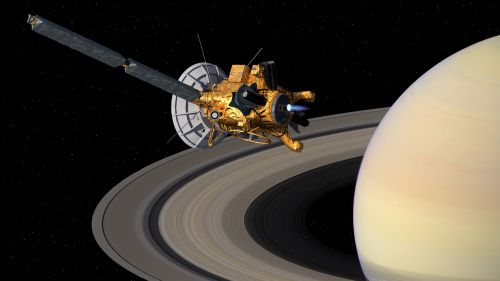
Aux spécialistes du JPL de dresser le bilan de ces vingt années passées dans l'espace, dont treize en orbite autour de Saturne.
La sonde a fait des découvertes extraordinaires comme des mers de méthane liquide sur Titan, son plus grand satellite naturel, et un vaste océan d’eau salée sous la surface glacée d’Encelade, une petite Lune saturnienne.
Les données recueillies par le spectromètre de Cassini ont également révélé la présence d’hydrogène.
Cet hydrogène signale une activité hydrothermale propice à la vie.
Cette découverte majeure du mois d'avril dernier a ouvert de nouveaux horizons aux scientifiques, comme la recherche la vie extraterrestre.
« Ce monde océanique d’Encelade a vraiment changé notre approche ur la recherche de la vie ailleurs dans notre système solaire et au-delà », a expliqué Linda Spilker.
Les deux lunes que sont Titan et Encelade abritant un vaste océan d'eau liquide et abondant en molécules organiques complexes réunissent tous les ingrédients nécessaires à l'apparition de la vie !
Cassini c'est aussi l'histoire d'une belle coopération entre la NASA, l’Agence spatiale européenne (ESA) et l’Agence spatiale italienne. Ces deux dernières ont construit la petite sonde Huygens que Cassini a transporté jusqu’en décembre 2004 date de son atterrissage sur Titan.
|
|
|
|
| Paul Emison pour DayNewsWorld |
|
There are no translations available.
PREMIERE IMAGE
DE LA COMBINAISON SPATIALE SPACE-X
|
|
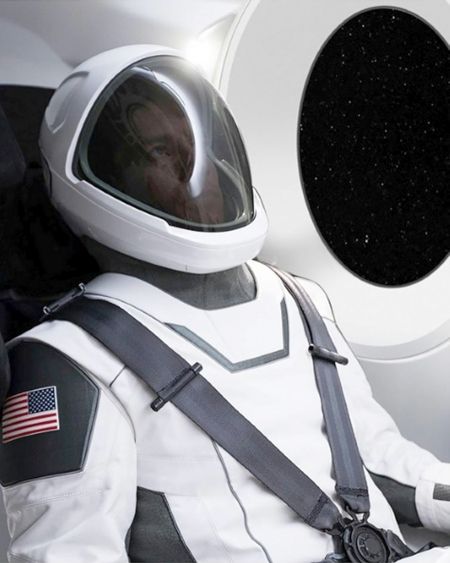 Le 23 août 2017, Elon Musk, le fondateur de Space X et de Tesla, a dévoilé sur Instagram un premier visuel de sa nouvelle combinaison spatiale. Le 23 août 2017, Elon Musk, le fondateur de Space X et de Tesla, a dévoilé sur Instagram un premier visuel de sa nouvelle combinaison spatiale.
La nouvelle combinaison spatiale d'Elon Musk va ringardiser celle de Thomas Pesquet
Le défi principal était de concevoir un équipement aussi pratique que beau."C'était incroyablement dur d'équilibrer l'esthétique et le fonctionnel".
Le défi a, semble-t-il, été relevé haut la main.
Assurément le design de ce scaphandre de l'espace paraît sur la partie de la combinaison que l'on aperçoit nettement plus esthétique que les standards actuels:
Taille réduite du casque d'une ressemblance ahurissante avec celui d’un des deux membres de Daft Punk, coupe ajusté ... On est pas loin de la combinaison du Valerian de Besson !
Elon Musk assure qu’elle a été testée et approuvée.
Cette tenue fonctionnelle..
Conçue en interne les coûts de production ont été réduit.
Ne permettant pas de se déplacer dans l’espace, elles seront plutôt portées lors du transport en capsule pour servir de sécurité en cas de dépressurisation de la capsule.
Le patron de Space X a conçu la combinaison spatiale que porteront les équipages des vols spatiaux autour de la Lune, programmée pour 2018 comme Elon Musk l'avait espéré en début d'année. Une première étape avant de viser Mars.
Le patron de SpaceX promet d’autres informations sur son programme spatial dans les jours à venir.
L’emploi du temps d’Elon Musk est des plus chargés en ce moment...
|
|
|
|
| Paul Emison pour DayNewsWorld |
|
There are no translations available.
AUX ETATS-UNIS UNE ECLIPSE SOLAIRE TOTALE
LE 21 AOUT
|
|
Les éclipses de Soleil longtemps mystérieuses pour les hommes ont été attribuées à des causes surnaturelles y voyant l'intervention d'une divinité, d'un démon ou d'un génie malin: pour les Chinois, c’était un dragon dévorait notre étoile, tandis que chez les Viking, c'était des loups la capturaient...Cela a pris du temps pour découvrir que le véritable coupable était la Lune. De nos jours, les scientifiques savent prédire les éclipses avec une extrême précision (moins d'une seconde)
« Il a fallu les observations des astronomes et l'étude du mouvement du Soleil et de celui de son satellite naturel, pour comprendre que c'est la Lune qui à chaque éclipse s'interpose devant le Soleil », souligne Pascal Descamps, astronome à l'Institut de mécanique céleste et de calcul des éphémérides (IMCCE) à Paris.
Alors que la dernière éclipse totale visible depuis la France remonte au 11 août 1999, les Américains, eux, vont vivre le lundi 21 août 2017 la première éclipse de Soleil totale qui traversera le pays d'est en ouest depuis 1918. Un événement si rarissime que l'éclipse risque d'être la plus scrutée de l'histoire de l'humanité.
|
|

|
L'éclipse sera totale :
en effet la Lune cachera intégralement le Soleil, sur un couloir large de 113 km de large qui concernera 14 Etats :
Oregon, Idaho, Wyoming, Montana, Iowa, Kansas, Nebraska, Missouri, Illinois, Kentucky, Tennessee, Georgia, Caroline du Nord et Caroline du Sud.
Certains endroits français comme les Antilles, la Guyane et Saint-Pierre-et-Miquelon vivront également ce phénomène.
En France métropolitaine, l'éclipse sera "en gros invisible, sauf depuis la pointe bretonne", a déclaré Pascal Descamps, astronome à l'Institut de mécanique céleste et de calcul des éphémérides (IMCCE).
Le meilleur endroit pour tenter de l'apercevoir sera Quimper (Finistère) et ses environs, avec un début à 21h41 et le maximum à 22h10.L'éclipse solaire est le résultat de l'alignement des trois astres que sont la Terre , la Lune et le Soleil.
La Lune va en effet se glisser entre la Terre et le Soleil, occultant pendant quelques minutes sa lumière.
|
|
Le diamètre du Soleil est 400 fois supérieur à celui de la Lune mais l'étoile est également 400 fois plus éloignée que le satellite naturel de la planète bleue.
Depuis la Terre, cette géométrie donnera donc l'impression que le Soleil et la Lune ont de même taille.
Lorsque les deux seront alignés, la Lune masquera entièrement le Soleil et le ciel deviendra noir quelques minutes seulement en pleine journée. On parle alors d'une éclipse totale. Cette dernière se produit tous les douze à dix-huit mois quelque part dans le monde mais cela ne touche qu'une étroite bande de notre planète, le plus souvent ère inhabitée (océans, pôles, déserts).
Lors d'une éclipse, la Lune cachant le Soleil, on peut observer sa couronne solaire, une zone de très haute température extrêmement dynamique que l'éclat du Soleil cache.
La couronne solaire est cette atmosphère externe de notre étoile s'étendant sur plusieurs millions de kilomètres. Sa température varie entre 1 à 3 millions de degrés alors que la surface du Soleil est à 6000 degrés. Les astronomes étudient comment l'atmosphère terrestre et le sol de notre planète réagissent à la baisse de température soudaine provoquée par une éclipse dans la zone concernée.
Le 2 juillet 2019, le Pacifique et l'Amérique du Sud (Chili et Argentine) seront concernés. Idem le 14 décembre 2020 (Pacifique, sud du Chili, Patagonie puis Atlantique). Le 4 décembre 2021, ce sera au tour de l'Antarctique. Le 20 avril 2023,touchera essentiellement l'Indonésie et l'Australie ,les États-Unis vivront une autre éclipse totale en 2024tandis que la France devra attendre le 3 septembre 2081 !
|
|
|
| Paul Emison pour DayNewsWorld |
|
There are no translations available.
A NOUVEAU DES AMBITIONS SPATIALES
POUR LES ETATS-UNIS ANNONCEES
|
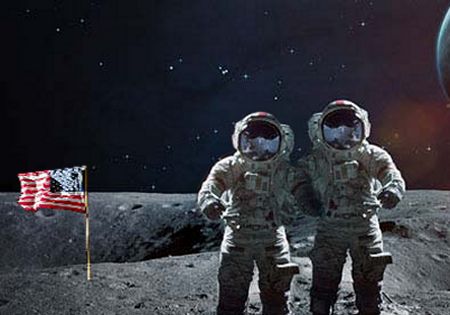
Le vice-président américain Mike Pence a annoncé jeudi l'avènement d'une «nouvelle ère» dans l'exploration spatiale. Il prévoit l'envoi par les États-Unis d'une mission habitée sur Mars et le retour d'astronautes sur la Lune.
Récemment nommé à la tête du Conseil spatial national, un organe consultatif, Mike Pence vient de visiter le Centre spatial Kennedy près de Cap Canaveral en Floride et a été impressionné par les capsules spatiales en cours de construction par le secteur privé pour le compte de la NASA.
«Notre pays retournera sur la Lune et nous mettrons des bottes américaines sur la surface de Mars», a affirmé Mike Pence devant environ 800 employés de la NASA.
Était également présent Buzz Aldrin, le deuxième homme à avoir marché sur la Lune après Neil Armstron
La NASA travaille sur un projet baptisé «Deep Space Gateway» pour envoyer des astronautes en orbite lunaire avec de nouvelles fusées développées par l'agence spatiale américaine.
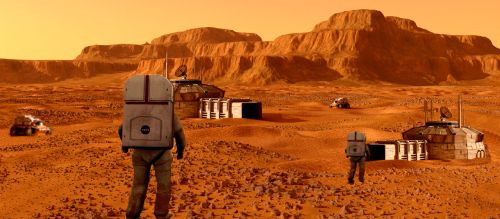
L'envoi d'astronautes sur Mars d'ici 2030 figurait déjà parmi les priorités affichées des programmes spatiaux des présidents Barack Obama et George W. Bush.
Voyages spatiaux moins coûteux
Depuis l'arrêt des navettes spatiales américaines en 2011, les astronautes américains dépendent des vaisseaux russes Soyouz s'ils veulent se rendre dans la Station spatiale internationale (ISS.).
Le siège est à plus de 80 millions de dollars !. Les entreprises américaines SpaceX et Boeing travaillent toutes deux à des capsules pour le transport des astronautes en orbite terrestre dès 2018.
 Mike Pence devant une capsule Dragon de SpaceX et un prototype du futur vaisseau Starliner de Boeing, a souligné que le gouvernement américain favoriserait la coopération avec le secteur privé pour rendre les voyages spatiaux moins chers, plus sûrs et plus accessibles. Mike Pence devant une capsule Dragon de SpaceX et un prototype du futur vaisseau Starliner de Boeing, a souligné que le gouvernement américain favoriserait la coopération avec le secteur privé pour rendre les voyages spatiaux moins chers, plus sûrs et plus accessibles.
Le président Donald Trump a proposé un budget de 19,1 milliards de dollars pour la NASA, une baisse de 0,8% par rapport à 2017.
Il a demandé à l'agence spatiale d'abandonner son projet de capturer un astéroïde et a mis fin aux financements demissions destinées à étudier le changement climatique et les sciences de la Terre.
|
|
|
|
| Paul Emison pour DayNewsWorld |
|
There are no translations available.
NASA ET COLONIES D'ENFANTS
ESCLAVES ENVOYEES SUR MARS
|
|
 Les rumeurs vont bon train sur Internet et se répandent tels des virus malfaisants. A tel point que la Nasa a préféré démentir immédiatement la rumeur partie d'un témoignage lors d'une émission de télévi « enfants »sion américaine.. Les rumeurs vont bon train sur Internet et se répandent tels des virus malfaisants. A tel point que la Nasa a préféré démentir immédiatement la rumeur partie d'un témoignage lors d'une émission de télévi « enfants »sion américaine..
Le présentateur Alex Jones jeudi 29 juin qui affectionne tout particulièrement les théories du complot, a invité Robert David Steele à s’exprimer dans son émission The Alex Jones Show, diffusée sur pas moins de 118 stations de radio dans tous les Etats-Unis. .
Voilà notre homme se présentant comme un ex-agent secret qui se met a affirmer que des enfants étaient kidnappés puis envoyés sur Mars via un voyage de vingt ans.
L’homme est là pour parler de Mars certes, et il a des "révélations" à faire certes mais quelles révélations !
Une fois arrivés, ces n’avaient d’autre choix que de devenir des esclaves dans les colonies martiennes
.Et ce n’est pas tout. Robert David Steele ajoute :
« Ils les terrorisent pour enrichir leur sang en adrénaline, et les tuent. Ça inclut aussi de les tuer, comme ça, ils peuvent récupérer la moelle récoltée. »
« Nous croyons réellement qu'il y a sur Mars une colonie habitée par des enfants esclaves, raconte-t-il, d'un ton grave. Ils y arrivent après un voyage de vingt ans dans l'espace. Et une fois arrivé sur place, ils n'ont plus d'autre choix que de devenir des esclaves ».
Mais ce n’est pas tout. D’après lui, la Nasa kidnapperait ces enfants, dans le but de « remplir leur sang d'adrénaline », puis les assassinerait « pour récupérer leur os, leur moelle" »,?! Des vampires quoi !?
S agit-il de l'hormone de croissance originelle ?
A la question du présentateur, sur le bien-fondé de cette révélation :
« Absolument, c'est un truc antivieillissement », renchérit alors le soi-disant ex agent-secret.
La folle rumeur se répand comme une traînée de poudre sur la toile.
La Nasa a immédiatement démenti dans le Daily Beast, par la voix de son porte-parole Guy Webster. « Il n’y a pas d’humain sur Mars. Il y a des robots actifs sur Mars. Une rumeur était en train de se propager la semaine dernière qu’il n’y en avait pas. Il y en a. Mais il n’y a pas d’humain. »
Mieux vaut en rire qu'en pleurer !!
Certains ont préféré le prendre avec humour.
« Si la NASA a kidnappé des gosses pour les envoyer sur Mars, il est mathématiquement impossible qu’il y ait des "colonies d’enfants" là-bas. Selon votre copain, ils ont voyagé 20 ans pour arriver à destination. DONC CE SONT DES COLONIES D’ADULTES. » dans le Parisien
A un autre internaute américain de le prendre au second degré Sur Reddit, :
"Un démenti... C'est exactement ce que ferait quelqu'un qui détient une colonie d'enfants esclaves sur Mars".
Gardons d'ailleurs en mémoire qu'Alex Jones se fait souvent l'avocat de ce genre de rumeur .
Ainsi en 2016, lors de la campagne présidentielle, le producteur avait répandu la folle rumeur selon laquelle des proches d’Hillary Clinton géraient un réseau pédophile dans la cave d’une pizzeria à Washington !
Ce qui aurait pu provoquer une tragédie humaine !! Sûr de cette information, un homme s’était précipité dans ce fameux restaurant pour ouvrir le feu mais heureusement sans faire de victime...
|
|
|
|
| Joanne Courbet pour DayNewsWorld |
|
There are no translations available.
RETOUR SUR TERRE DE NOTRE HEROS
THOMAS PESQUET
|
Il revient avec la "conscience que la planète est vraiment un joyau". "De voir la planète, de voir sa fragilité, de prendre du recul, cela permet d'apprécier cette fragilité-là", dit-il. "On n'a pas conscience à quel point l'atmosphère c'est mince (...), à quel point on est capable d'abîmer la planète, à quel point il faut la protéger."
|
|
|
 Thomas Pesquet revient sur Terre après une mission de six mois dans l'espace vendredi, au terme Thomas Pesquet revient sur Terre après une mission de six mois dans l'espace vendredi, au terme
d'une mission bien remplie!
Comme prévu, à un minute près, l'atterrissage a eu lieu à 16h10, heure française, dans les plaines désertes des steppes kazakhes, un peu plus de trois heures après que leur vaisseau s'est détaché de l'ISS à 12h49. Chacun équipé d'un scaphandre, les astronautes ont pris place dans la capsule Soyouz, qui s'est désamarrée de la Station spatiale internationale à 12h50 (heure française). Après un long parachutage, la capsule s'est posée à 16h10 sur le sol du Kazakhstan.
Les premières images du Français l'ont montré souriant et visiblement en bonne santé. Thomas Pesquet allait rejoindre Cologne.
La mission Proxima du 10e astronaute français de l'histoire prend fin, après six mois et demi passés dans l'espace confiné de l'ISS : à peine 400 m3 habitables c-à-d un appartement de 130 m2 avec trois mètres de plafond. À partager avec quatre à cinq colocataires. Pendant 196 jours !
Avant de s'envoler pour la Station spatiale internationale (ISS) en novembre dernier, Thomas Pesquet faisait de son retour en capsule Soyouz, l'un des moments les plus attendus de sa mission.
Avec le cosmonaute russe Oleg Novistky, qui a piloté la boîte de conserve de 2,2 m de diamètre et de 2,1 m de haut, le Français a effectuer une rentrée dans l'atmosphère à la vitesse vertigineuse de 28.000 km/h !!! 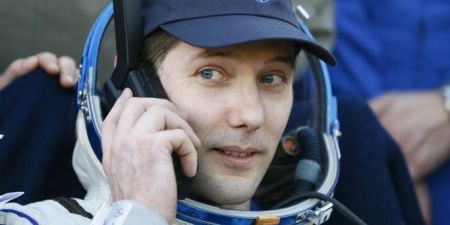 «C'est l'accomplissement d'un énorme travail collectif» «C'est l'accomplissement d'un énorme travail collectif»
Outre les effets personnels, ne repartent en Soyouz que les données d'expériences scientifiques (échantillons ou disques durs).
L'ex-pilote de ligne d'Air France a souligné que ce qui lui avait le plus manqué bien sûr ses proches mais aussi le sentiment de liberté: «Aller dehors, faire un tour de vélo, aller à la montagne, la mer, des sensations bêtes: le vent, la pluie, des odeurs différentes, un peu de perspective…» Il ne regrettera ni la nourriture, «pas terrible», ni les «toilettes de camping» !
Mais avant tout chose des souvenirs extrêmement positifs. Les sensations du décollage depuis Baïkonour, les seize levers de soleil quotidiens à bord de l'ISS, la vie en apesanteur, et les deux sorties en scaphandre réalisées en janvier et en mars. Ces dernières étaient destinées pour des opérations de maintenance pendant lesquelles il tenait la Station d'une main et voyait la Terre défiler juste sous ses pieds 400 km plus bas. Il s'est montré très professionnel.
Sur le plan scientifique, l'installation de la machine Mares qui mesurait l'activité musculaire des astronautes pendant des séances d'exercice l'a marqué. «C'est l'accomplissement d'un énorme travail collectif»
Le Normand a participé à une centaine d'expériences scientifiques, dont une soixantaine menées pour le compte des agences spatiales européenne (ESA) et française (Cnes). Les passagers de l'ISS sont de véritables cobayes et sont soumis à de très nombreux tests. Il s'agit d'avoir une meilleure compréhension de l'apesanteur sur le corps humain. L'état de quasi-apesanteur dans lequel il était baigné lui a permis d'effectuer des expériences inédites, à commencer par les effets de cette microgravité sur son propre corps .
En parallèle, ils mènent aussi des expériences de physique fondamentale, sur l'étude du comportement des fluides et des matériaux en apesanteur, ou de biologie, comme la culture de légumes.
Toutes nos felicitations à ce brillant scientifique français dont la France est fière. |
|
|
|
|
| Joanne Courbet pour DayNewsWorld |
|
There are no translations available.
THOMAS PESQUET
N'EN FINIRA PAS DE NOUS ETONNER !
|
|
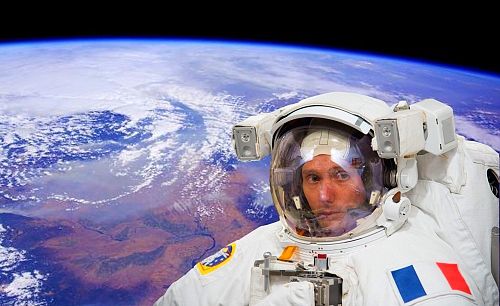 On connaît l'entraînement sportif quotidien de nos astronautes à bord de l'ISS. On connaît l'entraînement sportif quotidien de nos astronautes à bord de l'ISS.
L'astronaute français Thomas Pesquet, en mission dans l'espace pour 6 mois, demeure avant tout un bon citoyen ! Le voilà qui nous convie, nous Terriens, d' aller voter en ce dimanche brumeux
.En orbite à 400 km au-dessus de la Terre il n’en oublie pas l’élection présidentielle : Espérons qu'il avait pour divertissement mieux à se mettre sous la dent que les insipides débats politiques servis à nous pauvres Terriens réduits à voter entre ? J'aurais préféré vivre à ces moments là entre le flot interrompu d'images de l'espace céleste depuis la Station spatiale internationale ! et faire un grand retour sur Terre en juin prochain .Et quitte à faire après les législatives... Pour un quotidien bien différent d'une vie sur la Terre.
Leur mission à tous devra leur réussite également de l'entente de l’équipe notamment du caractère des habitants de l'ISS. Et la personnalité du candidat a fait partie des critères de sélection. Que de qualités rares requises en un même individu.
Vivre pendant six mois dans un espace restreint, en apesanteur, demande de grandes capacités d' adaptation à son environnement : dormir dans un sac de couchage accroché au mur, se laver avec des lingettes humides, s'exercer et faire de la muscu plus de deux heures par jour…
L'équipe de la Station spatiale internationale s'est organisée en créant un rythme régulier qui frôle la normalité..« On a des lumières qu'on allume à 6 heures quand on se lève, et on les éteint à 23 heures, et puis certaines changent d'intensité », raconte Thomas Pesquet à un journaliste. « Heureusement, sinon ce serait éreintant. » ; Et bien sûr les tempéraments des uns et des autres au quotidien est pour beaucoup dans le bon déroulement de la mission et dans les performances de l'équipe : DEHORS LES GRINCHEUX, ICI PLACE AUX ESPRITS CONCILIANTS !
|
|
|
|
|
|
|
|
| Joanne Courbet pour DayNewsWorld |
|
There are no translations available.
CE SOIR LE CIEL VA-T-IL NOUS TOMBER SUR LA TETE AVEC LE PASSAGE DE L'ASTROIDE 2014JO25 ?
|
|
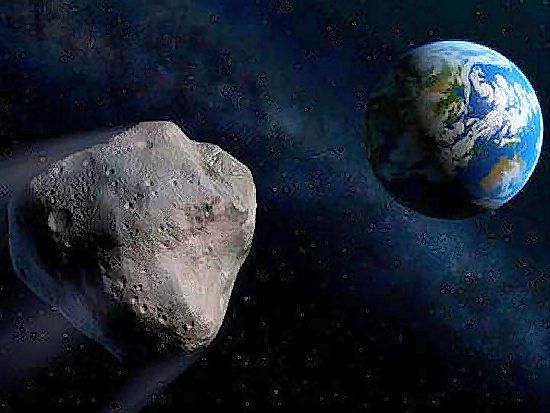 Un astéroïde géant, estimé actuellement à 852 mètres de large et baptisé 2014-JO25 passera à 1,8 million de kilomètres de notre Terre : Soit, un peu plus de quatre fois la distance de la Terre à la Lune donc moins de 1,8 million de km. Et ce dans la nuit de ce mercredi 19 avril 2017. Représente-t-il un danger immédiat pour la Terre ? Non selon la Nasa. Bien que classé par la Nasa dans la catégorie «potentiellement dangereux», cet objet céleste ne menace pas de frapper la Terre. Un astéroïde géant, estimé actuellement à 852 mètres de large et baptisé 2014-JO25 passera à 1,8 million de kilomètres de notre Terre : Soit, un peu plus de quatre fois la distance de la Terre à la Lune donc moins de 1,8 million de km. Et ce dans la nuit de ce mercredi 19 avril 2017. Représente-t-il un danger immédiat pour la Terre ? Non selon la Nasa. Bien que classé par la Nasa dans la catégorie «potentiellement dangereux», cet objet céleste ne menace pas de frapper la Terre.
L'Agence spatiale américaine assure qu'il "volera en toute sécurité". L'astéroïde 2014-JO25 ne fera que "frôler" la Terre. Il sera 23h23, heure française, lorsque l'astéroïde passera au plus près de nous...
Alors à vos télescopes !
A l'oeil nu, impossible d'observer le phénomène, en revanche un télescope de 20 cm suffira pour suivre son périple pendant deux nuits. Pour une bonne observation l'environnement doit être le plus sombre possible mais ce qui s’avérera surtout difficile , c'est de suivre l'astéroïde, l'objet s'approchant à une vitesse impressionnante de 120000 km/h (ou 33 km/s) de la Terre !!! La dernière fois que 2014-JO25 nous a rendu visite cela remonte à 400 ans et on ne le reverra pas avant 2.600 ans.
Les astronomes attendent avec impatience le passage de ce gigantesque caillou car son observation permettra d'établir plus précisément sa taille.
Avoir des données précises de la taille et de la forme est très important, puisqu'on n'en déduit la densité de l'objet... C'est important de savoir si c'est un rocher friable ou objet ferreux, qui traverse notre ciel en cas d'une éventuelle collision avec la terre.
La rencontre du 19 avril offre aux scientifiques une belle opportunité d'étudier de bien plus s près cet astéroïde. Des observations radar sont prévues au Goldstone Solar System Radar de la NASA en Californie et à l'Observatoire Arecibo de la National Science Foundation à Porto Rico. La précisions des images pourraient révéler des détails en surface jusqu’à quelques mètres.
Il faudra attendre le 7 août 2027 pour voir un aussi gros objet, 199-AN10 et ses 700 m s'approcher tout près de la Terre : Apophis, un beau bébé de 310 m qui flirtera avec la planète bleue, à 38 000 km, un dixième de la distance Terre-Lune.
Par contre le cas du dénommé 410777 (2009-FD) est préoccupant. Ce corps d'au moins 160 mètres a une chance sur 710 d'impacter la Terre le 29 mars 2185 détruisant alors une région de la taille d'un petit Etat ou provoquant des tsunamis. L'astroide 29075 (1950-DA) s'avère plus inquiétant dans la mesure où ce titan de 1,3 km pourrait nous frapper de plein fouet . Mais la probabilité que ce désastre advienne est de 1/8300.
Et la menace n'est pas pour demain, le contact éventuel étant prévu en 2880 !
Mais au sein de l'Agence spatiale américaine, une équipe surveille les géocroiseurs, c'est-à-dire ces objets voués à croiser un jour l'orbite de la Terre. Le Center for Near Earth objects studies (CNeoS) tient même une base de données des impacts possibles. Si elle précise que la «probabilité» de ces événements est «très faible», la Nasa considère qu'au vu des connaissances disponibles, le risque existe. Depuis une dizaine d'années, la Nasa et l'Agence spatiale européenne (Esa) ont lancé plusieurs programmes de détection des géocroiseurs. C'est ainsi que dans le cadre d'une mission conjointe avec l'Esa, la Nasa lancera en 2020 la sonde Dart droit sur l'astéroïde Didymoon pour voir s'il est possible de dévier un astéroïde sans utiliser la force nucléaire. Gageons qu'avant 2880 l'humanité aura trouver les moyens d'épargner la Terre.
|
|
|
|
|
|
| Joanne Courbet pour DayNewsWorld |
|
There are no translations available.
L'ASTRONAUTE THOMAS PESQUET A IMPRESSIONNE LA NASA : DEUX NOUVELLES SORTIES
EXTRAVEHICULAIRES LUI SONT CONFIEES !
|

Impressionnante la première sortie en scaphandre de l'astronaute français le 13 janvier si bien que la Nasa l'a retenu pour faire deux excursions de plus à l'extérieur de la station spatiale internationale.
Impressionnante la performance de Thomas Pesquet avec son coéquipier américain Shane Kimbrough :
l'équipe a parfaitement effectuer les tâches et réussi cette prestation avec une heure et demie d'avance sur le planning prévu !!!
Même si l'on comptabilise les opérations facultatives, la durée de leur intervention autour de l’ISS aura été plus courte que le timing imaginé par la Nasa : seulement 5h58 au lieu des 6h30 initialement prévues pour réaliser les tâches.
Certes, on pourra toujours objecter que Thomas Pesquet était assisté d’un vétéran des sorties extravéhiculaires (Kimbrough en compte quatre à son actif), mais l'astronaute français s 'est montré superperformant au point de taper dans l'oeil de la NASA qui lui confie deux autres sorties.
L’Agence spatiale européenne (ESA) a bien confirmé que l’astronaute Thomas Pesquet effectuera deux nouvelles excursions à l’extérieur de la Station spatiale internationale.
Fin mars et en avril pour ses deux prochaines sorties extravéhiculaires, mais les dates ne sont pas encore arrêtées en raison de nouvelles pièces attendues du cargo automatique Cygnus
Les deux sorties détaillées par l’ESA
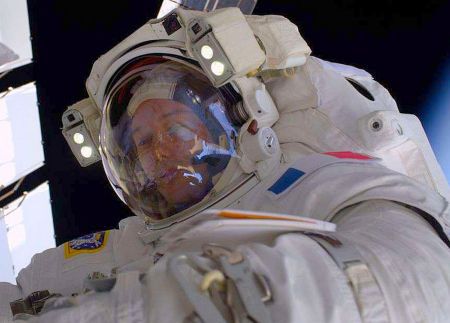 La La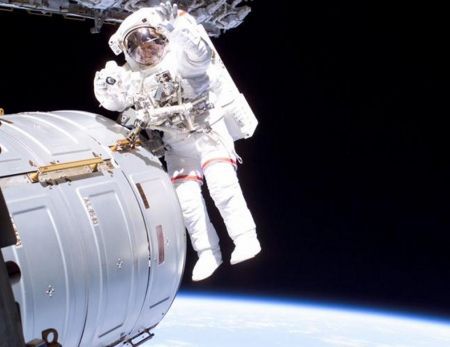 première sortie de Thomas Pesquet se fera en compagnie du même Shane Kimbrough . première sortie de Thomas Pesquet se fera en compagnie du même Shane Kimbrough .
Les deux hommes auront pour
« mission d’installer un nouvel ordinateur, de réaliser de la maintenance sur le système électrique et de déconnecter un adaptateur du système d’amarrage avant qu’il ne soit déplacé »,
précise le communiqué de l’ESA.
Cette mission, d’une durée de plusieurs heures, les conduira à travailler séparément une grande partie de la sortie Pour sa deuxième sortie, accompagné de Peggy Whitson, le spationaute français travaillera
« sur le remplacement d’une alimentation électrique destinée aux expériences scientifiques, mais aussi la grande expérience de recherche d’antimatière, AMS-02 », détaille l’ESA dans son communiqué.
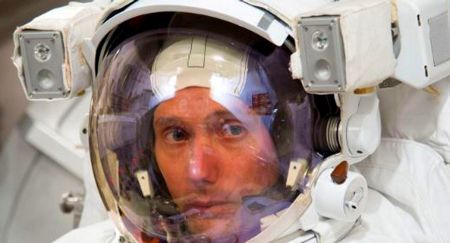
Pour l’ESA, la décision d’impliquer Thomas Pesquet dans deux autres missions
« témoigne des bonnes performances des astronautes de l’ESA ces dernires années ainsi que de la qualité de l’entraînement qu’ils suivent dans le Centre des astronautes européens ».
Avec ses trois sorties il égalera ainsi le record établi par son collègue français Philippe Perrin qui a lui aussi effectué trois sorties dans l'espace lors d'une seule mission.
Un nouveau record pour la France !
Thomas Pesquet rentrera sur Terre au cours du mois de mai 2017, après six mois dans l’espace pour sa mission Proxima.
|
|
| Joanne Courbet pour DayNewsWorld |
|
There are no translations available.
LA RUSSIE EST ACTUELLEMENT LE SEUL PAYS
A ENVOYER DES HOMMES SUR ISS .
|
|
En avril 2015, la perte d'un Progress avait déjà provoqué une profonde crise dans l'industrie spatiale russe. La Russie ayant dû alors suspendre tous ses vols spatiaux pendant près de trois mois.
Le vaisseau cargo avait également perdu contact avec la Terre avant de se consumer dans l'atmosphère. les Russes avaient attribué ce revers à une panne sur la fusée Soyouz. obligé un Un groupe d'astronautes avaient dû prolonger d'un mois leur séjour à bord de la station de recherche spatiale.
Le vaisseau-cargo non habité qui devait ravitailler la Station spatiale internationale (ISS) lequel le s'est consumé dans l'atmosphère peu après son décollage de Baïkonour au Kazakhstan( annonce de l'agence spatiale russe).
Perdu à quelque 190 km au-dessus de la région isolée et montagneuse de Touva, « la plupart des fragments ont brûlé dans les couches denses de l'atmosphère », a précisé Roskosmos.
Cette perte "n'affectera pas le fonctionnement normal des équipements de l'ISS et la survie de l'équipage de la station"car les réserves à bord de l'ISS étaient à "un bon niveau"
Progress MS-04 transportait un chargement d'environ 2,4 tonnes, dont de l'eau, des carburants et du gaz comprimé, ainsi que des produits alimentaires, des vêtements et des médicaments pour l'équipage de l'ISS composé actuellement du Français Thomas Pesquet, des Américains Peggy Whitson et Shane Kimbroughet, ainsi que des Russes Oleg Novitski, Sergueï Ryjikov et Andreï Borissenko.
Son arrimage à l'ISS était initialement prévu pour 16H43 GMT samedi et devait se faire en régime automatique, selon Roskosmos.
La Nasa a précisé que la première et deuxième étape se sont bien déroulées, mais qu'un problème a été enregistré lors de la troisième étape de la séparation entre le vaisseau Progress MS-04, qui devait se retrouver en orbite, et le lanceur Soyouz.
|
|
Une enquête est en cours.
|
|
|
|
|
| Paul Emison pour DayNewsWorld |
|
|
There are no translations available.
THOMAS PESQUET OBJET D'EXPERIMENTATIONS SCIENTIFIQUES A BORD DE L'ISS .
|
|
Thomas Pesquet se trouve à bord de la Station spatiale internationale depuis le 20 novembre où de nombreuses expériences seront menées sur les astronautes. Le Français en est à sa deuxième sur les 21 des 55 expériences que va mener Thomas Pesquet pour l'Esa.
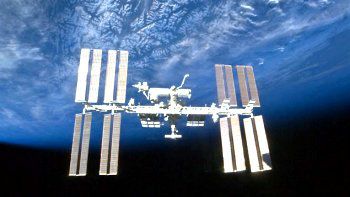
Les performances en micropesanteur de surfaces et revêtements innovants qui empêchent les bactéries de proliférer a été la première expérience de notre Français.
Cette étude- menée à l'aide du module Mattis- est rendue possible par le confinement de la Station spatiale.
En effet le recyclage permanent de l'eau et de l'air et le stockage à bord des déchets produits favorisent la prolifération de bactéries.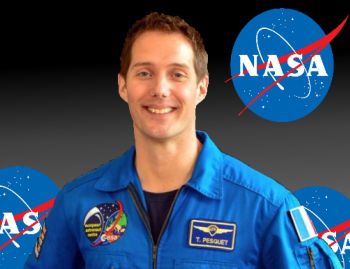
Avec une telle expérience le Cnes entend réduire les risques de contamination en s'intéressant aux propriétés antibactériennes de matériaux dans l'espace.
Bien entendu les retours serviront aussi aux hommes évoluant sur Terre:ainsi les chercheurs ont à cœur d’éliminer la concentration de bactéries sur les rampe d’escaliers, de métro, des poignées de portes... La deuxième expérience de Thomas Pesquet est celle de l'atrophie musculaire en apesanteur.
Elle sera renouvelée deux fois avec de nouvelles mesures effectuées dans dix jours puis 30 à 45 jours avant son retour sur terre.
En six mois un astronaute perd entre 20% ET 30% de sa masse musculaire. Une application directe : aider à la réadaptation des personnes longtemps alitées ou permettre à l'homme d'arriver en forme sur Mars.
Le module MARES ressemble à une énorme chaise équipée de capteurs. L' instrument scientifique MARES -une sorte d' énorme chaise équipée de capteurs- mesure la force exercée par des groupes musculaires isolés autour de toutes les articulations du corps cinq heures d'affilée !
|
|
|
| Paul Emison pour DayNewsWorld |
|
|
There are no translations available.
COMETE ISON
|
|
La comète ISON survivre à son plongeon dans l'atmosphère du soleil ou entend-elle périr , comme Icare , pour s'aventurer trop près ? Les astronomes disent que les rapports de sa mort imminente sont grandement exagérées .
ISON , connu officiellement comme C/2012 S1, est une comète soleil pâturage qui est mis à venir au sein de 730,000 miles de la surface de notre étoile à la maison en Novembre et puis dévalent par la Terre au début de Décembre . On croit provenir de la nuage d'Oort , un cluster hypothèse d'objets glacés à proximité des franges du système solaire , 50.000 fois plus loin que le soleil est de la Terre.
Compte tenu de la trajectoire de la comète, c'est peut-être notre seule visite de ISON , comme la gravité du soleil devrait fronde il vers l'arrière sur le système solaire interne - qui est, à moins que le soleil frites et déchire le distingue d'abord.
Cette inquiétude a frappé certains observateurs de la comète qui attendent sa terre très attendu fly-by en Décembre. Le rayonnement du soleil peut faire bouillir l'écart de son contenu glacées , et son attraction gravitationnelle intense pourrait déchirer la comète en lambeaux.
Mais les scientifiques disent qu'il n'y a aucune raison de compter sur ISON pour l'instant. Une étude publiée dans la revue Astrophysical Journal Letters a examiné les dossiers historiques de cométaires rencontres rapprochées avec le soleil et a constaté que ISON - alors que nous savons très peu de choses encore - est probablement trop dense pour être totalement déchiqueté par le soleil.
Au moins une partie de la comète devrait survivre à la fois la perturbation de marée de la gravité et de la sublimation du soleil ( la glace étant évaporée directement de l'état solide à l'état gazeux ) .
«Que ce soit ou non interruption se produit , le plus important reste doit être assez grand pour survivre perte de masse ultérieure en raison de sublimation pour que ISON à rester une comète viable bien après périhélie », écrivent les auteurs .
Les scientifiques de l' Comet campagne d'observations ISON NASA ont exprimé la même idée.
" Est-ce que cela ressemble à une comète fait long feu ? "
Karl Battams , astrophysicien au Laboratoire de recherche navale à Washington , a écrit dans un billet de blog , en montrant une photo de la longue queue , la comète verte éclatante pris des jours avant .
Les astronomes ne sont certainement pas en démissionnant - 18 satellites sont mis à l'image de la comète.
|
|
| |
|
| Paul Emison pour DayNewsWorld |
|
|
|
|



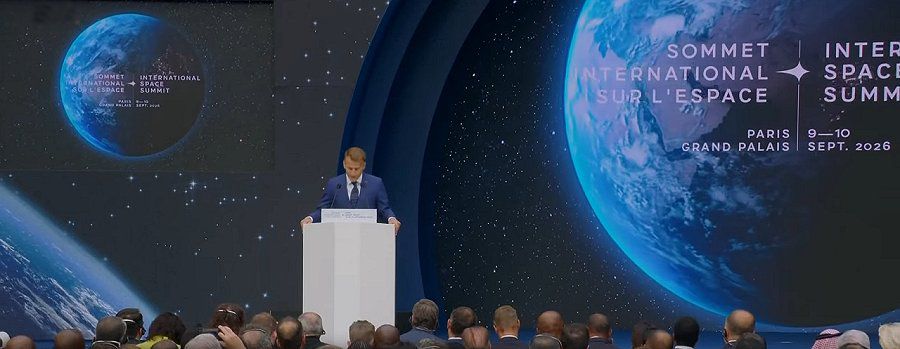 L
L