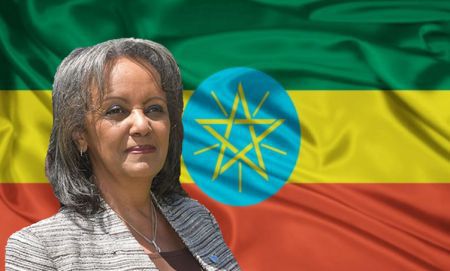
A WOMAN PRESIDENT IN ETHIOPIA |
|
| For the first time, a woman is president in Ethiopia.
Ethiopian parliamentarians on Thursday (October 25th) unanimously announced, for the first time, a woman, Sahle-Work Zewde, the country's president, after the resignation of the man who until now held this essentially honorary post. The career diplomat becomes the fourth head of state in Ethiopia. The adoption of the 1995 Constitution provides that a President may be elected for a maximum of two six-year terms.
She has been President of Ethiopia since October 25, an honorary function, but one that gives women a platform. "In a patriarchal society like ours, the appointment of a woman as head of state is not only a sign for the future but trivializes the role of women as leaders in public life," he said. elsewhere claimed on Twitter Fitsum Arega, the chief of staff of Prime Minister Abiy Ahmed. both Houses of Parliament first endorsed the resignation of President Mulatu Teshome, who had held this position since 2013 and resigned one year before the end of his term without providing any explanation. For the observers this resignation would result from ongoing negotiations between the four parties forming the ruling coalition, the Revolutionary Democratic Front of the Ethiopian People (EPRDF). If the President of Ethiopia is officially the Head of State, his responsibilities are essentially symbolic and honorary. Indeed, the prime minister, who represents the country in particular at major international summits, holds most of the power. In April, the EPRDF chose Abiy Ahmed as the new prime minister, for the first time from the largest ethnic group in the country, the Oromo. A vast program of reforms is at work with the release of dissidents, the opening of democratic space and peace with neighboring Eritrea. He recently appointed a new government, in which half of the positions are held by women. Prime Minister Abiy Ahmed nicknamed the "messiah" has continued to show his willingness to reform the country of 104 million inhabitants, on the edge of the precipice at the beginning of the year. |
|
| Britney Delsey for DayNewsWorld | |
 |
|