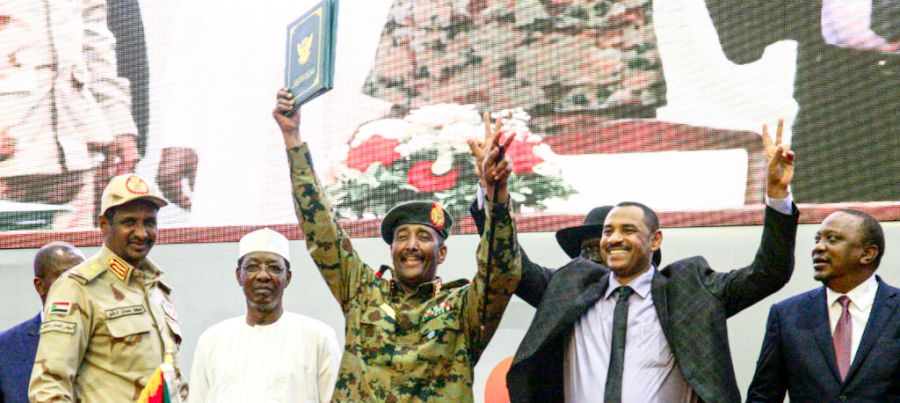
HISTORIC AGREEMENT IN SUDANBETWEEN MILITARY AND CIVILIANS |
|
| The ruling military and the leaders of the Sudanese protest sealed a historic agreement this Saturday, paving the way for a transfer of power to civilians. A ceremony was held Saturday afternoon in Khartoum on the banks of the Nile for the signing of documents that define the 39 months of transition to come.
With this signing, Mohammed Hamdan Daglo, number two of the Military Council, and Ahmed Al-Rabie, representative of the Alliance for Freedom and Change (ALC) and spearhead of the challenge, thus open the way to a transfer of power to civilians. The agreement reached in early August ended nearly eight months of an unprecedented protest that led to the fall of President Omar al-Bashir on April 11, after 30 years in power, before turning against the generals. of the Transitional Military Council that has taken over. "Civil power" Concluded through a mediation by Ethiopia and the African Union, this agreement was greeted with relief from both sides as protesters celebrated the victory of their "revolution". The early stages of the transition should follow the signing with the announcement Sunday of the composition of the majority sovereign council made up of civilians who must lead the transition. On Thursday, the Alliance for Freedom and Change (ALC), the spearhead of the protest, appointed Abdallah Hamdok, a former UN economist, to become prime minister. The Sovereign Council must announce Tuesday if he confirms it to this post. Limit the power of the military elite Elections are scheduled for 2022. The military is a minority in the 11 members of the Sovereign Council which must govern 40 million Sudanese, even if it will first be led by a general for 21 months. And if the Ministers of the Interior and Defense will be chosen by the military. The first stages of the transition should follow the signing with the announcement on Sunday of the composition of the Sovereign Council in majority consisting of civilians (6 civilians against 5 military) who must lead the transition. Thursday, August 15, the Alliance for Freedom and Change (ALC), the spearhead of the challenge, has appointed Abdallah Hamdok, a former economist of the United Nations (UN), to become prime minister. The Sovereign Council must announce Tuesday if he confirms it to this post. Mr. Hamdok will then have the daunting task of raising the economy of the country that collapsed after the secession of the South in 2011, depriving it of three quarters of its oil reserves. Elections are scheduled for 2022. If the military is a minority in the Sovereign Council (11 members) which is to govern 40 million Sudanese, it will be first led by a general for twenty-one months. And the ministers of the interior and the defense will be chosen by the military. "The biggest challenge for the government will be the dismantling of the Islamist [informal entities] that have taken control of all state institutions and key sectors of the economy," said Rosalind Marsden of Chatham House think tank established in London. A historic agreement in a country devastated by thirty years of calamitous management and an authoritarian and corrupt power based on the Islamic legal code. |
|
| Jaimie Potts for DayNewsWorld | |
 |
|