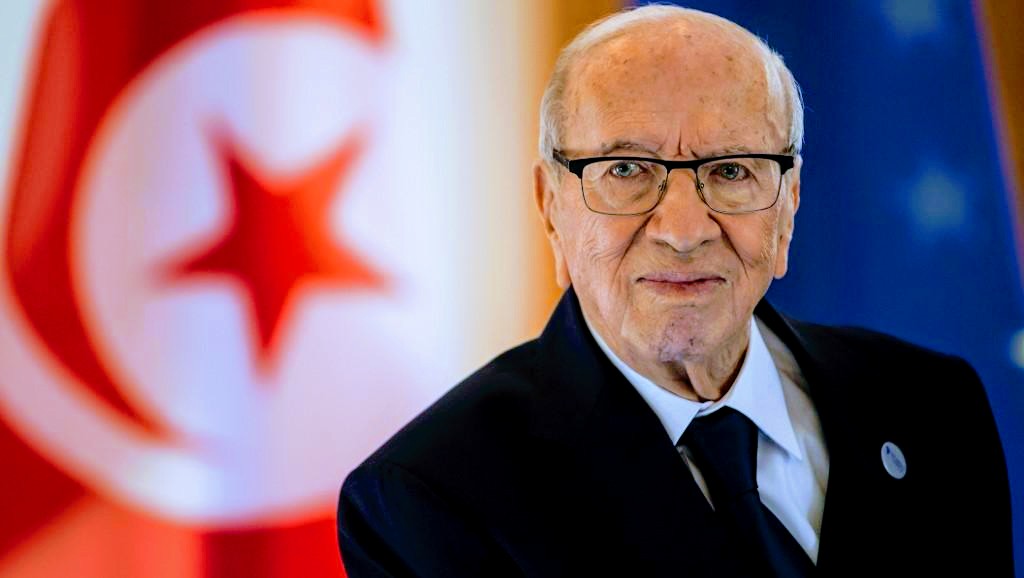
TUNISIAN PRESIDENT HONORS KEY MAN OF DEMOCRATIC TRANSITION |
|
| Several days of national mourning were decreed in Tunisia after the announcement of the death of President Beji Caid Essebsi. Beji Caid Essebsi, the first directly elected head of state since the 2011 revolution, died Thursday, July 25 at the age of 92. Béji Caïd Essebsi must be buried alongside his family members in the Djellaz cemetery, 25 km from the Carthage Palace he occupied since 2014.
"A phenomenal leadership," according to Donald Trump. Beji Caid Essebsi played a key role in the democratic transition initiated by Tunisia in 2011 after the fall of Ben Ali. The power-sharing agreement it had made between his party, Nidaa Tounes, and the Islamists in Ennahda helped to stabilize the political situation and avoid the autocratic drift seen in other countries affected by the "spring Arabic ". This bet of reconciliation with the Islamists will have avoided the country the chaos experienced by other "Arab Spring". If he saved Tunisia from the rise of extremes, Essebsi, however, was unable to deepen the democratic project dreamed of by the protagonists of the 2011 revolution. And although he reiterated that the rights of the man were one of the gains of the young democracy, the Tunisian president bore badly the criticisms coming in particular from certain media. Moreover, the dynastic drift of the presidential power, which saw him soften the ambitions of his son Hafedh, has also been controversial. The "Sheik" failed to complete his project of equal inheritance between men and women. President Béji Caïd Essebsi died a few months before the end of his term in December. The future of Tunisia Upon the announcement of the death of the president, the head of Parliament, Mohamed Ennaceur, 85 years, was sworn in to act in accordance with the Constitution. It provides that this interim does not exceed 90 days, ie until the end of October. Tunisia is thus preparing to undergo an acceleration of its electoral calendar, the legal term of the five-year term of Mr. Essebsi having been initially fixed in mid-November. Legislative elections, another equally sensitive deadline, are scheduled for 6 October. The electoral autumn promises to be loaded for Tunisians. The stakes of this new political cycle - the second presidential and third legislative elections since 2011 - are crucial. It is that of the rooting of democracy in this country of North Africa, both pioneer and sole survivor of the wave of the "Arab Spring" of 2011 . Many Tunisians have emphasized this rapid transition as their country is the only one of the Arab states affected by the 2011 protests to continue on the path of democratization. However, there are still many challenges to Tunisia, such as jihadist attacks, clan fighting and economic wait-and-seeism. The democratic transition remains fragile in this pioneer Arab spring even if, according to some analysts, the death of the president should not cause political upheaval in Tunisia. |
|
| Garett Skyport for DayNewsWorld | |
 |
|