HIGH RISK PRESIDENTIALS IN MALI |
|
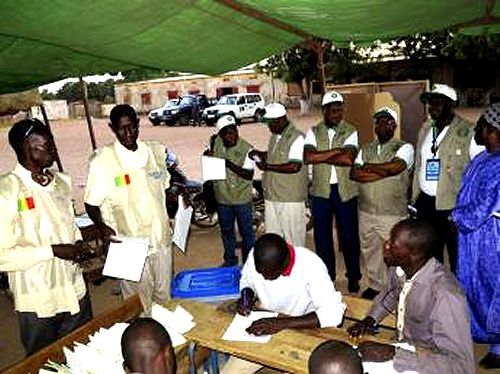
| E read in 2013 after the French intervention to chase Islamists, President Ibrahim Boubacar Keita (IBK) is a candidate for his own succession and even favorite, while the country is still plagued by terrorist acts and community tensions. A great instability raises fears overflows on this day of the first round of elections, the army was deployed to avoid clashes, the government has been funding television advertising spots for several days to call the population to calm. This is to say the state of tension in which is plunged Mali.
To allow for the holding of the vote in most of the country, more than 30,000 members of the security forces, national and foreign, are mobilized, according to the Ministry of Homeland Security. In terms of security, "today it can be said that the minimum conditions are likely to be met," said Mahamat Saleh Annadif, head of the UN mission in the country (Minusma), on UN radio in Mali, Mikado FM, while calling to remain "vigilant". Ibrahim Boubacar Keita, 73, elected in 2013 and head of the "Rally for Mali", puts his mandate at stake despite a disputed record. Indeed insecurity has increased in the country and the economic situation is far from satisfactory. But it is above all the security issue that is at the heart of tensions and hurts. In addition to the suspicions of fraud on the part of the presidential camp, the jihadist threat in the north of the country - which was taken by radical Islamists by France in 2013 - is growing. On the last day of campaign on Friday, the jihadists were invited to the debate by the leader of the main jihadist alliance of the Sahel, linked to al-Qaeda, the Malian Touareg Iyad Ag Ghaly, leader of one of the Islamist groups that had seized the entire north of the country in 2012 . "These elections are nothing but the pursuit of a mirage and our people will only harvest illusions, as they have become accustomed to," said in a video the head of the support group for and Muslims Community tensions have been exacerbated in recent years in this vast landlocked country of West Africa, counting about twenty ethnic groups. Insecurity has also undermined the center of the country. And IBK is widely criticized for not being offensive enough on the subject of insecurity. That is why the main opposition leader, Soumaïla Cissé, promised to bring "peace" back to the center of the country and hopes to capitalize on security issues. "Barkhane will not be eternal": Moreover, Mali lives on a drip of foreign military aid to maintain fragile stability. The French operation Barkhane is more than 4,500 soldiers tricolor distributed in the Sahel to fight against the jihadist threat, mainly in Mali. If IBK prevails, the international community fears that it will do more than under its first mandate. Jean-Yves Le Drian, prime contractor of the French intervention in 2013 when he led the Defense, signified his impatience. France and its partners do not want a status quo that would mean an extension of their presence. "Barkhane will be there as long as it takes but will not be eternal," says one to the Ministry of Armies, which by forming local armies, ultimately wants to "create the conditions" of his departure. The creation of the G5 Sahel in 2014, a coordination framework for five countries in the region to fight against terrorism, must also enable African countries to take charge of the situation. Two favorites out of 24 candidates: In any case, Malians are waiting for the president-elect (or re-elected) on security. More than eight million inhabitants of this vast landlocked country of West Africa, counting about twenty ethnic groups, are called to the polls to renew the president Ibrahim Boubacar Keïta or to elect one of its 23 competitors, whose head of the opposition, Soumaïla Cissé, and only one woman, Djeneba N'Diaye. They vote Sunday, July 29 for a presidential election that will weigh on the fate of the peace agreement of 2015 and, beyond, on the entire Sahel, still facing the jihadist threat despite five years of international military interventions. The official results will be known by Friday at the latest, before a possible second round on August 12. No less than 24 candidates !! Has the time for revenge for Soumaïla Cissé sounded? Largely beaten (nearly 78% of the vote) by Ibrahim Boubacar Keïta in 2013, the opposition leader, 68 years, this time hopes that the climate of insecurity will encourage Malians to get rid of a socialist president considered too passive . But 24 candidates - of which only one woman - will separate the votes. Among them, many former ministers of the head of state, which says a lot about the ferocity of the campaign even if the outgoing president, Ibrahim Boubacar Keita, and the leader of the opposition, Soumaïla Cissé, are given favorites Since the advent of democracy in 1992, less than one out of every two Malians has moved in five presidential polls. The last election, in 2013, was however particularly followed, in a post-coup context that had shaken the Republic, a few weeks after the outbreak of the war in the north of the country. The participation rate is traditionally low, significantly lower than 50%, in the first round of the presidential election in this country known also for its cultural influence. |
|
| Joanne Courbet for DayNewsWorld | |
 |
|