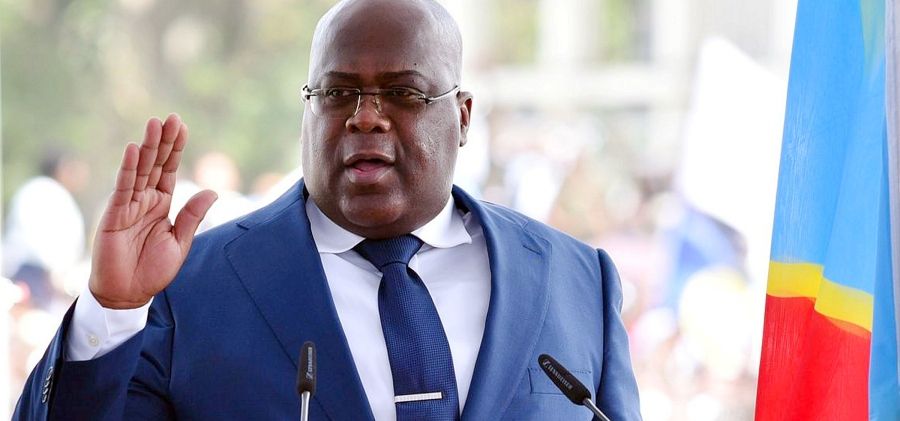
FELIX TSHISEKEDI PRESIDENT OF CONGO ALTERNANCE OR CONTINUITY OF POWER |
|
| A new era is opening up in the DRC. The opponent Felix Tshisekedi officially became, Thursday, January 24, the fifth president of the Democratic Republic of Congo (DRC). He succeeds Joseph Kabila, who leaves power after eighteen years at the helm of the country.
But this election is contested by Martin Fayulu, another opponent of Kabila, who denounced an "electoral coup" orchestrated by Mr. Kabila with the complicity of Mr. Tshisekedi. If the African heads of state of South Africa, Kenya, Burundi and Tanzania have welcomed, on Sunday, the election of Mr. Tshisekedi, others have delayed including two of the nine neighbors of the DRC, Angola and Congo. The African Union (AU) and the European Union (EU), in a joint statement, "took note" of the outcome of this contested election. As for the United States, they said they were ready to work with the new president. A "political coalition agreement" For a peaceful alternation, Mr. Kabila, a 47-year-old senator, encouraged "political leaders" to favor a "Coalition" rather than "cohabitation". Thus the pro-Tshisekedi and pro-Kabila have signed a "political coalition agreement" and "power sharing" which provides that the regal ministries (diplomacy, defense, domestic) return to the elected president's political family. The National Assembly is acquired by President Kabila with 337 seats out of 500, so that Mr. Tshisekedi will have to choose a prime minister in this majority. Nehemiah Mwilanya Wilondja, the President Kabila's chief of staff, or Albert Yuma, a Congolese boss, is being approached for the post. The army is also largely shaped by outgoing power. Towards "a reconciled Congo" Felix Thisekedi is committed to reforming justice, fighting corruption, poverty, tax evasion and improving respect for human rights. In his inaugural speech, the new president promised to release all "political prisoners". He also assured that he would improve respect for human rights in the country. "Under our mandate, we will ensure that every citizen respects the exercise of their fundamental rights. We are committed to banning all forms of discrimination, "he said. The new government will take over a mineral-rich country, but 70% of the 80 million people live below the poverty line, according to the IMF. |
|
| Andrew Preston for DayNewsWorld | |
 |
|