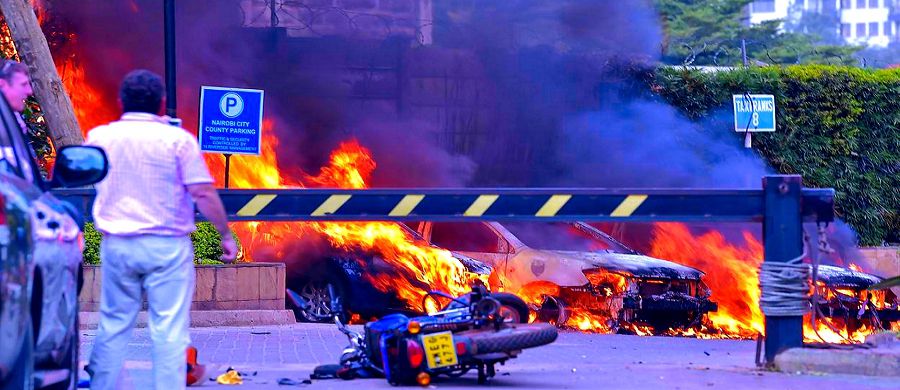
AT LEAST 14 DEATHS IN ISLAMIST ATTACKA NAIROBI IN KENYA |
|
| Kenyan security forces on Wednesday morning ended an attack by Somali Islamists Shebab against a Nairobi hotel complex after a siege of nearly twenty hours. The provisional balance is 14 deaths.
"I can confirm that the security operation at (complex) Dusit was completed about an hour ago and that all the terrorists have been eliminated," Kenyatta said at a press conference. also stating that "at this moment, we have confirmation that fourteen innocent lives have been lost (...), others have been wounded".
A police source said that two attackers were killed on Wednesday morning after an extended shootout. "They both wore red scarves on their foreheads and cartridges were tied around their chest (...) they each had an AK-47". "Coordinated Attack" and claimed by the Shebabs As early as Tuesday, Somali Islamist Shebabs claimed responsibility for the attack. Its modus operandi is reminiscent of other operations of the movement in Mogadishu in recent months: a bomb explodes and in the process, a commando enters the institution. This "coordinated attack" of the DusitD2 complex began with a loud explosion heard more than five kilometers away, followed by heavy fire. Tuesday's attack in Nairobi took place three years to the day after that of the Kenyan military base in El Adde, southern Somalia. Kenya has already been the target of large-scale jihadist attacks. On August 7, 1998, an al-Qaeda-claimed attack on the US Embassy in Nairobi left 213 dead and 5,000 injured. Since the October 2011 engagement of the Kenyan army in Somalia to fight al-Qaeda-affiliated Shebab, the country has been hit hard. After the Westgate attack on September 21, 2013, which killed nearly 70 people, a commando shot 148 people in Garissa University (east), most of them students, on April 2, 2015. While the Shebab, who were expelled from Mogadishu in 2011, have lost most of their strongholds, they still control large areas of the country from which they carry out guerrilla operations and suicide bombings. They vowed the loss of the Somali government, backed by the international community and by the 20,000-strong force of the African Union's Somalia force (Amisom), to which Kenya is contributing. In addition, Kenya, a country with a long porous border with Somalia, is exposed to shebabs that form cells there. |
|
| Alize Marion for DayNewsWorld | |
 |
|