LEGISLATIVES IN TUNISIA PARTI ISLAMISTE
ENNAHDA IN HEAD AND LIBERATION OF NABIL KAROUI
|
Presidential candidate Nabil Karoui, accused with his brother Ghazi for money laundering and tax evasion, was released four days before the second round, while at the same time, the official results confirm a halftone victory. Islamists in the legislative. 
The political landscape remains more fragmented than ever. According to the official preliminary results announced Wednesday, October 9 evening by the Independent Higher Authority for the elections (Isie), the Islamist-inspired party Ennahda has won the legislative elections on Sunday winning 52 seats out of 217. But he will not be able to form a single government, placing itself very far from the required majority of 109 votes.
Errahma is led by a controversial imam, Said Jaziri, known for his preaching and his radio, Koran Karim, which is widely listened to even though it is broadcasting illegally. Ennahda leader Rached Ghannouchi was elected deputy in Tunis. In second place, Nabil Karoui's party, Qalb Tounes, created in June, returns to Parliament with 38 seats.
The Social Democrat Party Attayar ("Democratic Stream") of human rights activist Mohammed Abbou won 22 seats. Karama, an Islamo-populist movement recently formed by a lawyer known to have defended suspected Salafists Seifeddine Makhlouf, won 21 seats.
The Free Destour Party of anti-Islamist lawyer Abir Moussi won 17 seats. Candidate disappointed in the presidential election, Mrs. Moussi, who defended the regime of ousted president Zine el Abidine Ben Ali, is elected deputy of Tunis.
Results that only confirm the fragmentation of Parliament and augur hard negotiations for the formation of a government.
|
|
|
|
|
|
|
|
| Jenny Chase for DayNewsWorld |
 |
HOUSE OF HORROR IN NIGERIA
MORE THAN 300 BOYS TORTURES
IN A CORANIC SCHOOL
|
|
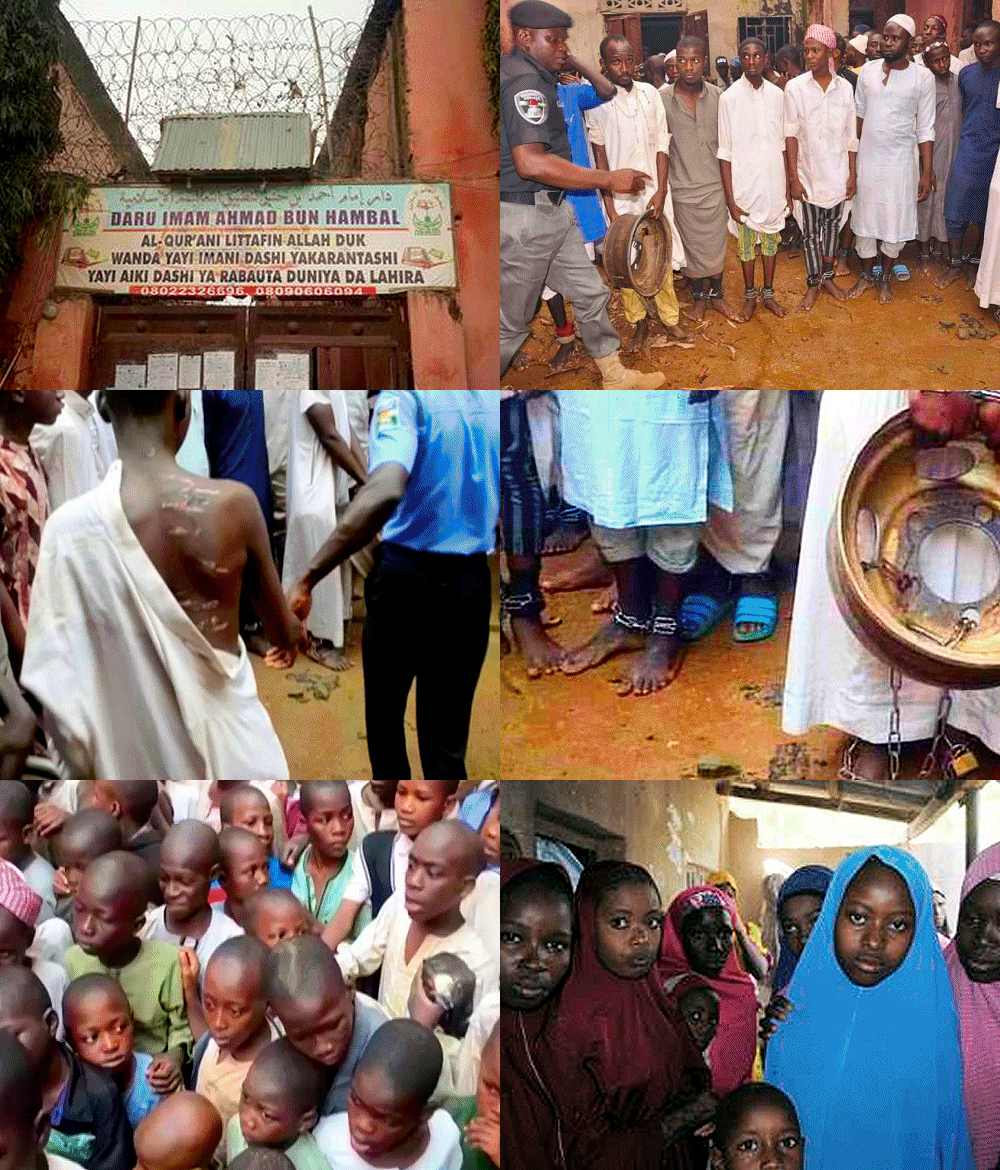
Police in Kaduna, northern Nigeria, discovered more than 300 boys in
"Different nationalities", including minors, victims of torture and rape in a so-called Islamic teaching center.
It was a raid conducted Thursday evening in a house in the Rigasa district that led to the discovery of boys between 8 and 18 years old living in
"Inhuman and degrading conditions under the guise of teaching them the Qur'an and straightening them," said Kaduna State Police spokesman Yakubu Sabo.
The owner of the establishment and his six assistants were arrested, he said.
"We found about 100 students, including children as young as nine years old, chained in a small room, with the goal of correcting and empowering them," said Sabo, adding that many of them wore lacerations on the body.
"The victims have been abused. Some of them said they were raped by their teachers, "added Sabo. The police also found a "torture chamber" where students were hung up on chains and beaten when teachers thought they had done something wrong.
«Correction houses»
The police raid was launched following repeated complaints from neighbors who suspected that something was wrong inside the school.
The school was opened about ten years ago. It housed petty criminals or drug users that their families brought to get them back on track.
Northern Nigeria, which is predominantly Muslim, hosts a large number of more or less formal "correctional homes" providing strict religious education in the absence of public facilities to take care of young people on their own.
|
|
|
|
|
|
|
|
| Kelly Donaldson for DayNewsWorld |
|
|
ANTI-SISSI PROTEST IN EGYPT
|
| For the second day in a row, demonstrators defied Egyptian power. Protesters demanding the departure of President Abdel Fattah al-Sissi gathered on the night of Saturday 21 to Sunday 22 October in Suez before being dispersed by the police.
"Sissi go away," chanted the demonstrators, "we will not leave, it is he who must leave". However, there were only a few hundred on the streets, opposition demonstrations being banned in Egypt since the military coup in 2013. There would have been a little more than 70 arrests. 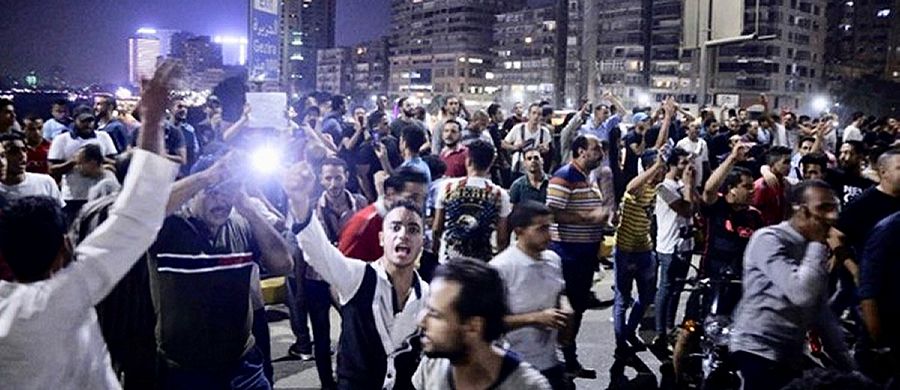
It was at the call of an Egyptian businessman Mohamed Aly, in exile in Spain that they took to the streets, Cairo, and other cities of the country including Suez and Alexandria. This contractor in the construction sector has published several viral videos since early September calling for the overthrow of Sissi and military, which he accuses of corruption. Mohamed Aly, called Saturday for a "march of a million" of people for Friday, September 27.
The president has denied all these allegations: "These are lies and they are meant to break the will of the Egyptians and make them lose all hope and confidence in themselves". Abdel Fattah al-Sissi regularly prides himself on leading a safe and stable country, unlike other countries in the region, such as neighboring Libya. However, jihadists are active in some parts of the country, as in the Sinai Peninsula.
Egypt lives under a state of emergency. The regime leads a fierce crackdown on the opposition, imprisoning Islamists, activists or bloggers.
|
|
|
|
|
|
|
|
| Andrew Preston for DayNewsWorld |
|
DEATH OF TUNISIAN DICTATOR BEN ALI
|
| The ousted President Zine El Abidine Ben Ali, 83, head of Tunisia from 1987 to 2011, died Thursday, September 19, 2019 in Saudi Arabia, where he lived in exile since the revolution of 2011, said the Tunisian Ministry Foreign Affairs. "We had confirmation of his death 30 minutes ago," added the ministry, without further details.
A week before his death, he was admitted to the hospital in Jeddah, Saudi Arabia. His family announced that his body must be transported to Mecca on Friday, where his burial will take place. 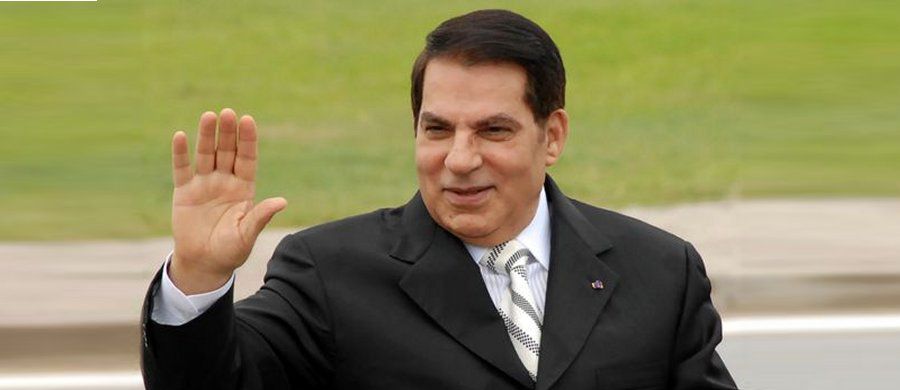
More than two decades of repressive power
He succeeded the father of independence, Habib Bourguiba, in 1987 "by a medical stroke" to spend twenty-three years in power, without sharing, before being swept away in January 2011 by the Jasmine Revolution. He fled, on January 14, 2011, in incredible conditions, to Jeddah, Saudi Arabia, where he had lived since in exile with his family.
In the early 1990s, the leader of Carthage announced he discovered the existence of an "Islamist conspiracy" to seize power through violence. This career soldier trained partly in France (Saint-Cyr) and in the United States then quickly establishes an ultra-repressive regime. The arrests begin in the ranks of Ennahdha. Huge trials are organized. Torture is systematized in the offices of the Ministry of the Interior. With the support of the police apparatus any dispute is stifled, the press and the unions muzzled.
During twenty-three years of an authoritarian regime he will maintain excellent relations with Western countries that appreciate his economic results (10 million tourists, 6% growth) and his fight against Islamism.
To the repressive regime introduced by the rais is added the monopolization of the wealth of the country by the family.
Capitalization of the country's wealth by the clan
In second marriage, the president married Leïla Trabelsi, a former hairdresser of twenty-one years younger. Then begins an era of corruption and nepotism, the beautiful family handing over wealth of the country with impunity and placing relatives in key positions. Banks, telecoms, tourism, etc. partly pass into the hands of the beautiful family, the Trabelsi, the Ben Ali, the Materi. The World Bank will estimate the hijacking of 5 billion euros, with nearly a quarter of private sector profits going into the pockets of Ben Ali clans.
If the coast of Tunisia enjoys a certain prosperity thanks to tourism, the situation in the interior of the country deteriorates the mining basin not benefitting from the economic consequences of this success. In 2008, riots broke out, violently repressed. It is the beginning of a gear that will be fatal to Ben Ali who, reelected in 2009 with 90% of the vote, does not meet the expectations of the population.
Immolation of Mohammed Bouazizi and protest movement
On December 17, 2010, Mohamed Bouazizi, a 26-year-old unemployed student, set himself on fire in front of the headquarters of Sidi Bouzid governorate, a small town in the center of the country because the police just confiscated the fruits and vegetables he he was selling to support his family on the grounds that he did not have a permit. What is lived as an unbearable humiliation. This desperate gesture will lead to the uprising of his compatriots and lead to the fall of Ben Ali.
A wave of protest sweeps across the country to Tunis where on January 14, 2011, 50,000 people are massed in front of the Ministry of the Interior. At 5:40 pm, the presidential plane takes off. On board, the president, his wife and their children who go into exile in Jeddah in Saudi Arabia.
In 2018, after trials in absentia for "intentional homicide", "abuse of power" or "embezzlement", he was sentenced in absentia to multiple prison terms, including several in perpetuity.
|
|
|
|
|
|
|
|
| Joanne Courbet for DayNewsWorld |
|
|