RETURN ON THE FORMER PRESIDENT OF ZIMBABWE
ROBERT MUGABE
|
Former Zimbabwean President Robert Mugabe died in Singapore on Friday, September 6th, at the age of 95.
"It is with great sadness that I announce the death of Zimbabwe's founding father and former President Robert Mugabe," said Emmerson Mnangagwa, the country's current president.
Why during his reign of thirty-seven years, until his fall in 2017, did this man go from being a liberating hero to being a ruthless despot ?
Robert Mugabe, ousted in 2017, was the last of the giants of his generation - after Nelson Mendela or Tanzanian president Julius Nyerere - to be alive. But it is alone and isolated that he died, far from his African land, in a hospital room in Singapore.
From hero of independence to despot
For the one who was the liberator of his colonized country then called Rhodesia, white and segregationist, also embodies the tyrant who led and shaped his country with an iron fist during his reign of thirty-seven years and precipitated the economic ruin of his country: "the leader of Zimbabwe has turned the former breadbasket of southern Africa into a land of violence and misery."
This hero of independence proclaimed in 1980 had made a bet, in the name of the unity of the people, of the policy of reconciliation. "You were my enemies yesterday, you are now my friends," assured the former guerrilla leader, even giving key ministerial positions to whites and allowing even their leader, Ian Smith, to stay. in the country.
In a short time the country then knows a better economic being. Seduced by Marxism, Africa's oldest leader discovers politics at the University of Fort Hare that he applies with the construction of schools, health centers and new housing for the black majority.
But that is without counting with its implacable political repression against the opponents, the authoritarian drift, the electoral frauds and especially its violent agrarian reform which precipitates the ruin of the economy. In 1985, liquidity is lacking, 90% of Zimbabweans are unemployed, civil servants are no longer paid. The country is sinking into misery, corruption and instability.
A pariah on the international scene obsessed with power
The one who up to then embodied the success of Africa for Westerners, then joined the ranks of pariahs banned from the international scene.
The president of Zimbabwe, released by the army, his party, Zanu-PF, and the street, is pushed to resign on November 21, 2017. He is then 93 years old.
"Mugabe has remained in power by (...) crushing his opponents, violating justice, trampling on the right to property, cracking down on the independent press and rigging elections," says his biographer Martin Meredith.
In December 2016, he had been elected presidential candidate of 2018 by his party. He had promised to wish his "100 years" to power, but he died before.
|
|
|
|
|
|
|
|
| Joanne Courbet for DayNewsWorld |
 |
SILENT EXTINCTION OF GIRAFFE IN AFRICA
|
| Does the "silent extinction" of giraffes threaten the African continent ?
At the continental scale, the population of these mammals has indeed decreased by about 40% between 1985 and 2015, to reach 98,000 individuals, according to figures compiled by the International Union for the Protection of Nature (IUCN) .

However, the NGO identifies distinct regional dynamics.
In Somalia, South Sudan, the Democratic Republic of the Congo and the Central African Republic, for example, conflicts encourage poaching and make it almost impossible to study and protect giraffes.
In eastern Africa, the crawling giraffe - one of four major species of giraffe - has lost about 60% of its individuals. The Nubian Giraffe, meanwhile, has experienced a tragic decline of 97% while in Central Africa, the giraffe population of Kordofan has decreased by 85%.
Only southern Africa is experiencing an increase in the number of giraffes.
The giraffe is an animal that arouses little interest among researchers, its gradual extinction risk going unnoticed !
|
|
|
|
|
|
|
|
| Carl Delsey for DayNewsWorld |
|
|
HISTORIC AGREEMENT IN SUDAN
BETWEEN MILITARY AND CIVILIANS
|
| The ruling military and the leaders of the Sudanese protest sealed a historic agreement this Saturday, paving the way for a transfer of power to civilians. A ceremony was held Saturday afternoon in Khartoum on the banks of the Nile for the signing of documents that define the 39 months of transition to come.
With this signing, Mohammed Hamdan Daglo, number two of the Military Council, and Ahmed Al-Rabie, representative of the Alliance for Freedom and Change (ALC) and spearhead of the challenge, thus open the way to a transfer of power to civilians. 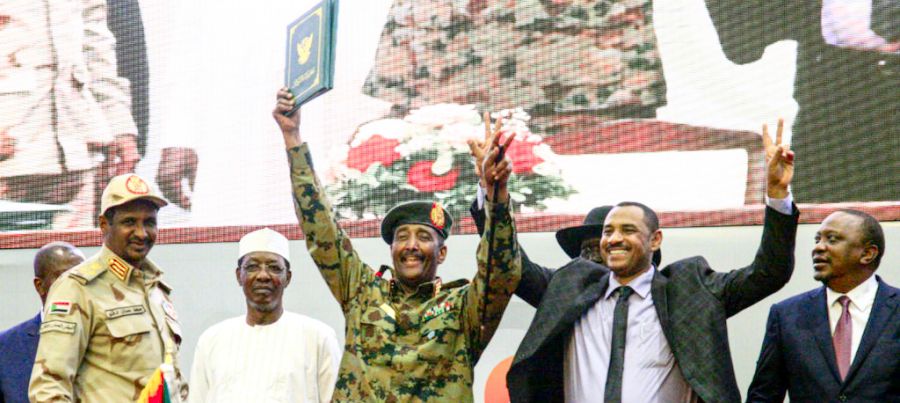
The agreement reached in early August ended nearly eight months of an unprecedented protest that led to the fall of President Omar al-Bashir on April 11, after 30 years in power, before turning against the generals. of the Transitional Military Council that has taken over.
"Civil power"
Concluded through a mediation by Ethiopia and the African Union, this agreement was greeted with relief from both sides as protesters celebrated the victory of their "revolution".
The early stages of the transition should follow the signing with the announcement Sunday of the composition of the majority sovereign council made up of civilians who must lead the transition. On Thursday, the Alliance for Freedom and Change (ALC), the spearhead of the protest, appointed Abdallah Hamdok, a former UN economist, to become prime minister. The Sovereign Council must announce Tuesday if he confirms it to this post.
Limit the power of the military elite
Elections are scheduled for 2022. The military is a minority in the 11 members of the Sovereign Council which must govern 40 million Sudanese, even if it will first be led by a general for 21 months. And if the Ministers of the Interior and Defense will be chosen by the military.
The first stages of the transition should follow the signing with the announcement on Sunday of the composition of the Sovereign Council in majority consisting of civilians (6 civilians against 5 military) who must lead the transition. Thursday, August 15, the Alliance for Freedom and Change (ALC), the spearhead of the challenge, has appointed Abdallah Hamdok, a former economist of the United Nations (UN), to become prime minister. The Sovereign Council must announce Tuesday if he confirms it to this post. Mr. Hamdok will then have the daunting task of raising the economy of the country that collapsed after the secession of the South in 2011, depriving it of three quarters of its oil reserves.
Elections are scheduled for 2022.
If the military is a minority in the Sovereign Council (11 members) which is to govern 40 million Sudanese, it will be first led by a general for twenty-one months. And the ministers of the interior and the defense will be chosen by the military.
"The biggest challenge for the government will be the dismantling of the Islamist [informal entities] that have taken control of all state institutions and key sectors of the economy," said Rosalind Marsden of Chatham House think tank established in London.
A historic agreement in a country devastated by thirty years of calamitous management and an authoritarian and corrupt power based on the Islamic legal code.
|
|
|
|
|
|
|
|
| Jaimie Potts for DayNewsWorld |
|
EBOLA IN THE DRC A GLOBAL HEALTH EMERGENCY
|
| More than 1800 deaths. It's been a year since the north-eastern part of the Democratic Republic of Congo (DRC) is plagued by the tenth Ebola epidemic in the country, by far the worst. But one year after the return of the virus in the DRC, the epidemiological situation seems out of control.
The epicenters have indeed moved from North Kivu to Ituri to multiply on several fronts. Until then, Goma, the capital of North Kivu in eastern DRC, had been spared Ebola but four cases were recently diagnosed in Goma. The haemorrhagic fever killed 1,737 people in one year in eastern DRC and the cumulative number of cases is 2,578, of which 2,484 are confirmed and 94 are probable, according to the bulletin of the Ministry of the Interior dated Sunday, July 21, 2019. 
Global health emergency
"It is time for the world to take note of the situation and redouble efforts," said Tedros Adhanom Ghebreyesus, Director General of the World Health Organization (WHO). The United Nations (UN) agency, which coordinates the Riposte, the coordination structure of the fight against Ebola, in support of the Congolese authorities, ended up decree, July 17, the state of health emergency world.
But the activities of the structure in charge of the fight against the epidemic face two major challenges: the attacks of armed groups and the mistrust of part of the population fueled by the lack of resources implemented.
"The most important challenge is to avoid any interruption of the Riposte by attacks by armed groups," insists David Gressly, UN coordinator for emergency response to Ebola.
The mistrust of the population
Added to this is the mistrust of some of the people who perceive the Riposte as an instrument of contested political power in Kinshasa.
At the outbreak of the epidemic, the teams sent by the Congolese Ministry of Health and the WHO have in fact preferred local elected officials to community structures and the political elite to customary chiefdoms, often more influential. A strategy that turned out to be a big mistake.
"The Riposte (...) gave the impression of being politicized," said Rachel Sweet, a researcher at Harvard University, which has been a major obstacle and has favored instrumentalizations by local politicians, the spread rumors and incitement to violence. "
Disagreements about health policy were also added. A second "experimental" vaccine produced by a Belgian laboratory would have been used, according to the retired health minister, Dr Oly Ilunga. For now, only the vaccine, also experimental, Merck US laboratory is used.
In addition, the lack of vaccines and opaque management of dose reserves by WHO have been denounced.
A new care strategy adopted by the new president
To remedy the lack of effectiveness of the fight against Ebola led by the Ministry of Health, the new president, Felix Tshisekedi, has adopted a new strategy by entrusting the management of the Riposte to a committee of experts led by Professor Jean -Jacques Muyembe Tamfum, who co-discovered the Ebola virus in 1976. This renowned scientist aims to overcome this epidemic in "three to four months".
Ebola haemorrhagic fever is a concern in Africa in the Great Lakes. Identified in 1976 in the DRC, it appeared in December 2013 in southern Guinea and marked the beginning of a deadly epidemic, with some 11,000 deaths in March 2015 also affecting Liberia and Sierra Leone.
The World Bank, aware of the "health emergency" has just announced the award of 300 million dollars (271 million euros) for this new phase of fight against Ebola.
|
|
|
|
|
|
|
|
| Britney Delsey for DayNewsWorld |
|
|